New Mars Forums
You are not logged in.
- Topics: Active | Unanswered
Announcement
#51 Re: Planetary transportation » Bikes on Mars? - Don't laugh! » 2025-10-13 21:51:32
Does anyone remember this wild-looking thing NASA created?:
#52 Re: Planetary transportation » Bikes on Mars? - Don't laugh! » 2025-10-13 21:47:35
quasar777,
How about a true "iron horse"?:
#53 Re: Planetary transportation » Bikes on Mars? - Don't laugh! » 2025-10-13 21:35:33
quasar777,
Perhaps you're thinking of the "Deus Ex Machina" concept created by Loniak Design for Yamaha Racing:
New Atlas - The Deus Ex Machina Wheeled Exoskeleton - new horizons in personal mobility - June 13th, 2008


Edit (a pic of the device without its rider / wearer):
This was the "techno-futurism" gadgetry that was supposed to power the above device:
Nano-phosphate batteries / ultra-capacitors for 15 minute recharge times (still a highly experimental tech)
Top Speed: 75mph; 0-60mph: 3 seconds (should be good for killing yourself quickly on the moon)
36 pneumatic "muscles" (presumably for steering of this "wearable vehicle")
2 linear actuators (presumably for adjusting ride height / angle)
Artificial "spine" with 7 "vertebrae" (presumably for weight shifting)
There's enough cool-sounding buzz-words strung together to satisfy the most discriminating keyboard motorcyclist. All of the above listed techno gadgets are technically real, at least as lab-ready concepts, and some do work to one degree or another, but not as part of a singular integrated vehicle design with exhaustive testing behind it, which would be a hard requirement for this "wearable" off-road ATV-like device to be used on the lunar surface for personal off-road transport.
Do I think it could work?
It probably could, but why not just design a proper dirt bike or ATV and call it a day? What significant benefits does this over-sophisticated device provide to its wearer, apart from a "flying / gliding sensation"? Is there any mass / volume benefit? I think the origami folding feature might save some space. However, looking cool and functioning reliably are two very different things. It's undeniably cool, but what would razor-sharp grains of lunar regolith do to all of its flexible parts? We should probably test that here on Earth, first.
#54 Re: Planetary transportation » Bikes on Mars? - Don't laugh! » 2025-10-13 20:54:28
quasar777,
I think this is the basic concept, but this type of vehicle could be ridden while wearing a space suit:
#55 Re: Science, Technology, and Astronomy » SPS Mechanical Solar Power Satellite Steampunk Vision » 2025-10-11 04:14:36
A key technology for solar power satellites, only now in its infancy, is room temperature masers- coherent microwave power transmission devices. Synthetic diamond wafers are capable of transmitting RF power without significant loss of beam coherency over great distances. Imperial College London and Northumbria University have done quite a bit of the civil work on such devices, all of it within the past 15 years or so. We can think of this tech as the microwave frequency equivalent of a laser, but without the significant efficiency losses that still plague solid state lasers. The insistence on using solid state electronic devices is why high power military lasers remain relatively impractical. Lasers with exceptional power outputs measured in megawatts have been available for many decades, but require complex chemical processes that need to be managed by qualified engineers to prevent the devices from exploding in operation. For obvious reasons, the military didn't want to contend with that kind of complexity, in much the same way that virtually all military missiles use solid rocket motors vs liquids.
Traditional masers were experimented with from the 1950s to 1970s for military applications related to sensing, targeting, and communications, but unfortunately required deeply cryogenic temperatures, and were mostly scientific curiosities due to their special operating requirements, despite repeated attempts to further develop the tech for military purposes. I watched a couple of TED Talks and tech presentations on this new class of devices on YouTube a few months back. Prior to that, I never knew room temperature maser devices existed.
I think one of our first Mars probes was able to transmit pictures from Mars to Earth because a maser-based deep space receiver on Earth was so selective that the paltry RF power output from the probe's radio could be tuned-into well enough to capture the data it sent back. However, that device had to be operated near absolute zero using LH2 or LHe, IIRC.
In the near-future, I think these devices will see use as low-cost / low-power microwave band radar systems for space probes / light aircraft / missiles / drones. Longer-term, their application to solar power satellites is compelling. A maser's ability to significantly reduce the size of ground-based rectennas means individual vehicles could be effectively powered from orbit. Room temperature maser tech has the potential to dispense with some of the heavy batteries and solar arrays in favor of beaming power.
One particularly interesting presentation from Northumbria related to using a LED for the input power driving a room temperature maser device. If we can almost directly create coherent microwave radiation using photonic input power that would be a real game changer for orbital power stations.
Anyway...
As power requirements scale up, there's quite a difference in terms of overall design, total system complexity, and materials energy input between square kilometers of semiconductors vs mirrors or fiber optics. Mirrors can be scaled-up in a more or less linear in nature, especially when the photonic power is being thermalized into a central receiver tube. For a mirror with 200m^2 vs 20m^2 of surface area, the components used in the plant design don't change substantially. The cost differential is mostly a function of the mass of materials produced and transported. In terms of total plant cost per Watt, there's an economy of scale to be had by using thermal power systems.
This is not the case for purely electronic power systems where every component in the system is some type of electronic device. The differences in voltages and amperages dictate the use of entirely different electrical and electronic components to efficiently transmit and condition the power from the periphery of an array, back to a centralized collection / distribution station. The semiconductor wafers used to generate the power don't change, but transmitting 10X to 100X more electrical power back to a centralized point, presumably for microwave power transmission to a ground-based rectenna, involves changing everything else. The wiring gauges must change, insulation requirements increase to prevent arcing since a significant voltage increase is the primary means to reduce resistance losses during power transmission while minimize wiring mass, step-up / step-down transformers must also change, and the array control system changes to account for many more array elements and system components. A control system appropriate for a 100kWe to 1MWe array is inappropriate for a 1,000MWe array.
For a high temperature thermal system with a centralized receiver tower and Supercritical CO2 gas turbine turning an electric generator, concentrating 10MWth vs 1,000MWth requires a direct scale-up of the same basic plant components. The count and/or surface area of the mirrors changes substantially, but a thermal power plant doesn't involve a multitude of wiring runs with different gauges, power inverters, step-up transformers, electronic control and monitoring systems, etc.
If a photonic-to-maser power system ever becomes practical, then we can dispense with thermal-to-electrical conversion as well, using only fiber optics to collect power from the Sun, special solar-pumped diodes which directly convert (~35% efficient) the photonic power to feed the maser, and then transmit it as RF power to ground-based power terminals, for conversion to electrical power by the powered device. Photovoltaic-to-LED-diode is far less efficient, typically below 10%. Masers can be around 35% efficient over millimeter wavelengths useful for power transmission through atmospheric water vapor. Here on Earth, we might use such tech to power ships at sea. Some people will fixate on the apparent lack of efficiency, but the figure that matters is the ability to continuously remotely power an enormous machine, such as an ocean-going cargo ship, or perhaps a train on Mars, without enormous quantities of onboard energy storage, ground-based power generation and distribution infrastructure, or operational problems arising from intermittent power availability.
The most obvious first use case for a multi-gigawatt maser-based power satellite is thermal power transfer to boost the orbits of satellites and spacecraft in lower orbits. A power sat would save the most money by powering vehicles from the launch pad using simplistic Hydrogen-based heat engines, ones requiring no oxidizer mass, then to propel heavy payloads to higher orbits, and ultimately to achieve escape velocity for interplanetary transfers. Decoupling the energy supply from the powered vehicle means very heavy payloads can be moved using only modest amounts of propellant.
One question I have, though, is if we can generate gigawatts of power in orbit, then why not consume it there for manufacturing purposes?
As we transition to optical computing devices that are anywhere between 1M and 10M times more efficient per compute operation, why not put those new AI data centers in orbit where they're co-located with a power source capable of delivering a near-direct power source for their consumption?
The Earth observation and military satellites are already doing a lot of onboard imagery processing prior to sending the data back to Earth, so drastically increasing their compute power using optical chips consuming direct / near-direct optical power from the Sun is the next logical step in their evolution. Maser-based synthetic aperture radar could provide HD video-like image resolution in almost any weather conditions. The X-band radars they already use are capable of centimeter resolution and easily pick up supposedly "stealthy" ships and aircraft, which are specifically supposed to reduce observability against X-band radar. The images are a little more "blurry" when compared to non-stealthy objects, yet clearly identifiable as to exactly what they are. These things won't be able to read the paper you have in your hand, but they will be able to discriminate between civil and military ships / aircraft / vehicles, discard non-essential information, clean up the images, and only return near-finished intelligence products for human assessment.
Since the military is already paying for a lot of this development, and the civil applications also benefit at the same time, why not ask Daddy Warbucks to help finance the power transmission and sensing tech we'll inevitably need when we settle Mars?
Those recon satellites are already dual-use, meaning an "ordinary" (but wealthy) civilian can pay for and request their imagery. The government paid to put them up there and pays to have priority on tasking, but apart from that almost anyone with money (provided they're not an enemy of the state) gets to benefit from them. All we'd be doing is giving them a gentle nudge in the direction they already want to go.
On that note, what about using power satellites in higher orbits to power observation satellites in lower orbits, and power relays transferring power from GEO to LEO or GEO to LEO to surface?
We could also use GEO power sats to "clean up" the lower orbits by delivering optical or maser power to de-orbit the junk using ablation, or perhaps even collect it for recycling since we already expended energy to put it up there in the first place.
#56 Re: Science, Technology, and Astronomy » Carbon-Free Propulsion Using Articulated Tug and Barge Technology » 2025-10-03 23:35:48
Island Victory is one of the most powerful tugboats in the world, with 42,880hp worth of installed engine power. The props on tugs like this are nothing too spectacular when it comes to propulsive efficiency, perhaps 65% efficient at converting shaft power into thrust. That's a necessary concession to high-thrust at low-rpm, frequently accomplished using ducted propellers that don't perform very well at higher speeds. The prop design can't and won't be optimally efficient at all speeds. Even variable-pitch props don't produce as much thrust at low speeds as ducted props, which is why tugs frequently use ducted props. You have to design to a given criteria set, same as an aircraft propeller. Efficiency will be very important for a tug using batteries, liquid air, or other forms of natural energy, all of which have far lower gravimetric and volumetric energy density than hydrocarbon fuels. Larger diameter props do help with that, but there will be draft limits, especially within inland waterways. The Sharrow prop design could help reduce diameter while maintaining thrust, without the use of a thrust-robbing duct at higher speeds. Large diameter props also cost a lot more, but so do Sharrow props. The hull forms used by modern tugs are already pretty close to ideal for their intended applications, although rudders are optimized to minimize thrust sapped from the prop(s). Perhaps the new weldable Mangalloy steel plate developed by the Japanese and South Koreans would allow liquid air to be carried within a "double hull", similar to LNG, at more reasonable material and fabrication cost, as compared to stainless, and with fewer corrosion / pitting issues, which is why no ocean-going ships use stainless hulls.
To a point, top speed is far less impressive for a tugboat than pure "pulling power" at speeds below 10 knots. However, the ability to tow ships in for repairs will likely be affected. For starters, you cannot sail at any speed you please, into or out-of a port facility, nor within the confines of restricted inland water ways. Power required also increases dramatically as speed increases, so travel at lower speeds is advantageous to total cost, provided that personnel and equipment costs don't exceed fuel costs, whatever said "fuel" happens to be. 4,000hp might be plenty for low speed travel, but it will affect the bollard pull of a tug. This implies more tugs, more powerful motors / engines, and/or shorter operating times at full power. That said, 10 knots was well above the speed at which we would approach congested ports aboard an aircraft carrier, which somewhat counter-intuitively, is now a much smaller ship than many of these new super-massive cargo and tanker ships requiring tugboat assistance to navigate from / to a pier.
If we're serious about using liquid air as a viable marine fuel, then we need to create ocean-going barges capable of station-keeping, operated along common shipping lanes, able to perform liquid air transfer to ships underway, to refuel cargo and tanker ships. The US Navy calls this "UNREP" (UNderway REPlenishment). Each ship in a battlegroup typically has an UNREP event scheduled once or twice per week. This adds cost, but allows for continuous semi-autonomous operation at sea, without the need to visit a port. The barges will likely use some form of wind and/or solar power to suck in, filter, compress, and liquefy the air. As ships pass through, they will come alongside the barge, take on a fresh load of liquid air to continue their intercontinental transits.
Large scale liquid air energy density is around 125Wh/kg of usable energy, which could be doubled or perhaps tripled with an onboard load of molten salt. Diesel fuel burned in a very large low-speed marine engines, which are about 50% thermally efficient, provides 6,250Wh/kg, so 50X greater usable energy density. I've seen Aluminum-air batteries with energy density figures quoted at up to 2,500Wh/kg. Lithium-ion batteries are around 300Wh/kg at the cell level, but not at the pack level, and some packaging is still required to inhibit the worst effects of a thermal runaway and to move large strings of cells as a singular unit. Iron-air and modern Lead-acid batteries have very similar energy density. You can't make a ship's energy supply 2.5X (Aluminum-air batteries) to 50X (liquid air) heavier and still expect the ship to be roughly the same size or to perform similarly. The "super-sized" tugs referenced in the article would quite literally be the same size as WWII era battleships, meaning 25,000t to 40,000t, not tugboats. Succinctly, no amount of efficiency improvement can overcome energy deficits of that magnitude. Diesel engines and diesel fuels remain the workhorses of the entire modern world for a reason. Thus far, no other energy generation and storage technology can match the combination of characteristics they provide. The end result will be more costly ships with less range and cruising speed capability, which implies a requirement for many more ships and the support infrastructure to complete the same transportation and maneuvering tasks.
The only kinds of emission-free ships capable of covering economically-useful distances are, in point of fact, ye olde wind-powered sailing vessels. The modern "take" on classical sailing ships involves using a 1,000m^2 technical fabric "kite" tethered to the bow of the ship and flown at an altitude of 300m, using an automated computer control system to model wind and ship behavior. This provides roughly 100,000kg-f of propulsive power, using average wind speeds. It does not require tall heavy masts to hold sails. A pay-in / pay-out device similar to a capstan is used to control said device, using deck space that is typically clear / available on most cargo and tanker ships. To deliver 100% of the force required to achieve top speed using its diesel engine, the Emma Maersk container ship, a very large vessel, even by today's standards, requires a bit over 7.5MN of force to sail at 24.5kts, so the sailing kite's surface area becomes 7,648m^2. The giant diesel engine and fuel cold be replaced by a nominal quantity of liquid air for electrical power generation and maneuvering near ports.
SeaWings "Kite" Deployment:
Flying this "kite" at altitude permits access to higher average wind velocity: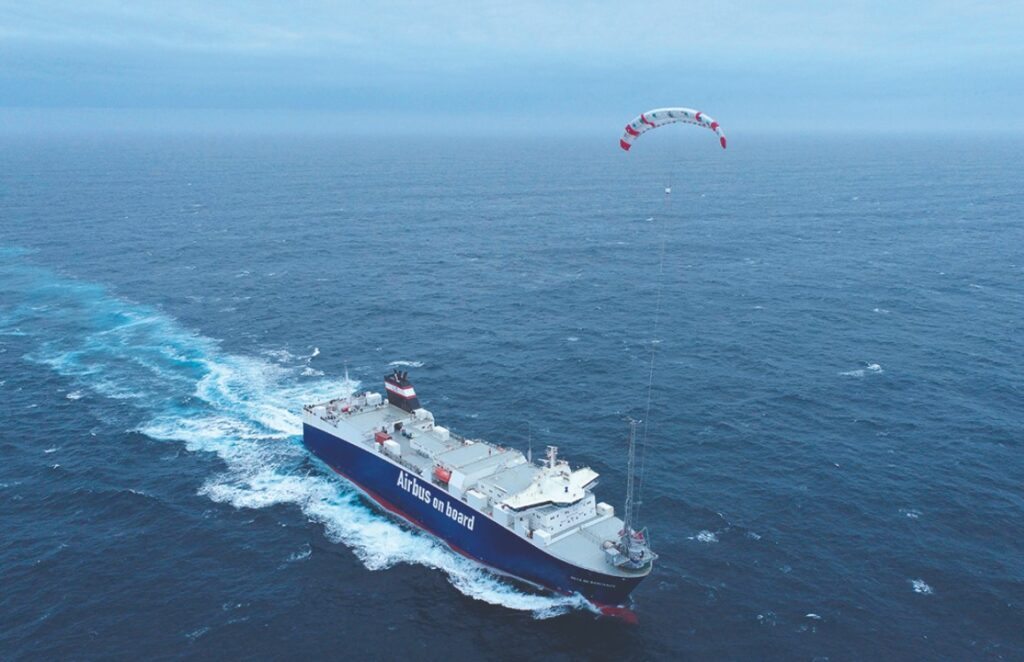
Bar Technologies uses both Aluminum 37.5mH (750m^2 / 200t per sail) and composite 20mH to 24mH 3-element sails (<30t per sail), which achieve greater lift than single element rigid sails using a fowler flap design similar to that used by commercial airliners: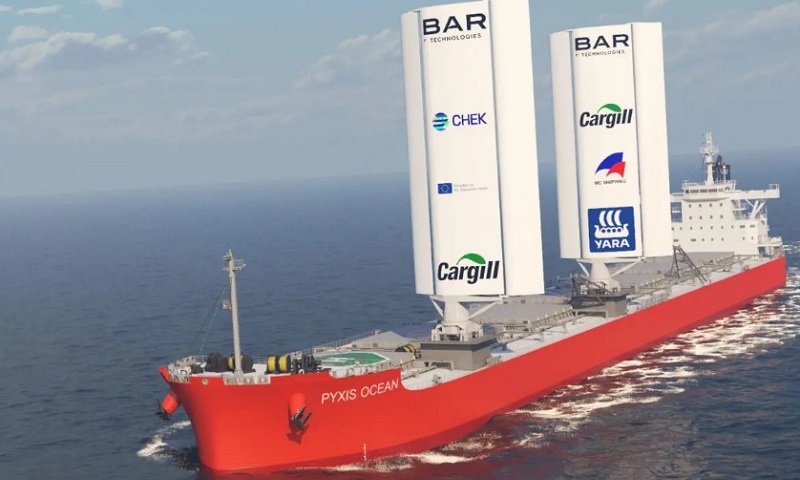
#57 Re: Science, Technology, and Astronomy » Google Meet Collaboration - Meetings Plus Followup Discussion » 2025-09-22 14:51:37
tahanson43206,
We're in the process of moving between houses. The new house is only a block or so from the old house, but downsizing has had it's challenges. In the new house, the seller's movers removed the existing stacked washer and dryer they initially claimed was going to stay in the house, and then left the water spigots for the washer turned on, with the end result that the first floor was flooded out in our new home after the utilities turned our water back on. Most of the first floor is tile and I caught it within about an hour, but the bedrooms are carpeted, which created a huge mess. Water and carpets don't mix. There were other plumbing issues as well, which I'm slowly resolving. Long story short, that mess delayed our move. Fun times, as always.
#58 Re: Science, Technology, and Astronomy » 3I/ATLAS Comet Will Swing by Sol » 2025-09-17 20:42:52
I watched an entire YouTube video on this with Randall Carlson. This is a very interesting object with unusual physical properties.
#59 Re: Not So Free Chat » Politics » 2025-09-12 00:46:15
The US will not be a Constitutional Republic if Trump continues what he is doing now. It is becoming a fascist totalitarian dictatorship. If he can, there will be no more elections.
Our leftist Democrats are now warning us about the fact that they're behaving as real communists / fascists / what's the difference typically behave, because they're tired of waiting to establish a proper dictatorship here in America. Whatever accusations Democrats are making, you can be sure that's what they're actually doing. Thanks for the warning, though. My fellow Republicans have told them, repeatedly, that their dystopian dictatorship fantasy is never going to happen. I've not seen Democrats this agitated since we took their slaves away from them.
Constitutional separation of powers has already been challenged.
Separation of powers is an ongoing issue, one which will never be fully resolved, especially since Congress continuously delegates authority to the President. Whether it was wise for Congress to delegate their authority is another matter entirely.
If he can, there will be no more elections.
One American President you disagree with was elected for four years, so there will be no more elections in America after he's gone? Good to know. I'll file that one away for the next election in 2028. I'm aware of the fact that Democrats want to remove the ability of the electorate to choose who and what to vote for, but President Trump's second election was a giant middle finger to that idea.
Courts have ordered Trump to stop deporting people nabbed by ICE. Courts have ordered individuals who have landed immigrant status, legal residents, to be returned to the US. Trump and his team have refused. Blatant refusal to comply with court orders means the Constitution no longer exists.
When President Obama deported far more illegals than President Trump has thus far, where was your outrage over the constitutionality of his decision making back then? Either show some consistency in your condemnation or admit that you're not consistent because you're prejudiced against President Trump because he's making decisions that show deference to the American people, its own citizens, rather than people from everywhere else.
Trump claimed he has the ability to interpret law. The Constitution says the President does no such thing, the Courts do that. Trump claimed the ability to create tariffs by executive order. The Constitution says only Congress can do that.
All law enforcement requires interpretation of the law. If a person who is not a lawyer or judge isn't allowed to interpret what a law means, then there's no such thing as law enforcement. Lawyers and judges aren't rolling around in squad cars, arresting murderers, thieves, and rapists. The person enforcing the law is effectively "deciding" if/when/how a law has been broken... which sounds an awful lot like they had to make an interpretation of what the law is and how to enforce it.
The United States Congress has delegated their authority to make / adjust tariffs, to the President of the United States, pursuant to codified law, which Congress has passed and previous Presidents have duly signed into law. More specifically, a Democrat President named John F. Kennedy signed much of the basis for the President Trump's congressionally-delegated power to levy and/or increase tariffs, into codified enforceable law. Democrat President Jimmy Carter used this law in 1979. Republican President Reagan used the law in 1982. President Trump is now using that very same law in 2025.
The US Constitution is the litmus test for all laws. It is not now and never has been the law itself. The only thing that's meaningfully changed in 2024 is that President Trump has recognized that the US cannot run a trillion dollar trade deficit indefinitely without affecting the quality of life for the lower and middle classes here in America, so he's using the powers delegated to him, by Congress, to attempt to improve their lives through greater domestic production of all goods and services, which they can capitalize on by supplying their own labor in deference to their own countrymen. If the United States Congress doesn't like President Trump's delegated powers to make or change tariffs, then a 2/3rds majority vote to modify or entirely rescind the Trade Expansion Act of 1962 would remove all previously delegated Executive Branch power to make and adjust tariffs, irrespective of what President Trump thinks about it, which Congress has thus far refused to do.
Until the Supreme Court either reinterprets the President's delegated powers to make or change tariffs, or the United States Congress acts to modify or rescind those powers, President Trump's ability to exercise those delegated powers carries the force of law with it. I do so wish people lecturing Americans about our own laws would inconvenience themselves by actually learning something about the law and how it works, beyond their personal beliefs / desires about it.
About a decade ago, the mainstream left in America ran out of plausible arguments to explain away their increasingly anti-social behavior, which was a manifestation of their radicalization. From the time of President Obama onward, the Democrat Party was hijacked by radicals, people who became the "next-wave" socialists and communists, the ones who were responsible for the majority of the political violence in America between the 1960s and 1970s. Senator Joe McCarthy wasn't wrong about the threat these people represented, but American society was too earnest and polite to deal with them as the clear and present danger to human civilization that they've always been. After more than a century, there hasn't been a single successful implementation of their utopian socialist / communist society, yet they persist in their dogmatic religious beliefs about the proper role of government in society. They've always brought misery and mass death to people dumb enough to fall for their tricks. Those same radicals, who are now of age to hold positions of significant political power, don't even pretend that they want to be Americans anymore.
The rest of us have been forced to suffer through the radical left's endless stream of fake manufactured identity crises and general depravity. The left's indoctrination-from-birth radicalizes their cry-bullies and general purpose street thugs via the educational system, and then leads them around by the nose, from made-up problem to made-up problem. The sky is always falling in their world. That's the only way to unite the left's myriad of fractious opposing-interest factions, who otherwise have little to no common cause to vote for the same people. The near-nonexistent attention span of their rank-and-file membership is all our radical left has left to work with. Any honest classical liberal has already left the Democrat Party, the party of death and destruction, finally realizing to their horror that they don't remotely believe the same things the people around them do. It's an endless attempt to avert attention away from how wicked they've become in their lust for power. The left's now self-evident issue connecting with ordinary Americans is that normal people who have classical liberal tendencies don't want to live in a society based upon wickedness, intimidation, and violence. That "control strategy" has not worked well for them, as of late. More and more people are fed-up with the corrosive nature of the left's policies and their naked communist agenda.
Charlie Kirk was the most recent sacrifice to the violence which is both supported and imposed by the radical left. He dared to voice his opinions in public, one which merely illustrated the results of the radical left's horror show of public policy making and culture, which makes a mockery of the ideals of democracy, so one of them murdered the man who was famous for going to college campuses around the country and debating beliefs and policies with leftists. He exchanged words with people he disagreed with, rather than arrows. Our leftist media and their brainwashed drones immediately posted videos gleefully celebrating his murder. Their total lack of self-awareness is mind-numbing but predictable. They represent the latest incarnation of a failed ideology, one devoid introspection or love or forgiveness.
Any person or political party who publicly advocates for your murder and financial destruction, or attempts to silence you until they can murder you, is not one which you can peacefully coexist with, because they won't allow it. I'm done pretending that these people are anything but brainwashed to the point of absurdity and violence. They no longer attempt civil discourse, because they're incapable of it. Every action and utterance of theirs only further reinforces that point.
#60 Re: Science, Technology, and Astronomy » Google Meet Collaboration - Meetings Plus Followup Discussion » 2025-09-08 20:19:43
I'd like to point out that the landing gear on the Falcon 9 / Falcon Heavy boosters are 100% CFRP structures, with a white thermal barrier protective coating, presumably some kind of thermal spray ceramic coating. Landing gear absolutely counts as a high stress load-bearing structure, one expected to survive a landing so hard that it permanently deforms an Aluminum crush tube contained within each hydraulic strut upon landing. Moreover, the outer-mold-line for that gear is markedly different from the Falcon's Al-2195 propellant tank, which ensures that they also experience some brief localized shock impingement heating.
To wit, Falcon's CFRP landing gear components have repeatedly survived both the peak heating impulse caused by plunging back through the thicker lower atmosphere following their Mach 6 burnout velocity, plus some minor impingement of the engine plume upon restart for retro-propulsion. A Merlin engine is nowhere near as powerful as a Raptor, but it's still briefly bathing the underside of the booster in a sheet of white-hot flame.
My assertion, which should not be too controversial, is that the booster cores for both Falcon and Starship rockets could be fabricated from CFRP consisting of IM7 fiber bound within a PBI matrix, with a thin thermal barrier coating applied, which should result in virtually no loss of base material tensile strength associated with peak heating. Al-2195 Aluminum-Lithium alloy (82ksi with a T8 temper) and 304L stainless (30.5ksi according to MatWeb, possibly up to 42ksi for slightly modified alloys) or similar alloys are very weak materials compared to IM7 (800ksi for the fiber, 395ksi in a typical composite using 8552 resin, given a typical 60/40 fiber-to-resin ratio, by volume). Said resin is weaker than PBI, so my presumption is that a 60/40 IM7-to-PBI composite would be modestly stronger.
IM7 composite is 9.4X to 13X stronger than 304L and 4.8X stronger than Al-2195-T8. All known metal alloys, irrespective of type, are W-E-A-K compared to this "garden variety" aerospace structural CFRP, fabricated using the modern method of using automated fiber placement machines, aka "tape winding machines", laying down unidirectional fiber tow / roving / tape. That said, we will still use metal for the thrust structure, 300M (turbofan engine mounts for airliners) or Aermet VIM/VAR steels (more exotic, but considerably better YS than 300M or Ti-6Al-4V, though more expensive than either by a wide margin) or Ti-6Al-4V (common enough here in America, where there is extensive Titanium forging experience for military aircraft and government spacecraft). For commercial rocketry, I would bet on 300M, but government rockets frequently call for carefully designed Titanium mounts, such as that used by the Space Shuttle. Use of the described materials has become a fairly well accepted industry standard practice in aerospace because it's so exhaustively well-proven at this point.
NCAMP / NASA Material Qualification Report for IM7 (uni-tape)/8552 composites:
Hexcel 8552 IM7 Unidirectional Prepreg 190g/m^2 & 35% RC Qualification Material Property Data Report
Unidirectional IM7 tape / tow / roving, laid down by an automated fiber placement machine, followed by hot mold curing using PBI, is what I'm proposing. This is how high temperature / cryogenic temperature capable composite propellant tanks could be fabricated.
HexCel HexTow IM7 Carbon Fiber Product Data Sheet
HexCel 8552 Resin Matrix Product Data Sheet
As the data sheet shows, 8552's tensile strength is 17.5ksi.
PBI exhibits a tensile strength of about 32ksi when used as the matrix in CFRP composites, or 23ksi for the neat resin. IIRC, PAI is one of the strongest "neat" polymers, around 28ksi without any fiber reinforcement, but only rated to 500F service temps.
Any composite capable of 800F service temps without meaningful weakening is more than good enough for a booster stage. A good thermal barrier coating means the composite can survive transient 1,000F+ aerodynamic heating associated with Mach 5 to Mach 7 burnout velocity without permanent weakening of the composite structure.
#61 Re: Science, Technology, and Astronomy » Google Meet Collaboration - Meetings Plus Followup Discussion » 2025-09-08 08:44:11
The "missing context" of my prior post, since only GW and tahanson43206 were present for our Sunday meeting, is for use as the material of choice for the booster stage's propellant tanks, which only see a peak velocity of about Mach 5 and peak heating of about 1,000F as the booster falls back through the atmosphere and lands the way the Starship booster lands.
CFRP is far stronger and lighter than any kind of metal alloy, even with temperature transients of up to 1,000F. CFRP fabricated using special resins, such as Polybenzimidazole (PBI), used in conjunction with externally applied thermal barrier coatings, can survive the peak heating transient associated with the booster's burnout velocity, without the use of heavier and more delicate heat shielding tiles. The combination of 800F capable PBI (without degradation or softening) and a thin (1.4mm thickness) thermal barrier coating such as Aluminum-Oxide (Al2O3), will allow a booster stage's propellant tanks to be fabricated from IM7 fiber, at perhaps 1/4 the mass of 304L stainless steel, presuming that the bulk structure is 4mm thick (the propellant tank wall thickness of the actual Starship Super Heavy Booster). Said composite would still be drastically stronger than 304L over the entire temperature range that the booster experiences. Said materials have already been tested by NASA, for use in the Space Shuttle Program, all the way back in 1969, which is when testing of those materials began.
PBI is expensive and hard to process because it requires greatly elevated temperatures during the molding process, relative to all other thermoplastics. The base material itself is not egregiously expensive to purchase in bulk quantity, but on a per-mass basis, plastic parts made from or with PBI are much more expensive to use than resins which can be molded at much lower temperatures. I think it qualifies as a "Gucci" material in that regard, but only because resin molding at elevated temperatures is relatively uncommon. All that is to say that the molding equipment required to fabricate gigantic PBI-infused CFRP parts, such as propellant tanks, will cost a pretty penny (tens to low hundreds of millions), but buying the PBI plastic resin material itself from Celanese / "PBI Performance Products, Inc." will not be outlandishly costly. If a corporation or Uncle Sam owns the high temperature mold and robotic tape winding equipment, that's one-time cost to them, and then very light yet highly temperature resistant CFRP parts can be robotically tape-wound / compression molded / fully cured in a matter of days, with far less touch-labor on the part itself. A small team of semi-skilled materials handlers will be required. Touch labor will mostly be limited to removal of mold flashing. Application of the thermal barrier coating would be done using a robot to ensure highly uniform thickness, as is already common for ceramic coated pipeline components used in the oil and gas industry.
#62 Re: Science, Technology, and Astronomy » Google Meet Collaboration - Meetings Plus Followup Discussion » 2025-09-08 01:26:02
Thermal barrier coating for carbon fiber-reinforced composite materials
Abstract
Carbon fiber-reinforced plastic (CFRP) composites are widely employed in lightweight and high performance applications including supercars, aero-vehicles, and space components. However, although carbon fibers are thermally stable, the low thermal endurance of the matrix materials remains a critical problem in terms of the performance of the material. In this study, we proposed a new, Al2O3-based thermal barrier coating (TBC) for the CFRP composites. The TBC comprised α-phase Al2O3 particles with a mean diameter of 9.27 μm. The strong adhesion between the TBC and the CFRP substrate was evaluated using a three-point bending test. When the CFRP substrate was subjected to a 500–700°C flame, the 1.45-mm thick TBC protected the CFRP substrate remarkably by reducing the surface temperature to 188–228°C. The thermo-mechanical responses of this TBC/CFRP composite were analyzed after thermal shock tests. Surprisingly, 50% of the pristine flexural strength of the TBC/CFRP composite was preserved, whereas that of neat CFRP was reduced significantly by 95%.
Compared to metal or ceramic matrix composites, carbon fiber-reinforced plastics (CFRPs) are versatile but have low durability in high-temperature environments. This characteristic requires that a thermal-barrier coating be applied to protect the CFRP. Various methods have been used to apply such a coating to metal matrix composites, such as electron-beam physical vapor deposition, chemical vapor deposition, and thermal spray. Among these, thermal spray is preferred for its simplicity, short processing time, and scalability for large applications. But despite inherent utility, this technique was previously known to be unsuitable for CFRP applications. By adjusting flame spraying coating parameters, a method was discovered that not only allows a thermal coating to be applied to CFRP materials but also allows deliberate manipulation of each individual layer. Through this method, pores can be intentionally introduced in the inside layers of the coating, further decreasing thermal conductivity.
The process has proven successful, decreasing thermal conductivity to the point of protecting CFRP composites from temperatures up to 500°C. Combining lightweight, high-strength, and extreme-environment properties into one, this paves the way for improved firefighting equipment, aerospace body protection, and applications in the automotive industry.
All those yellow areas shown are high temperature composite parts. On the side facing the engine, they have thermal barrier coatings applied, in addition to high temperature capable resins. Hot bleed air from the turbine flows around the nozzle, to help mask the thermal signature from the far hotter exhaust flow from that giant F-135 engine.
Here's a good shot of the nozzle: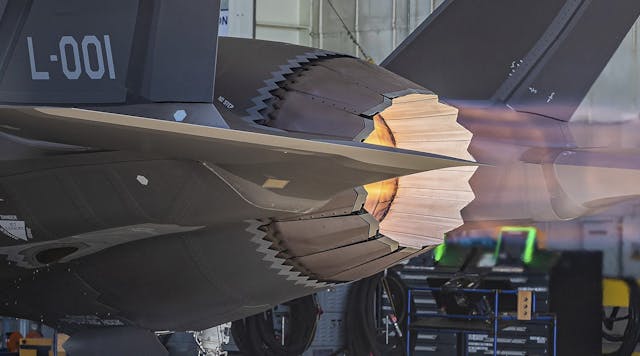
That saw-tooth pattern you see on both the nozzle itself and the composite skin does more than merely reduce the radar return. It also aids in mixing and acoustic signature reduction. On the composite skins you see on the jet engine nacelles of the most modern commercial airliners, it's deliberately used to reduce engine noise.

NASA partnered with industry many times during years of chevron testing, including these tests of nozzles on a specially-adapted GE engine mounted on a Boeing 777. Chevron nozzles will be seen on more engines in the coming years. - The Boeing Company / Bob Ferguson
NASA Helps Create a More Silent Night
Anyway...
F-35 heat management
The skin temperature near the engine is not uniform and is affected by several active and passive cooling systems.Cooling vents: The F-35's airframe near the engine nozzle has small vent holes to circulate air over the engine, dissipating some of the heat.
Bypass air: The F-35 uses a turbofan engine that mixes hot exhaust from the engine core with cooler bypass air. This significantly lowers the overall temperature of the engine's exhaust plume, which reduces its IR signature.
Exhaust dilution: By diluting the hot exhaust, the F-35 reduces its heat output before it leaves the jet.
Thermal coatings: The aircraft uses specialized thermal barrier coatings to insulate the skin from the engine's heat.
Material limits: The aircraft's skin near the engine is made from high-temperature resistant materials, but in 2014, an F-35 experienced an engine fire due to a rub in the engine that caused a local temperature of over 1,000C (1,900F), exceeding the material limit of 540C (1,000F)
Material Data Sheet for the Cycom 5250-4 Resin System used in the high-temp BMI composites near the F-135's hot section:
CYCOM® 5250-4 PREPREG SYSTEM
Maximum continuous service temperature up to 400F (204C)
Short-term service temperature up to 450F (232C)
Max service temp is only 450F, but take careful note of how those aforementioned thermal barrier coatings can drastically reduce temperature and damage to the resin matrix.
Proof Research is a maker of CFRP over-wrap firearms barrels and they also fabricate the hot section composites for the F-35.
PROOF Research - May 18, 2016 FaceBook Posting
Our Advanced Composites Division in Dayton, Ohio makes high temp composite parts for the F-35, they also design our barrels using the same technology.
Gun barrels get really freaking hot, much like the engine casing of that gigantic F-135 engine.
All that said, I promised GW to provide a link to a 1,000F capable (intermittent service use) "resin", used in high-temp CFRP applications:
Wikipedia:
Polybenzimidazole
It was first synthesized in 1949, by the Material Laboratory of Wright Patterson Air Force Base, which is why I'm a little surprised that this keeps getting questioned. That said, full synthesis of the material we use today was accomplished in 1961. NASA contracted with Celanese to use PBI in the space suits used in the Apollo spacecraft, following the Apollo I fire. Today, the company originally created to make PBI-based polymers, named "Celanese", operates as PBI Performance Products, Inc. The Space Launch System 5-segment solid rocket motors use PBI plastic
In 2016, NASA qualifies the use of PBI in the insulating compound for the reusable and largest solid fuel rocket motor ever built for flight - the Space Launch System Five-Segment Booster.
When Skylab fell to Earth, the part that survived the re-entry was coated in PBI and thus did not burn up.
...
Imidazole derivatives are known to be stable compounds. Many of them are resistant to the most drastic treatments with acids and bases and not easily oxidized. The high decomposition temperature and high stability at over 400°C suggests a polymer with benzimidazole as the repeating unit may also show high heat stability. Polybenzimidazole and its aromatic derivatives can withstand temperatures in excess of about 500°C (932°F) without softening and degrading. The polymer synthesized from isophthalic acid and 3,3'-Diaminobenzidine is not melted by exposure to a temperature of 770°C (1,420°F) and loses only 30% of its weight after exposure to high temperature up to 900°C (1,650°F) for several hours.
This NTRS Report dates back to 1971, in which PBI composites were studied for Space Shuttle Program TPS:
STUDY AND PRODUCTION OF POLYBENZIMIDAZOLE BILLETS, LAMINATES, AND CYLINDERS - Prepared by LOCKHEED MISSILES & SPACE COMPANY
Said study describes tests performed on PBI-infused carbon cloth "laminates" (CFRP by another name) materials.
In 2025, for a thermally-protected spacecraft propellant tank structure, we'd probably use IM7 fiber as government-furnished material (no choice, because it's what NASA and our aerospace primes have on-hand, meaning no ultra-high tensile strength T1200 fiber), get a specialty PBI resin from a company that makes it, use an aerospace prime to fabricate the part (Boeing or Lockheed-Martin or Northrop-Grumman), and then we'd hire a specialty company to apply a highly uniform ceramic thermal barrier coating (expensive but necessary).
#63 Re: Human missions » Starship is Go... » 2025-09-05 20:02:22
Hypersonic Materials and Structures
All those new materials and fabrication methods under T&E 10 years ago are now fairly standard for reentry TPS. Starship could be using any of those new TPS materials, most likely some combination of them.
#64 Re: Meta New Mars » Housekeeping » 2025-09-04 23:24:20
tahanson43206,
This weekend I should have some time to address the banned users issue.
#65 Re: Interplanetary transportation » NASA funds Direct Drive Fusion Propulsion » 2025-09-04 23:20:31
I think pure greenfield science is a worthy goal unto itself. I agree with the notion that pursuit of knowledge, for its own sake, is a worthy and laudable goal. However, when our stated exploration goals require better / cheaper / faster propulsion systems, and we have what's required on-offer from a competent corporation that can deliver the goods, I think that is where science must be goal-oriented. A number of corporations have offered improved engines over many decades now. Apart from SpaceX and Blue Origin, NASA is still using engines that were the product of 1970s development efforts. NASA and DoD spent billions upon billions of dollars on new engine designs, but none of them ever replaced what they've either been developing or actively using over 50+ years. That's the extent of what we have to show for all the efforts made by our various aerospace primes. There's no world where that makes rational sense, except in a carefully constructed one that's long since been strangled by bureaucracy. The RS-25 could've been evolved into something 3D-printed components, uncooled RCC nozzles, improved turbopump designs and materials, etc. We spent good money and decades of development work on all of that, yet it's nowhere to be found in the engines NASA is using to send people back to the moon. It's little wonder that their rockets cost so much and have flown so infrequently, relative to what was promised. We can't keep running the same program while expecting different results.
There's a reasonably logical progression to in-space propulsion technology, the one mission critical technology where all of humanity is weakest. We began with solid rockets which were more suitable for weapons than space launch vehicles. We swiftly moved on to liquid fueled engines. We developed ion engines around the same time the Apollo Program was in full-swing. Around the same time development of ion engines began in earnest, we also developed nuclear thermal rockets using compact / high power density fission reactor cores. Neither were intended to replace chemical rockets for orbital launch vehicles, but both were necessary in-space propulsion solutions to problems that chemical rockets could not address in a practical way. Fusion rockets are the next logical progression of in-space propulsion options. While we work on fusion rockets, we should continue to pursue propellantless "impulse" engines and warp drives. Although teleportation and various other Star Trek level technologies will likely require another century or more of development work, if we put forth the effort now, when it matters most to near-term colonization efforts, then we'll have "real starships" by the time we work out the details of the more advanced bits of Star Trek tech. What we cannot do, presuming the goal is real exploration and colonization, is to continue to aimlessly throw money at every potentially interesting new propulsion technology without maturing "within reach" technologies to relentlessly advance our propulsion systems. Pulsed fusion using supersonic implosion of light alloy foils to generate thrust is well within reach. Continuous fusion using gases would be better still, but we're probably at least a couple of decades away from that being achievable.
Why wait another several decades for "better fusion rockets", when a fully functional pulsed fusion rocket would mean on-demand access (no waiting for orbits to align) to the solar system within the next decade? All the individual pieces work. We need to put them together into a fully functional high-thrust / 5,000s+ Isp in-space propulsion system. This is an engineering task, rather than a greenfield tech development task. NASA balked at spending more money on completing development of a pulsed fusion rocket engine the moment a continuous fusion rocket looked as though it was a possibility. It's as if they cannot maintain focus long enough to produce a fully functional product usable for their own purposes. In their own words, they did that "because a continuous fusion rocket engine could be even better". That sounds great, but nobody has created a fully functional stationary continuous fusion reactor, so creating a flight weight continuous fusion rocket engine seems more than a little premature, even though there are companies actively pursuing this. We have to start somewhere, so clearing the lowest set of technological hurdles to an operational fusion rocket engine seems like the best place for NASA and JPL to start. Argue over how the rocket could be made "even better" after you have a TRL9 pulsed fusion rocket engine. Improving the TRL of a continuous fusion rocket engine ought to be that much easier when you already have an in-service pulsed fusion engine.
We need people and corporations to expand the edges of the performance envelope with the express purpose of using the fruits of their labor as a goal-oriented enabler for our stated exploration and colonization objectives. NASA, the agency, stated quite clearly that human exploration of Mars was the prize, even as it continued to pursue a plethora of pure science projects. While useful in their own right, the "result" which emerged over the course of many decades was an unfocused and unimaginative collection of distantly related science projects with no clear tieback to stated exploration objectives. The problem, at least as I see it, is the lack of measurable progress towards the agency's stated human exploration objective. Nobody who is in charge seems the least bit interested in true exploration, likely because it's dangerous, unpredictable, expensive, and requires unwavering determination to succeed. We clearly had that during the Apollo Program, but lost it somehow because we changed technologies. We looked for reasons why we couldn't succeed, rather than accepting and using what was on offer. For example, Shuttle-C should've been pursued during the Space Shuttle era to maintain the capability to conduct exploration missions. SLS is about 30 years late. ISS should've been used as a prototype Interplanetary Transport Vehicle. The means has always been there, but the will has not.
It would be fair to say that private corporations are now driving technological development aimed at specific exploration and colonization objectives, because various billionaires see space exploration and colonization as one of the few remaining, truly worthwhile, "next steps" in human development. After you acquire tens of billions of dollars, space exploration and colonization is the only worthwhile investment commensurate with the level of investment involved. You can build more factories to turn out new tech trinkets, gold-plate your toilets, or build an enormous yacht that might get used once per year, but eventually all of those "status symbols" will be viewed as empty idle pursuits by someone who is driven to build an empire. Elon Musk famously lives in a studio apartment, drives an unremarkable "standard" Tesla his company built, and owns a handful of clothes, because there's no point to accumulating more "stuff" that he'll never see or use. This is a very peculiar state of affairs, because traditionally governments have been the driving force behind exploration efforts.
The men and women who are now leading these efforts have looked upon what their governments are doing and said to themselves, "You're no longer completing the job that the people you represent expect to be done, after you sold them on the idea and spent obscene amounts of money. We don't have many milestones we can point to whereby progress can be shown to the general public. We're taking over where you've failed us." That's the quiet part, not typically said out-loud, but it's present in the minds of people looking at what NASA is doing and asking pointed questions about the apparent lack of progress. Do or do not. There is no "try".
#66 Re: Interplanetary transportation » NASA funds Direct Drive Fusion Propulsion » 2025-09-04 14:39:41
There's a major difference between the difficulty of confining a plasma long enough to use it to generate baseload electricity vs the far lower relative difficulty of intentionally allowing said plasma to escape from its magnetic confinement chamber to generate thrust. The technological bar to clear for generating electricity using fusion, in a manner similar to a fission reactor, is monumentally high. The bar to clear for achieving thrust has already been cleared. There's no question that using fusion to achieve thrust actually works.
When MSNW LLC did the initial development work on the concept, they proved that all major components worked to the degree required, but then NASA immediately pivoted to something that looked better in theory, namely continuous thrust generation from continuous fusion power, but continuous fusion requires long term plasma confinement, similar to a conventional Tokamak. That's the part we cannot yet do in a practical manner- fusion that generates net positive electrical output to use as input for a self-sustaining reaction.
Why did they do that?
NASA is focused on science, not producing tangible usable things like a pulsed fusion drive as an enabler for their own exploration missions.
That's the best answer I can come up with.
#67 Re: Science, Technology, and Astronomy » Google Meet Collaboration - Meetings Plus Followup Discussion » 2025-08-31 19:12:12
tahanson43206,
Here's a link that shows the "belly-to-belly" MUSTARD spaceplane concept that uses 3 roughly identical spacecraft, 1 of which would ascend all the way to orbit:
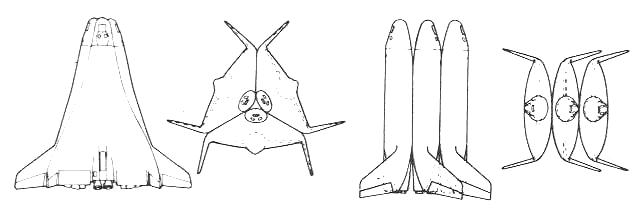
#68 Re: Single Stage To Orbit » SSTO Sub Forum Policy » 2025-08-31 17:52:17
GW,
CFRP's strength can be improved and porosity reduced using a method known as "Carbon Forging", which was pioneered by Lamborghini. The process combines extreme heat and pressure. A French Company named Duc Helices makes propeller blades for light aircraft and helicopters using this method. The "forging" process takes less than a minute, sometimes only seconds, and can be used with chopped fiber, fabrics laid by hand in a mold, or roving/tow which has been laid down using an automated fiber placement machine, which is how CFRP rocket propellant tanks are made by companies like Rocket Labs. IIRC, at least one company makes high performance CFRP wheels / hubs for sports cars this way. They use a combination of fabric, chopped fiber, and roving / tow, all in one part.
#69 Re: Business Proposals » Maximum Use of Conductors, Distributed Electric Storage, Pyrolysis. » 2025-08-26 21:34:46
Maybe this graph can help illustrate the effect of Copper ore depletion on energy consumption:
#70 Re: Not So Free Chat » Oil, Peak Oil, etc. » 2025-08-24 19:50:53
Reliable Energy Intensity Estimation
Global average steel making energy intensity is 19.76GJ/t (19.76MJ/kg). Rather than using the absolute best figure achieved, which is what our photovoltaics / electric wind turbines / batteries enthusiasts typically do, I think using a global average energy intensity value is far more appropriate, since steel will inevitably be sourced from wherever it's available. Steel is a staple construction material, one for which we have detailed energy intensity data publicly available because it's not considered proprietary knowledge. At 31.4kg/m^2 of solar thermal collector array, using 2mm thick stamped sheet steel mirrors and tubing for structural support (does not include the steel rebar in the foundation), the embodied energy for the steel is 620.424MJ/m^2, or 172,351Wh/m^2. Steel mirror support structure is identical to "tube-and-fabric" light aircraft structure.
Design with Sophistication, Operate with Simplicity
At least one company holding a contract with NREL ran an AI-enhanced computer aided engineering program for optimizing support structure geometry to minimize mass and cost. The end result was that support mass was about equal to mirror mass, using a welded tubular steel support structure. This was done for 5m to 10m width parabolic troughs with single-axis Sun tracking, not the gigantic perfectly flat "billboard" mirrors used by solar power towers. My assumption is that the bulk of generated power will come from the most simplistic and user-friendly solutions. Advanced economies can afford to invest additional material and monetary resources into solar power towers, where the overall efficiency of the solution might matter more to them, at the scale they require. For all solar thermal component designs, multiple examples of full scale hardware are built and tested, then operated within a functional power plant, typically for at least a year, but often for multiple years to evaluate durability. Thus, very little extrapolation of potential future performance is required. For photovoltaics, very small sample quantities are subjected to a battery of standardized tests, which is fine and desirable, but this testing tells you very little about broader context of mass production because it's frequently singular wafer special production runs in a lab, with minor variations for test purposes (also good to have), because scale-up frequently entails building a brand new factory to efficiently fabricate at scale. Real world performance is highly dependent upon process control and testing to minimize rejection rates, equipment in the factory which has a major effect on said rejection rates, the competence of the installation crew, and site selection. I've had an electrical engineer, a certified electrician with over 20 years of experience who specializes in commercial photovoltaic panel installations, and run-of-the-mill rooftop panel installers all show me the results of amateur hour in plant design. They all spoke of spending days to months of rework to salvage poor quality installation work. The consensus is that pure mechanical assembly tends to be less error-prone than a combination of mechanical / electrical / electronic assembly, because less knowledge and experience is required.
Expect Similar Energy Intensity for Solar Thermal and Photovoltaics
You have to add more energy for a steel-reinforced concrete support structure, but this also applies to roughly equally heavy photovoltaic panels with single-axis Sun tracking. Photovoltaics still use support tubing and reinforced foundations. Getting back to mirror design, a polished hot-dip Aluminum coating is also required. That adds even more energy to the final total for the mirror, because there are no free lunches here or anywhere else. There's a real energy cost to every concession made to design efficiency. The Aluminum coating is corrosion-resistant, which is why it's applied to factory automotive exhaust tubing and mufflers, and highly reflective after polishing. Surface finish quality of the steel greatly affects reflectivity, hence the use of a cold-rolled product. An electronic or mechanical sun tracking mechanism is also required for each mirror assembly. Troughs are typically rather long, but can be assembled onsite from smaller sub-assemblies for ease of transport. The net-net is that the total mass of materials for parabolic troughs, in a real world plant, is remarkably similar to real world commercial photovoltaic farms. Total embodied energy will be lower, but only modestly so. There is, however, a radical difference in the embodied energy of thermal vs electrical energy storage in electro-chemical batteries. The major difference between mirrors and photovoltaics is service life before unacceptable degradation occurs, the kinds and abundance of materials required, the use of field repairable vs factory replaceable technology units, and ease as well as completeness of recycling. All similarities between mirrors and photovoltaics end there. As previously stated, the Silicon that comes out of photovoltaics recycling is not readily usable in brand new photovoltaics, because the energy intensity of photovoltaics recycling significantly exceeds that of mining and refining virgin materials.
Supply Chain Management
Types of materials required by solar thermal generation and storage tend to involve very simple manufacturing processes by way of comparison to photovoltaics / control electronics / wiring / power transformers, so the supply chain is much shorter. Complete onshore manufacturing of stamped steel is possible for major economic powers. Materials and components don't need to crisscross the globe multiple times. Transport energy is lower as a result. The steel stamping / welding / hot-dipping equipment is far less energy-intensive per kg of finished good. All electronic devices require extensive supply chains. A myriad of highly specialized facilities are required to fabricate Silicon wafers and power electronics equipment. No single country contains all the materials or hosts all the facilities for photovoltaics and electronics manufacturing. There is such a thing as a purely mechanical dual-axis Sun tracker that uses solar thermal power to deliver torque to the mirror array. No control electronics are required until we arrive at the single electric generator and step-up power transformer.
Plant Security and Assurance of Supply
The most sophisticated hackers in the world will have a very difficult time affecting a mechanical solar thermal or mechanical wind turbine plant. Their ability to affect operations inside a solar thermal plant itself is near-zero without direct physical access. If the Sun is momentarily masked by clouds, all that built-up thermal inertia continues to drive the turbine and electric generator. Solar thermal plants can also include 8 to 16 hours of onsite thermal energy storage provided by tanks of pulverized rock or molten salt, because it's cost-effective to do. Only large storage tanks of heated material are required. That means generation doesn't end entirely at sunset. Strictly speaking, given sufficient onsite thermal energy storage, no complete backup power plant is required when collection ends at sunset. In large installations, the temperature delta between start of stored energy consumption at or near sunset and resumption of collection at sunrise, varies by less than 1C. It's similar to a nuclear power plant in that regard, but without the security requirements. If you managed to get your hands on some molten solar salt, apart from burning yourself, what else could you do with it? Perhaps most importantly, the entire grid can't crash the way Spain's grid did, due to the fact that purely electrical photovoltaics and wind turbines provide zero grid inertia. Vertical power spikes and drops are only possible when the turbine, electric generator, or step-up power transformer catastrophically fails. That greatly simplifies grid operation. Even if you did eventually have to burn some fuel due to seasonality or catastrophic equipment failure, you have hours to perhaps days to spin-up natural gas turbines, which means they don't need to run in the background 24/7/365. You only run them for supplemental winter power.
Solar Thermal Materials Details
Cold-rolled steel and steel-reinforced concrete are the primary materials required by solar thermal, plus a small amount of Aluminum applied using the exact same technology required to create typical factory automotive exhaust tubing and mufflers (stamped and welded cold-rolled sheet steel hot-dipped in Aluminum). The total mass of materials required per square meter of mirror surface area is not significantly more or less than the mass of materials required for photovoltaic panels. There are no existing materials limitations when it comes to delivering enough steel, concrete, or commercially pure Aluminum coating. We don't need to wait additional decades to centuries to acquire enough high purity Silicon, Copper, Lithium, Aluminum, rare earths (for the control and power inverter electronics) from extraction.
Materials Recycling Processes
The recycling process for Aluminized steel involves heating the shredded sheet metal to melt-off the Aluminum coating, and then stuffing the now-uncoated shredded steel back into an electric arc furnace. Presumably, most of the Aluminum and steel can be recovered. I'm not entirely familiar with the process used to recover concrete. My understanding is that ground-up / powdered concrete can be and presently is mixed into fresh batches of concrete, but like so many other composite materials, it's not 100% recyclable into brand new concrete, strictly-speaking. The steel rebar can be recovered and recycled at near-100% rates.
Solar Thermal vs Photovoltaics Service Life
A photovoltaic array has meaningfully faster degradation over time than a much simpler polished metal mirror, thus a shorter useful service life. Metallic mirrors can easily last for a human lifetime, possibly several lifetimes with periodic re-polishing. Some of humanity's oldest mirrors, made from materials like obsidian, predate our discovery of metallurgy. Metal mirrors with corrosion protection should last at least 3X longer than photovoltaics. In a very hot and dry desert, only scratches will degrade mirrors over meaningful timeframes.
I can simplify this obviously contentious issue to a pair of YES/NO questions:
1. Is 10 years of global (at 2024 production rates) steel, commercially pure Aluminum (the only kind that comes directly from the smelter), concrete, and solar salt or crushed rock production enough to deliver the solar thermal collector surface area, or mechanical wind turbines to compress air in places that are not sunny, plus 28 days of thermal and air energy storage to account for seasonality, enough to provide 70% of humanity's Total Primary Energy Supply?
2. Is 10 years of global (at 2024 production rates) high purity polySilicon, Copper, Aluminum, Lithium, and rare earth metals production enough to produce the photovoltaics, electric wind turbines, electronic control systems, and electro-chemical batteries for fast storage, to store 28 days of electrical energy to account for seasonality, enough to provide 70% of humanity's Total Primary Energy Supply?
Allowable Concessions to Dreamers
I'm perfectly willing to concede that potential future advances in photovoltaic and battery tech may be able to do what has thus far proven functionally impossible, provided that you are able to supply realistic materials demands estimates for all required materials. If you can't do that, then there's nothing to compare. You're presenting a fever dream with no numbers to evaluate. We don't judge merit on the basis of "nothing". In point of fact, we would say that "nothing" is entirely without merit, therefore any argument over the future potential of nothing is without merit. It's entirely belief-driven, much like religion. Maybe it will work beautifully, or maybe it won't, but nobody actually knows, so why are we pursuing religion when our problems are math-based?
The arguments put forth by our photovoltaics / electric wind turbines / batteries enthusiasts are exactly like debating the merits of man-made fusion reactors. Thus far, no self-sustaining made-made fusion reactor exists. We don't know if it's even possible because nobody has been able to make it work. Fusion is another future technology with potential, nothing more. Any argumentation over what it might potentially provide is without merit. Do the hard work to create a fully functional example of the tech first, and then we'll know what merits it does or doesn't have. I'm not going to bet the future prosperity of my children on tech that doesn't actually exist. No sane and rational parent would tell their child to simply "believe" that everything will work itself out, without a pointed admonishment about putting in the work to make sure it does happen.
I have materials consumption figures from actual solar thermal installs, which were helpfully compiled by US DoE and NREL, to use as sanity checks for my materials demand estimates. I don't need to dazzle anyone with futurism "nothingness" when I can show real numbers for real machines that produce reliable power. Opportunistic power seems to provide an irresistible temptation to people who deal in possibilities, rather than probabilities. Business and government operates primarily on probability. The US federal government spends some money on maintaining nuclear weapons on the basis of the rather low probability but high impact of a nuclear war. It spends many many more dollars on conventional fighting forces, because all wars to date have involved a lot more shooting than nuking. That's why track record and trust through reliable action are so important to business and government. They'll give you a golden opportunity, but then they expect you'll show up to do the work. That's what our "all-electric dreamers" have failed to do thus far. When it comes to sourcing the wish list of materials to put their ideas into practice, they think belief or possibility or "the market will figure it out" is an acceptable substitute for demonstration. I've seen no practical demonstration of a grid run primarily on their favored technologies. All the examples they point to are back-stopped by hydro dams, nuclear reactors, or coal / oil / gas.
#71 Re: Science, Technology, and Astronomy » Google Meet Collaboration - Meetings Plus Followup Discussion » 2025-08-24 19:20:43
tahanson43206,
My web browser crashed.
#72 Re: Not So Free Chat » Oil, Peak Oil, etc. » 2025-08-21 00:07:47
Void,
Our process purifies silicon to more than 99.999%.
Photovoltaics of the 2010s, which were about 15% efficient, used 99.99999% pure Silicon. Photovoltaics of the 2020s, which are 25% efficient, use 99.999999999% pure Silicon. 99.999% pure Silicon may allow you to create photovoltaics with 10% conversion efficiency, which may be fine for use on the lunar surface because there is near-zero atmosphere. 40% efficient triple-junction photovoltaics do not use 99.999% pure Silicon. Add another eight "nines" to the end of that purity value. Greater efficiency comes from much higher purity materials, exponentially more energy input, and more exotic materials.
Blue Origin's electrolysis furnace is innovative, but much like Boston Metal's electrolysis-based steel making process, it does in fact use significantly more energy. That is a mathematical certainty, not a guess. We've had electrolysis cells for high purity metal production for many decades now. All that fortified food made here in America uses extreme purity Iron created through electrolysis, but there's a massive energy cost to producing it, which is why it's more expensive than Pig Iron and steel. The energy input into Blue Origin's electrolysis cell, per kilo of metal produced, is conspicuously absent from their fluff piece. If they had something truly remarkable, they'd be monetizing it. The metals smelting industry would be throwing money at them.
To their credit, Boston Metal has been completely honest and very public about the fact that their CO2-minimized steel making process uses more energy than traditional Blast (Pig Iron) and Basic Oxygen Furnaces (steel). They're producing the same steel product at the end of the day, but it's more energy-intensive. The principle benefit is greatly reduced CO2 emissions, which is a worthy goal, but the implication of what consuming more energy means is that more energy of ALL TYPES (which includes hydrocarbon fuels) will be consumed. Shifting where the CO2 gets generated doesn't change the fact that it's still being generated.
The reason engineers used Carbon in so many reduction processes is pretty simple. Carbon drastically reduces the input energy for metal ore reduction.
The reduction zone in the blast furnace, where Iron ore undergoes reduction reactions, takes place between at or under 1,000C. The hearth zone of the furnace where molten Iron is collected, is heated to at least 1,600C. Pure Iron melts at 1,538C. The blast zone can be much hotter, since forced air induction is used to ignite the coking coal.
The Hall-Héroult process takes place just below 1,000C, and the use of a cryolite bath and Carbon anodes is what allows Aluminum smelting to take place at this temperature. Even at Al2O3's boiling point, which is just shy of 3,000C, Oxygen will not thermally dissociate from Aluminum, because the bond is so incredibly strong. There are other methods for making Aluminum, all of which consume a lot more energy.
Silicon melts at 1,414C, but quartz is heated to at least 1,500C, so the 1,600C reduction temperatures mentioned in the article seems like a plausible value to me.
If regolith is simply scooped up off the lunar surface and dumped into an electrolysis furnace, whereupon every kilo of regolith is heated to 1,600C, even though not all metals need to be heated to that temperature extreme for reduction, then by definition you're using a lot more energy to do that. After you produce liquid metal, then you need selective high temperature separation methods to produce the various different kinds of metals you want. That issue is created by deliberately starting the process with a hodgepodge of different oxidized metals, rather than locating deposits of high grade ores, separating them using a grinding and flotation process, and then proceeding with reduction.
All parts of the metals extraction and refining processes were deliberately optimized by engineers to reduce energy consumption. We don't use targeting of rich ore grades / grinding / flotation, "just 'cause". We don't extract Lithium from sea water for the very same reason. When compared to chemical reaction methods, every electrolysis process I'm aware of consumes more energy to produce the same end product. We do tend to use electrolysis when high purity and excellent temperature control is required. There are real benefits to using electrolysis, but energy efficiency is not one of them. The Hall-Héroult process is an electrolysis process, but we use it in conjunction with heating and a chemical (cryolite) bath to reduce the reduction temperatures. This assertion of fact applies to Iron, Aluminum, and Silicon. It may not apply to certain technology metals.
If electrolysis was energy efficient, then we'd already use it to produce most metals. It's not, though, and that's why we don't use it to produce metals, unless required, as is the case for Aluminum smelting. There are no "free lunches" to be had here. Nobody here wants to hear that, but it's still true. Once again, hope is not a valid systems engineering strategy for creating the next generation of the largest machines humanity has ever created. If you want to use natural energy sources, then you have to stop fixating on electrical technology and start understanding how energy is actually used, and then accept that only low energy input and readily recyclable materials are suitable to task.
#73 Re: Not So Free Chat » Oil, Peak Oil, etc. » 2025-08-20 11:04:00
From the "Unpopular Truth" article:
3. Solar-grade silicon (SoG-Si) making and wafering
For solar panel manufacturing to be complete, more is required. Metallurgical grade silicon (MG-Si) from the smelter, usually of 98% purity, does not meet the purity requirements of the photovoltaic industry, it must undergo two more energy-intensive processes before it can be made into solar cells and then into panels.
Firstly, the Siemens Process converts metallurgical grade silicon (MG-Si) from the smelter into polycrystalline silicon (called polysilicon) by using an extremely energy intensive process, a high-temperature vapor deposition process (Troszak 2019). The purity requirement for solar grade silicon (SoG-Si) is currently 9-11N (99.999999999%), a factor of 10,000 to 100,000 more pure compared to the 5-6N purity required for solar PV a decade ago and likely the basis for the solar panels on your roof (if you have some). In the Siemens process, silicon is crushed and mixed with hydrochlorous acid (HCl) to create Trichlorosilane gas (SiHCl3). This gas is heated and deposited onto very hot rods of polysilicon (1.150C) while the reaction chambers walls are cooled.
Each batch of polysilicon “rods” takes several days to grow, and a continuous, 24/7 supply of electricity to each reactor is essential to prevent a costly “run abort.” Polysilicon refineries depend on highly reliable conventional power grids, and usually have two incoming high-voltage supply feeds. (Sources Mariutti and Schernikau 2024, unpublished academic paper, Troszak 2019).
Secondly, the Czochralski Process turns the liquid silicon metal from the smelter and doping materials (gallium or phosphorous) into the silicon ingot, a large monocrystal, 20-30 cm diameter and 1-2 m in length. Next, the ingot is sawed into rectangular bricks, which are sliced into wafers using a diamond wire sawing process (Figures 3 and 4). This process requires several days, and uninterrupted 24/7 power supply. An ingot/wafer/cell plant can use more than 100 MWh additional energy per ton of incoming polysilicon, which is about 6 times as much as the original smelting of the silicon from ore.
Estimates of the energy and therefore CO2 footprint of silicon purification and wafering also diverge widely in the academic literature, mainly due to two reasons. On the one hand, there is no agreement on the estimated energy demand for these core processes. For example, solar grade silicon (SoG-Si) is the most energy-intensive step in the silicon purification process and should best be understood. Yet, SoG-Si inventories report an electricity demand ranging from 50 kWh/kg to 110 kWh/kg, which appears quite low.
On the other hand, secondary and pre-smelting processes are rarely included when considering the definition of an energy footprint, applicable to the average Chinese silicon industry. Currently, reporting used by governments for decision making, tend to be based on best-in-class plants, like in Europe or North America, which is far removed from reality.
#74 Re: Not So Free Chat » Oil, Peak Oil, etc. » 2025-08-20 01:10:45
Humanity's 24/7/365 energy consumption is about 20TW, so 70% is 14TW. Existing photovoltaics will require 311.808Mt of polysilicon to deliver a constant 14TW. Photovoltaics are currently produced using High Purity Quartz (HPQ) sand. Global annual production is about 1.6Mt, excluding the highest purity quartz used in microchips. Kerf, which is primarily generated by sawing polysilicon ingots into wafers, results in a loss of about 40% to 55% of all the polysilicon produced, even though it's recyclable and is mostly recycled. Global annual net production of polysilicon for photovoltaics is therefore around 0.96Mt (960,000t), best-case scenario. In reality, kerf consumes 50% of total polysilicon production for 0.5mm thick wafers, so 0.8Mt/year is available. A 1m^2 photovoltaic panel made from 0.5mm thick wafers contains about 1.16kg of polysilicon. That means it would take almost 390 years, using 2024's polysilicon production rates, to create enough usable polysilicon to deliver that constant 14TW. Unfortunately for us, photovoltaics only last for 25 to 30 years before significant capacity (defined as 20% or more) is lost.
If average photovoltaic panel efficiency is 25%, then 1m^2 of photovoltaics generates about 1.25kWh/day (1,000W/m^2 * 0.25 * 5hrs per day). Humanity's daily Total Primary Energy Consumption is about 336TWh (14TW * 24hrs), which means we need 268,800,000,000m^2 (336,000,000,000,000W / 1,250W/m^2) of photovoltaics to deliver equivalent constant power using 5 peak generating hours per day. Any extra power generated during off-peak hours will likely be devoted to polysilicon production since we don't have enough HPQ. At 1.16kg of polysilicon per square meter of photovoltaic array, we will need 311,808,000t ((268,800,000,000m^2 * 1.16kg/m^2)/1,000) of polysilicon. Any theoretical efficiency gains over combustion will be immediately offset by vast additional production demands using lower purity materials or sub-optimal materials.
311,808,000t / 800,000t per year (2024 polysilicon production rate, minus 50% kerf) = 389.76 years of polysilicon production at 2024 production rates, presuming 0.5mm thick wafers
What is high purity silica quartz sand, its main mine and manufacturers
According to the statistics of the United States Geological Survey, as of the end of 2019, the global high-purity quartz raw material mineral resources are about 73 million tons, of which Brazil is the country with the largest resource volume in the world, with a resource volume of 21.11 million tons, and the ore type is mainly natural crystal. The United States is the country with the second largest resource volume, with a resource volume of 18.22 million tons, and the ore type is mainly granite pegmatite quartz. Canada ranks third in the world, with resources of 10 million tons, and the ore type is mainly vein quartz.
We do recover and re-cast almost all of the kerf generated by sawn ingots of polysilicon, so that's good news, but both production capacity and proven HPQ reserves are sorely lacking. However, we don't have enough Copper for the fast storage batteries, nor do we have enough HPQ to come within a country mile of supplying most of humanity's Total Primary Energy Consumption, by primarily using polysilicon-based photovoltaics and Lithium-ion batteries- the only technologies in mass production at the present time.
Can we use lower grade Silicon-bearing ores?
If you don't care about the energy input, anything is possible. We'll be forced to do that fairly soon if we significantly ramp-up production rates. There will be an exponential rise in energy consumption to refine lower grade quartz sand to the degree required, but it could theoretically be done with considerable effort and energy expenditure.
The lack of materials abundance, as it relates to current photovoltaics, wind turbines, and batteries technologies, doesn't bode well for them becoming the dominant energy source in the foreseeable future. We need 390 years of 2024 polysilicon production, which requires more HPQ than exists in known reserves, plus more Copper than exists in known reserves to provide 28 days of fast storage, in order to deliver the first batch of Gen III solar and battery tech at sufficient scale to mostly displace hydrocarbon fuels. Certain rare earth metals used in electric wind turbines require thousands of years of production at current rates, making them even less practical in some ways, though much better in others.
Existing PWRs like the AP-1000 design, Gen II solar thermal, and Gen I mechanical wind turbines, are looking like the only near term realistic solutions for displacing most hydrocarbon fuel consumption. All Gen III tech is severely materials limited at the present time. CO2 emissions keep going up every year because current Gen III tech cannot offer sufficient capacity for significant displacement of hydrocarbon fuels.
#75 Re: Not So Free Chat » Oil, Peak Oil, etc. » 2025-08-19 11:41:26
Why are there no photovoltaics factories powered by the very product coming out the loading docks of the factory?
If photovoltaics truly are the cheapest means of generating electricity and achieve energy payback so quickly, and fabrication / assembly of electronics requires lots of electricity, doesn't that seem like an absurdly obvious place to re-invest the supposedly cheapest energy that they create?
Why is 90%+ of the world's photovoltaic cell production capacity powered by coal and assembled using the equivalent of indentured servants?
Why not re-power those giant wide-open rock pits where the input materials to make photovoltaics are mined?
Doesn't that seem like an equally obvious place to put them?
Is it not the least bit curious to people advocating for more photovoltaics to generate grid energy that the bulk of the energy used to create photovoltaics doesn't come from the supposedly cheapest form of energy?
The Unpopular Truth - Coal's importance for solar panel manufacturing, by Dr. Lars Schernikau
If people advocating for more of this nonsense cannot answer such questions with honesty, then maybe it's because they either don't have good answers or are being dishonest with themselves and others.