You are not logged in.
That's not going to be worth while, if the trip from LVO is chemical then the propellent for that and the whole capsule would likely mass more then the propellent to just have that Ion drive system at SVL2 just come down and pick up and push the whole crew vehicle out again. Splitting up the 'supplies' is not very advantageous, it's ~6 months of food which is like 1-2 ton total. Most of the mass in in the equipment that is part of the a habitat that can keep the air/water pure, your return vessel would be duplicating all of that when you already have a functional copy that came with the crew and already had the capability of lasting 1.5 years so another half a year in that habitat can't be that much more, I wouldn't abandon a habitat that's survived that long for a tiny cramped capsule with very limited endurance to make a life-or-death rendezvous with another habitat that's untested, and that capsule trip is going to take a while SVL2 is probably what a week away for Venus?
So Krypton looks to be only slightly cheaper the Xenon at ~$1800 based on the x100 cost factor. I guess the improved ISP is the main driver for it's adoption.
Solid Rocket 'recovery' on Shuttle system was always a CROCK, the things are just giant steel tubes at that point, the value recovered is tiny. The propellent that needed to be put back into the tube is 80% of the cost of manufacture. Liquid fueled rockets are worth recovering because the liquids are <1% of the cost. Many false analogies have been made between solid and liquids in this regard, implying that recovery of a burned out metal tube is comparable to recovering of a complex liquid rocket engine based vehicle. From a monetary standpoint the Shuttle boosters were an expendable asset, and solids are not fit for human spaceflight in my opinion, they exist only to subsidize their use a military weapons and to give lift-off thrust to underpowered first stage HydroLox vehicles which have proven to be terrible in cost performance vs Hydrocarbons.
The Shuttle orbiter was extremely inefficient as a stage, 3/4th of the mass reaching orbit was the orbiter itself, it would be hard to do worse then that. Still it may ultimately end up being impractical, we have had to wait for decades to get 'almost' first-stage recovery. I would not be surprised if we have to wait another few decades for 2nd-stage to become viable. Maybe we will even see a return to 3 stage rockets with the second stage being sub-orbital and making a return much like the 1st stage (far down range) and the 3rd being more a capsule that can splash in the ocean. More stages are 'bad' but if we have reliable first-stage recovery, and reliable capsule recovery but a kind of black-zone in the middle then it's tempting to split the 2nd stage in half and use the two techniques that we already know work.
Yes Void, your way out into soft-science fiction at this point and I find that very annoying as I consider this to be an Engineering forum not a fiction forum, if your not willing to do the leg work to make even the most basic back of a napkin check as to the viability of an idea I am not going to bother talking about it or do the checks for you.
Tom: I see some of the general scenario now that your laying out, having interplanetary staging vehicle stop at SVL2 and having something smaller go down to LVO to conduct the science portion of the mission. This would save the DeltaV to re-boost the interplanetary vehicle up from VLO back to Venus escape velocity which is a significant amount of DeltaV, it also means the interplanetary vehicle dose not need to do any kind of aerobraking and could be a low-thrust vehicle specialized for deep space and presumably heavily shielded from radiation.
More demands are placed on the smaller mission vehicle though, it must make a longer transit down from the L2 into an airocapture/airobrake maneuver. Then it must climb out of the Venus gravity well and return to SVL2 all by itself, this is MOST of the DeltaV of a transfer back to Earth. If this vehicle houses the crew then it would be large as well , conceivably as large as the interplanetary vehicle and the fact that it both houses the crew and has this much DeltaV capability means that the rendezvous is hardly necessary, direct return would be feasible.
In on the other hand multiple trips between SVL2 and LVO were being made, or the decent craft to LVO (and presumably into Venus atmosphere and surface) were unmanned probes being controlled by crew at SVL2 then it is a very attractive mission architecture. It would be much like an Asteroid visitation in which the DeltaV at the destination is very low, the mission duration would be about 2 years so it would be good practice before Mars missions which are minimum of 3 years.
I would really like to see what the numbers are for transfers between SEL1 and SVL2, and correspondingly between SEL2 and SML1. I suspect the DeltaV costs are close to the Heliocentric portions of low-thrust missions after a spiral out of the planetary gravity well. That can be half the deltaV in a typical slow trajectory so their is good potential that transfering between Lagrange points IF the transfer vehicles are really really massive and reused and it's practical to get propellent too them.
Yea that video was really cool with some provocative music too. But it's defunct now in the sense that they are not going to even try 2nd stage recovery on Falcon family rockets. It remains to be seen if they try that same overall profile with the Raptor family rocket or if they go for something totally different.
A true heat-shield is a must have for that 2nd stage recovery, the question is do you go nose first as the video depicts which requires you to flip over (which the video dose not show), or try to cover the engine with some kind of clam-shell heat-shield and come in tail first.
Yes you indeed to have a bit more energy at that point then you do at Venus but you seem to be implying it is nearly equal to an Earth-orbital energy and that it is virtually free or super cheap to go between Sun-Venus L2 and Earth (or maybe Sun-Earth L1 which would be closer). I will need to see some numbers to be convinced of that, Venus is normally 108 million km from the Sun so an additional million is hardly any difference at all, I can't see this being remotely the effect your attributing to it. I think your misapplying the Earth-Moon Lagrange dynamics in which the bodies are much closer in mass and the Lagrange points are considerably further from the moon. In the Lagrange points between planets and the sun are so close to the planets they can effectively be considered to be ON the orbit of the planet.
And I still do not see the point of going to and stopping at this point on the way to and from Venus, just because I have access to stopping point part way through my trip to/from Venus I'm not saving any total DeltaV because I'd still need to go down into and out of Venus gravity well. And because it co-rotates with Venus it's got the same synod cycle with respect to Earth. Are you imagining this as some kind of position for a free floating colony?
Void when you say L2, do you mean Sun-Venus L2? I don't really see any advantage to going to that spot, it has higher radiation then being in low orbit of a planet, and it has the same angular speed around the sun as Venus itself so it dose not seem to be much easier to get to or from then Venus itself.
The links that SpaceNut provided earlier on Radiation, I tried to read them but the author is totally rambling and incoherent and seems to be throwing around conspiracy theories, I wouldn't trust any judgments made in them.
The cots of Xenon is definitely one of the reasons I think it's going to be abandoned as a propellent, particularly if SpaceX can get the cost to orbit down to their goal of $1000 per lbs, the propellent cost would actually be significant compared to the cost of launch. The next fall back would seem to be Krypton though, I don't know the cost but as a lighter more common element I assume it's significantly less, I have seen NASA proposals for the ARM mission talking Krypton instead of Xenon.
I think this hovering issue may be addressed in the Raptor rocket family that SpaceX is now sketching out. It was recently announced that this engine is aiming at a half million ftlbs of thrust, considerably smaller then earlier speculation and hints, and less then the ~10x extrapolation from the current Merlin/Falcon family.
This implies MORE first stage engines, my guess is 20 in a honeycomb arrangement, 1 central engine, a second ring of 6 around that and a outer ring of 13. This gives one center line engine which if it can throttle down to 50% would be just 1/40th (2.5%) of the liftoff thrust. That may be enough to do a decent hover. This is admittedly a lot of engines in the first stage, it immediately reminds of the the N-1, once again SpaceX would be following in Russian footsteps if it went this route. On the other hand the Falcon Heavy will launch with 27 engines, if that becomes a normal routine launch then 20 dose not look very scary.
How the second stage would work I am not sure, it would seem to need more then one Raptor engine, anything from 2-4 seams reasonable. In any event a second stage is not going to be able to hover because it's engine count is to small and their is no center engine, and even if their was it would be producing too much thrust. Second stages will inevitably need smaller touch-down engines, presumably located on the landing legs.
I find anything manned in the outer solar-system very speculative simply due to the duration of life-support and human-factors necessary to get their, it is not a propulsion problem alone, the radiation fields of the gas-giants make the GCR and solar-flares look mild.
That said the ability to brake cheaply at such locations would be great for any mission, Callisto though is not such a location, it's got practically no atmosphere so unless you were planning to brake in Jupiter's upper atmosphere and take a massive radiation dose I don't see the benefits. Titan is a very airo-brakable locations though and an unmanned probe using this tech to get into orbit their would be nice, though the savings may not be so huge because probes can do slow ballistic captures at almost no propellent cost.
Fast and cheap braking looks to be most critical for Mars, Venus, Earth where we have a strong incentive to reduce trip duration due to radiation/life-support concerns, yet we face a double propulsion penalty for doing so, once when we escape Earth and again when we brake. Slow ballistic capture would continue to expose crew to all the radiation of interplanetary space so it just trades propellent mass for radiation protection mass, thus the need for a fast braking with the planets atmosphere.
The numbers I have seen show that from LEO to Mars (for a reasonable 6 month trip with continual thrust) about half of your DeltaV is in the Spiral up to high Earth orbit, and the other half is in the Helocentric transfer.
The first half is basically a fixed amount of DeltaV for a continual low-thrust vehicle, the lower the thrust the longer it takes but DeltaV total remains the same.
The Heliocentric trip portion is much more 'normal' in the sense that you can get to the destination faster by raising the total mission DeltaV requirement AND the thrust requirement.
Might colonists rely on synthesizing protein rather then animal-husbandry?
http://www.unibio.dk/technology/
Looks to be a technology for turning raw chemical feed-stocks like Methane, CO2, O2 (all stuff that any ISPP would create), and some Amonia (something you would need for any food production) and some trace mineral mix which could be brought from Earth without too much trouble and eventually recycled or sourced from regolith. The system looks to be bacteria/yeast type fermentation and produces dried powered protein meal.
The Earth-side usage of the technology is as a replacement for fish-meal in animal-feed. On Mars I don't see people eating 'protein gruel' directly, rather it would be mixed other appetizing materials brought from Earth (Cocoa powder + Water + Protein powder = Chocolate protein shake). Or the Earth-side usage would be duplicated, feeding the powder to life-stock, probably fish or poultry to essentially convert the protein into a more appetizing form.
I realize now that I need to account for molar mass to get a fair comparison of total Ionization energy costs when comparing O2 to other gases.
O2 27.7 kCal/g, includes disassociation and ionization
Ar 9.11 kCal/g
And for comparison the SoA Xenon is 280.00 Kcal/g to ionize and thus 2.13 kCal/g to ionize.
This explains a lot of the motivation for Xenon, going from a Xe to Ar is a rather big jump on it's own, going to O2 is three times as much again and 13 fold more energy then the Xe. This may just not be worth the energy cost unless Solar power density just gets to really really high levels like 1000 W/kg. If vehicles remain power limited then use of Oxygen just on energy basis my be prohibitive. Argon sourced from Mars may be preferable.
Can't wait for the vids, if you find some link them here, I'll do the same.
I'm not surprised they had an issue, they had always said the chance of success was small, just getting on the Barge is a partial success and they now have some hardware too do a inspection on (or do they have scrap metal?).
Found a vid:
The next person to so much as breath a word about any other propulsion system other then SEP is getting reported to the moderators, this is a thread about SEP propellent choices, nothing else, I am sick of every thread turning into a mess as everyone throws out their pet propulsion type and starts trying to compare them.
In the context of Mars I believe water, while it's storage on-board of a Reusable SSTO capsule while it would not be very difficult it's rarity on the surface of Mars and high cost of production and high demand for use in habitats/farming etc etc makes it seem unlikely that it would be used as propellent in large quantities. If the destination were some water rich body in the outer solar-system then this would change dramatically and I can easily see water as the preferred propellent.
CO2 on the other hand would be available in basically endless supply on Mars (indeed liquid CO2 may kind of take the role of universal solvent in industrial process that water takes here on Earth) and it can be compressed and stored without too much trouble. I think it comes down to the complexity of a third tank system for the vehicle vs the reduced energy cost of production on the surface.
The actual quantity of propellent that ends up being needed to re-propellent the SEP vehicle will determine how much of an issue that 3rd tank is, if the amount of propellent being offloaded to the SEP vehicle on each round-trip is very small compared to the total vehicle mass and tankage then a 3rd tank is not much trouble. If on the other-hand the landers need to offload significant amounts of propellent then the tank is large and starts to compromise the vehicles design, it might be better to simply have external tanks on the SEP, take these down to the surface, fill them and then relaunch them and re-attach that to the exterior of the SEP vehicle. That would basically eliminate any propellent transfer and the propellent for the SEP system is completely independent of what ever fuel/oxidizer mix the landers use.
At Earth orbit I expect propellent delivery to a SEP will generally be done by taking excess propellent from the upper-stage of a rocket, and this is where the biggest advantage of having commonality with that stages 2 existing tanks and fluids would be found. Upper stages are very light, very tightly engineered things, being able to modify them as little as possible and just connect to the LOX ports and draw the stuff off would be much simpler then having a 3rd tank stuck on top of the stage as cargo.
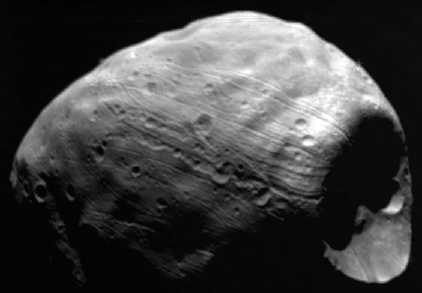
I have been trying to estimate the amount of Radiation shielding that can be achieved on the surface of Phobos, specifically in the bottom of Limtoc crater (inside Stickney).
I believe it may in fact end up being the best radiation shelter in the whole Mars system because Mars itself fills so much of the 'sky' above, their are virtually no un-impeded lines out to deep space. Limtoc crater is 2 km across and from images looks to be quite deep and cone shaped, and it points almost directly at Mars continuously because of Phobos tidal-locking. As you can see in this photo which is taken strait 'up' from low Mars orbit.
http://upload.wikimedia.org/wikipedia/c … Phobos.jpg
Stickney is rather shallow and dose not point directly at Mars, but Limtoc is slightly skewed and in the rim wall of Stickney and points more squarely at Mars. To determine the shielding we need to know the rough conic 'sky' angle out of Limtoc, the angular size of Mars from Phobos, and the degree of alignment between the two cones. Then we can compute the approximate amount of unshielded sky and the GCR dosage over time.
My very rough conservative estimate of Limtoc conic sky would be a 140-120 degree cone, or in other words the crater rim is 20-30 degrees above the horizon and reduces the sky by a modest amount. Mars in the sky from Phobos is 40 degrees. And for alignment I'd again guess that about 30 degrees off from being pointed directly at Mars, this would mean that the rim dose not block any of Mars and the open sky is just the simple subtraction of the two areas. I don't know how to do the calculation to subtract the conic intersections and derive a % of the remaining hemisphere that is exposed which would then tell us the % of GCR dosage vs open space or vs Mars surface.
How many times do I have to tell you to stop thread-jacking with this Nuclear obsession of yours. Stick to the propulsion system in the title or don't post. If you want a comparative debate between SEP and Nuclear go to the thread I made for that debate with GW http://newmars.com/forums/viewtopic.php?id=6177 or start a new one.
MPD may prove to be the better propulsion system over VASIMIR, I'm not married to any implementation of Electric Propulsion. Even old simple HALL thrusters are still being improved and could reach the ISP levels we currently get form Ion engines now. Energy efficiency is a major concern but all current techs are reasonably efficient and none seem to be truly eliminated from competition due to an inefficiency problem, rather choices seem to hinge on factors of ISP, thrust and system scalability and mass.
I explicitly said the number did not include breaking O2 bonds, and I know that needs extra energy, this is where a helpful person would go find the numbers, looks like I have to do it myself.
http://en.wikipedia.org/wiki/Bond-dissociation_energy
119 Kcal/mol, so O2 takes a total of 433.33 Kcal/mol to disassociate and ionize, a whooping 19% more then Argon! If we Ionize to the 2+ level then Oxygen looks worse as it's Ionization energy grows rapidly after the first electron, I don't know if Ion engines typically go beyond a 1+ level, it would seem a big waste to do so.
Ion engines are also higher ISP for lower atomic masses as a smaller atomic mass translates to higher exhaust velocity given the same acceleration field. The use of heavier propellents is to get higher thrust levels. But higher per unit-propellent power inputs (which are growing steadily with each generation of thrusters) can also generate higher thrust, so I'm assuming the evolution will be towards lighter propellents to trade thrust levels for even higher ISP. Once we reach the thrust levels necessary to complete a decent round-trip in one synod their will be no need for any more thrust (unless we find that human health is being significantly improved by shortening trip times even more) and we would rather trade that for lower mass fraction.
If oxygen reactivity is a fatal flaw for gridded Ion engines then that only rules out that one combination, VASIMIR concepts and a number of others are still viable, these all plan to use a wide range of gases including water which would be mostly Oxygen so what matters is the different damage/erosion rates for different ionized gasses and plasmas, and they are ALL going to be quite nasty in this regard requiring a 'don't touch' magnetic bottle to use, so the chemical reactivity of the gases really seems to be moot at that point.
NTR is just 900 ISP and we don't need the thrust level, we have been over that a million times, stop bringing it up, it is a thread derailment.
Aren't the erosion issues caused by the kinetic energy of collision rather then the chemical reactivity of the propellent? The general research trend has been to get lower and lower amounts of impacting on grids by keeping the propellent under tighter magnetic control so it just flows around the elements of the grid while still providing thrust, so it would seem that this problem is being reduced and may allow the head-room for a more reactive element like Oxygen.
Also consider that non-grid based SEP systems like a HAL or a VASIMIR should have less issue with corrosion. What tech ends up being used could be a make or break for use of Oxygen.
As we try to go to higher and higher ISP in development of any Electric propulsion system, the ratio of total energy input used to ionize the propellent drops as a percentage of the total, I don't think the Ionization energy is all that different for O and Ar.
Simple search here but this actually seems to indicate it is lower then Argon, this doesn't include energy needed to break the O2 bond though which might be significant.
http://oxygen.atomistry.com/energy.html (314.33 Kcal/mol)
http://argon.atomistry.com/energy.html (363.73 Kcal/mol)
Both are higher then Xenon at 280.00 Kcal/mol which explains one of the advantages of thouse heavy elements, easy to Ionize and high thrust, but lighter elements give better ISP.
I've been wondering, a Solar Electric Propulsion systems have traditionally using Propellents entirely different from conventional rocketry, generally noble-gas mono-propellents. Some speculation on use of easily store-able compounds like water or hydrocarbons. Pure oxygen never seems to be considered.
Oxygen would have comparable ISP to Argon due to similar atomic weight, lower electrical efficiency might result from the higher energy needed to ionize it but the broad performance characteristics look comparable to many of the normally considered propellents.
The obvious downside is LOX is cryogenic, and if you can avoid that on a small satellite sized vehicle on a multi-year trajectory it's an obvious choice to go with non-cryo propellents.
BUT, as soon as we start to look at a reusable architecture which involves a rocket lander shuttling between the SEP vehicle and a planetary surface then a lot of things change. The rocket vehicle MUST have LOX tanks and MUST be able to refuel on the planets surface which correspondingly MUST have a robust LOX production capability.
If we wish to also re-propellent (can't really call it refueling when theirs no fuel) of the SEP vehicle in orbit then we would need to ADD a 3rd tank to the Rocket vehicle AND a 3rd propellent production capability to the planets surface. Both would be added cost and complexity, where as making excess LOX is a predicted output from most ISPP processes on Mars like Sabiter and is likely to be the lowest energy per unit mass propellent to produce other then CO2.
Likewise LOX is ALWAYS going to be present on every vehicle launched from Earth and if the upper stages of rockets had their LOX tanks stretched slightly then could devote a fraction of payload to extra LOX that would be offloaded to a SEP vehicle. If done at the right ratio this would archive both the loading of cargo and propellent onto a vehicle with the use of a single launcher rather then needing a separate 'tanker' launch.
Now if we also had some Rocketry on that SEP vehicle (making it hybrid) for the purpose of orbit circularization, Oberth-effect optimized escapes, emergency thrust etc. Then the potentially exists for carrying small amounts of fuel along with us to Mars from Earth and in fact we would likely just attach one of thouse stretched-LOX upper-stages to the vehicle. Now we can depart for Mars on LOX-SEP, brake into orbit with some fuel and remaining LOX, then refill the LOX tanks from Mars ISPP, then depart Mars on LOX-SEP and finally brake at Earth with the last of the fuel.
The whole architecture from Earth-surface to Mars-surface and back is just 2 fluids and it only requires that LOX be transferred in orbit at Mars, simpler and safer then transfer of two fluids. And no real pressure is put on the Mars propellent production infrastructure as no precious hydrogen is needed, just a slightly larger LOX tank on each lander and the ability to transfer it on orbit.
So long as the mixture is matching the ISP of Methane and won't coke the engine it's a viable substitute, improved hydrogen leveraging is the main goal with ANY other benefits as bonus, Landis and others have looked at CO because it's Hydrogen-less and compounds leverage even further. The Acetone looks like it may have potential, any idea what kind of ratio it would be at to the Acetylene and then the final Hydrogen:Propellent leverage would look like? Also what are the chemical synthesis requirements of Acetone?
I think Viking had to basically Bake the soil at oven temperatures to get ~1% moisture out, that would be be a tremendous energy expenditure for a very scant amount of moisture, I can't see it being practical unless it is at very large scale like a cement-plant AND your processing the Regolith secondarily for some other purpose like construction material, ore, growing medium etc etc.
For all resource extraction purposes SOLID MATER SUCKS, if it were not for the fact that we can get metal from it here on Earth we would never touch the stuff, and I don't think we will use Mars regolith or crust until that same point, and only after we have scavenged all the nickel-iron meteorites from 100 km radius too. Atmosphere beats solids for every element that is in the atmosphere even in tiny amounts like water.
Most of that savings would have been the smaller Command module not the propellent, the mass fraction just dose not change enough between HydroLox and Hypergolic for the DeltaV of a service modules which is only around 3-4 kms total, it is just not far enough up the curve for the lines to diverge much. Add in the difficulty of storing the Hydrogen for the duration of the trip and it's clear they made the correct choice in the Apollo service module, it was the terribly heavy Command Capsule that was the problem in Apollo and Orion has done it's best to be "Apollo capsule on Steroids" which compounds the biggest problem with that capsule.
No one is proposing pure acetylene being used, either we find a mixture that makes a viable liquid-feed engine or we don't use acetylene in any form.
The question is what kind of mixture might work, I don't think any of us are sufficient in chemistry to really tell. Something with a lower burn temperature is logically what's needed, and it needs to dissolve the Acetylene fully and produce a dense fluid.
Welcome to the forums kb