New Mars Forums
You are not logged in.
- Topics: Active | Unanswered
Announcement
#626 Re: Terraformation » Artificial Suns and how to make them » 2016-10-18 09:47:59
In order to use a light bulb filament, it would have to be cooler than the surface of the Sun. Tungsten has a melting point of 3695 K (3422 °C, 6192 °F)
Proxima Centauri has a surface temperature of 3,042 K This is interesting, apparently Tungsten can come into contact with the surface of that star, even though fusion is going on in that star's center, and the tungsten will remain a solid. That also means you can have an artificial star that is as hot as Proxima, shed light like Proxima yet remain solid, if it is solid, it can be made into a hollow shell, and we can put something radioactive and fissionable in its center. The Tungsten shell would keep the radioactive stuff on the inside, and it the stuff is above critical mass, it will undergo a runway chain reaction. We want it to maintain temperatures of around 3,042 K. Probably would take a lot of uranium or plutonium to keep this thing glowing and illuminate Titan. I suppose at some point, we would need to refuel this artificial Sun. It would be hard to get close enough to do this, perhaps we could build another sun to pick up the slack while we wait for the older sun to cool enough so we can touch it, empty out its contents and then refuel it with fresh nuclear materials.
#627 Re: Terraformation » Artificial Suns and how to make them » 2016-10-17 19:56:12
I think the hill sphere of Titan would be greater than the 24-hour orbit radius, so you can just have the orb orbit the moon. Anyway if placed at L1 with a moon that is tidally locked would create the same situation that supposedly exists on Proxima b.
#628 Re: Martian Politics and Economy » Corporate Government » 2016-10-17 10:17:24
Elon is trying to jump straight to the colonial transport. I've always believed we need a small exploration mission first, about the size of Mars Direct.
Why? Don't we already know what we need to about Mars? This has been put off for far too long! All you have to do is prepare for what you don't know. Probes can find out all sorts of things, and they are cheaper to send than people.
Then several missions to build a small base and explore Mars. Then use in-situ resources to build the base larger, to accommodate more people. Then use those people as a work force to build a larger base, able to accommodate the first 100. So ability to produce not only propellant but food would already exist by the time the first colonial transport arrives. Once they arrive, use those people as a work force to build up ability to manufacture replacement parts for maintenance of the ship.
The real big thing is a propellant depot in Earth orbit filled from a location off-world. Do you transport propellant from Mars all the way back to Earth? Or one of the Martian moons? Or an NEA?
Looks like you are asking for a lot of side trips. Do you intend on living forever? Elon Musk is a lot like me in this respect, we have limited time to get things accomplished. Doing it the government way, just won't do.
#629 Re: Martian Politics and Economy » Corporate Government » 2016-10-17 06:57:16
Government support means that the plug can be pulled at any time, it also means that the pressure is off to generate revenue for as long as that government support exists. So the colonists won't care about revenue so long as the money keeps flowing from the Federal Government, and when that money stops, they will be forced to abandon the colony and return to Earth, or else they will die! Government subsidy I not the best way to get a colony going. Governments are regulators, not producers. Remember when the government was operating the shuttle and selling launch services off of it? In those days, you could pay the Federal government to launch your satellite out of the Shuttle's cargo bay, and the other launch service providers were complaining, because the prices NASA was charging was an afterthought. Some commercial satellites got launched off of the shuttle, NASA was paying for the shuttle operations, and launching those satellites was a little incidental revenue which defrayed some of the costs of operating he shuttle, after the Challenger accident, this stopped, but for a time, the US Government was in the satellite launch business, and all its competitors were complaining, because of the unfair advantage NASA had in subsidizing its shuttle launches with taxpayer's money. If a Mars Base is operated this way, it would be vulnerable in just the way the shuttle was. If you had an accident which resulted in the deaths of astronauts, support from the government would dry up and the colonists would be forced to return to Earth.
#630 Re: Martian Politics and Economy » Corporate Government » 2016-10-16 23:57:51
It remains to be seen whether anyone will become rich. Like any capital venture, there are risks. In order to be successful, Elon Musk needs to make money, if he doesn't make money, then the project is a failure. The only way a Mars Colony can sustain itself is if it produces a Gross Domestic Product, it the colony needs constant support from Earth, then its GDP is negative.
#631 Re: Terraformation » Titan Terraformation - Is it possible? » 2016-10-16 23:53:22
if you go outside and you die, then the world is not habitable. I like having an outdoors, other people, they like living in tunnels. I define terraforming as not needing a wall to keep inside your habitable environment. You can talk about domes all you want, but that is not really terraforming.
#632 Re: Human missions » Musk's plans for Mars » 2016-10-16 08:58:39
We are living in the 21st century, I expected bigger! After all, when I lived in the 20th century, what did I have to compare it to but the 19th century, that was an era of horses and buggies and steam locomotives, and now we fly in airplanes and can travel anywhere in the world in a matter of hours. The Wright Brothers thought big. One hundred years ago we were fighting the First World War, and there was tremendous development in aviation technology at that time, and it continued through the Great Depression and World War II to land us in the Jet Age, from the point of view of a child growing up in the 1970s, I expected that to continue, I expected that we would be living in space by now. From the 1970s looking backwards I see tremendous progress in aviation, and I expected that to continue right into space. There were people in the 1970s that were thinking even bigger than Elon Musk today, everyone was hitching their wagon to that supposed miracle shuttle that NASA was trying to develop. It looked like an airliner to us, and we couldn't wait to buy tickets into space. A funny thing happened on the way to the 21st century however, something called "The Great Stall" occurred, we got frozen in those airplanes, the technological developments started emphasizing how to pack as many seats in those airliners as possible to reduce ticket prices! There used to be supersonic concords, but the Arabs put a stop to those! They wanted us facing to Mecca and praying instead of going into space, so we could live the lives of Lawrence of Arabia and Ally Babba and the Forty Thieves instead of colonizing space! seems the Arabs got their way at least in their own region, they get to pretend they are living in the 7th century except with bombs and guns and oil wells to pay for them.
#633 Re: Terraformation » Artificial Suns and how to make them » 2016-10-16 07:00:25
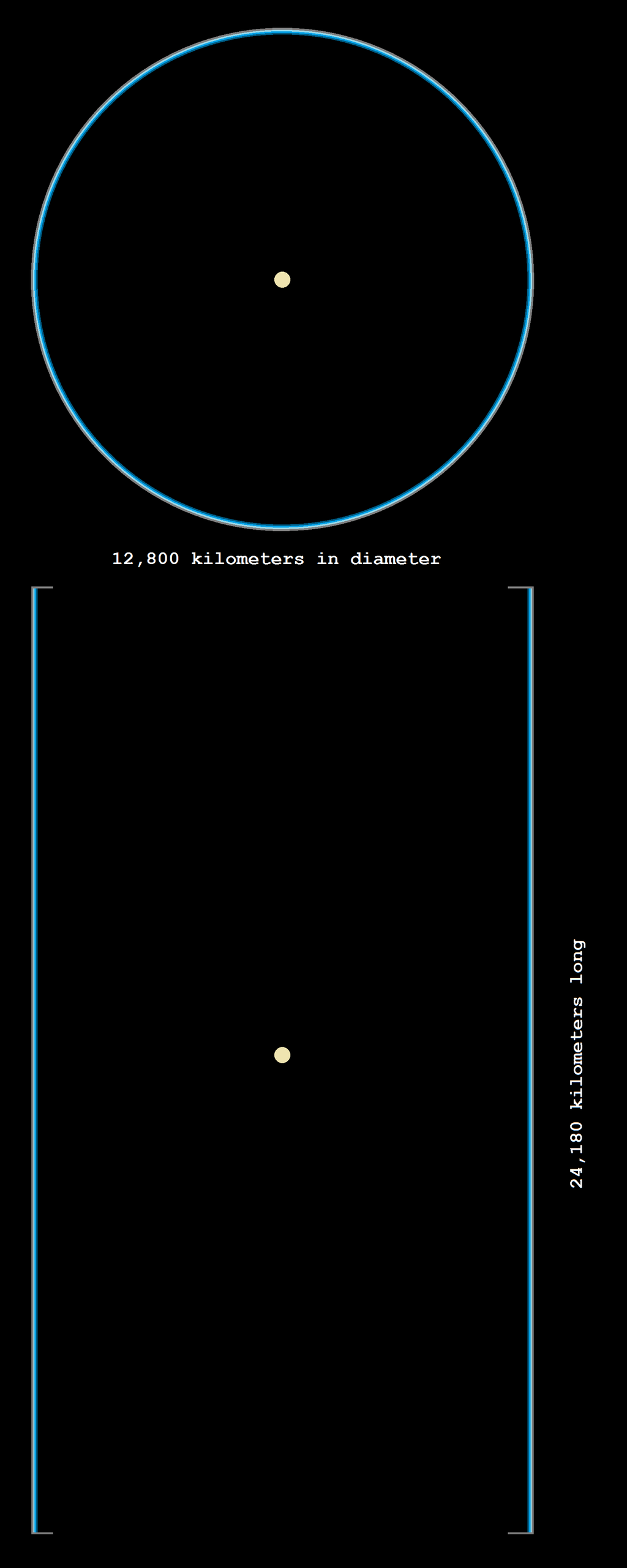
Another use for an artificial sun.
#634 Re: Terraformation » 2014-UZ224: New Dwarf planet » 2016-10-15 12:30:31
Tom,
First of all I want to nod to Antius, who said:
I would suggest that Jupiter's moon Pasiphae might be a good early candidate for ocean floor terraforming. It is close enough that it might be reached using the ITS architecture that Musk is working on. At 58km across, a 5GW heat source would be needed to keep the subsurface ocean liquid, with a 0.8km thick crust providing about 1KPa base pressure, which is enough to prevent the ocean from boiling. At 23million km average distance from Jupiter, tidal forces on the ice shell should be minimal.
If the entire sea floor were Para-terraformed there would likely be too much heat to allow the ice shell to be stable. Assuming the satellite is a 50/50 mix of ice and rock, the surface area of the silicate core would be 4700km2 and lighting it to Earth standard light levels would require about 500GW of electric power. This would melt the ice shell. To prevent the ocean from boiling into space a tensile shell would need to be built over the ocean to maintain a 1KPa pressure.So that is one option which Antius has included as well as 2014-UZ224.
I suggested developing the technology on Mars, and I mentioned Calisto.
I do like pretty much what Antius has offered, but I see no reason to not apply it to Mars. Since we hope to establish humans there, I see no reason not to seek to master the entire water cycle of that planet to human advantage, and this could include very large bodies of water with an ice layer over them like Europa.
In fact if there were geological energy sources under the Martian polar ice caps, you would be looking at a Europa like Mars, only it's rocky surface would be only partially covered with ice covered water.From there, if you wanted to access the Jupiter system, a first step could be exactly what Antius suggested for Jupiter's moon Pasiphae. And the nice thing about that is in the vicinity of Jupiter, you do not have to rely on nuclear heat (But you would use it if you could). Solar heat would still be effective in the vicinity of Jupiter with concentrating mirrors that are not ridiculously large.
So, then this would be a progression from solar to nuclear energy, as humans drifted further and further out in the solar system. Adapting/making these little ocean worlds.
Once Antius had done what he intended to with tiny moons around Jupiter, some effort could move on to Saturn and so on. But still around Jupiter are four very large chunks of matter. Io, Europa, Ganymede, Callisto.
You mentioned Europa.
I would choose Callisto instead, because:
-It appears to have a mixture of materials on it's surface, is perhaps not totally differentiated.
-It suffers much less from radiation from Jupiter's magnetic field.
-It is the least deep in the Jupiter gravity well. So, it is the most accessible, per space transport methods.In addition, we do not want to damage any potential life which could exist in the oceans of Ganymede, or Europa. Io, is the absolute worst case for exploitation, but maybe someday.
So, I will explain my intentions for Callisto more.
First of all, I do believe that that moon does not have much of a polar axis tilt.https://en.wikipedia.org/wiki/Callisto_(moon)
Callisto is composed of approximately equal amounts of rock and ices, with a density of about 1.83 g/cm3, the lowest density and surface gravity of Jupiter's major moons. Compounds detected spectroscopically on the surface include water ice,[13] carbon dioxide, silicates, and organic compounds. Investigation by the Galileo spacecraft revealed that Callisto may have a small silicate core and possibly a subsurface ocean of liquid water[13] at depths greater than 100 km.[14][4]
https://upload.wikimedia.org/wikipedia/ … llisto.jpg
So, it looks likely good for chemistry, as it does mention organic compounds, which I may hope will include some Nitrogen.
Quote:
Like most other regular planetary moons, Callisto's rotation is locked to be synchronous with its orbit.[3] The length of Callisto's day, simultaneously its orbital period, is about 16.7 Earth days. Its orbit is very slightly eccentric and inclined to the Jovian equator, with the eccentricity and inclination changing quasi-periodically due to solar and planetary gravitational perturbations on a timescale of centuries. The ranges of change are 0.0072–0.0076 and 0.20–0.60°, respectively.[10] These orbital variations cause the axial tilt (the angle between rotational and orbital axes) to vary between 0.4 and 1.6°.[27]
As far as energy, we have already established that it get's enough solar energy, to use reasonably sized concentrating mirrors. The tilt of the sun in the sky will be much simpler than that of the Earth and Mars, and no wind loads, and most likely not much of a cleaning burden per dust.
You could concentrate sunlight onto photovoltaic cells, or use power towers, or a hybrid.
Fission power? Maybe if the ores are found.
Fusion power? Sure, if it is ever achieved (Which I expect it will be eventually).So, Antius has built a little ocean city on Pasiphae, and I want to establish a mining process on Callisto.
On Callisto, we have a palate of materials and energy sources to work from. We can build canals, seas, and oceans on Callisto, with similar characteristics suggested for the Antius worlds.
An extra complication in this case, is your bodies of water could melt down bottomlessly, unless you purposely limited the deepness, with some insulator, lets say a thick layer of mining tailings. Probably canals are the best, so that the cold of space can seep down and under these bodies of water, and so, actually you can transport heavy things about in these canals (Covered canals).
So, if the people of Callisto exported mined materials, they would also have lots of tailings, which would include excess ice, and rock. It would get into the way, so why not shoot it to an "L" location and construct a world. An Antius ocean city world.
I don't think Venus has so much to offer. And I cant imagine the effort that would be required to crash an outer solar system object into it. Also the results would most likely unsatisfactory.
So, then if we presume automation/robots, "How many little ocean worlds could you make out of Callisto?". I am thinking it is a vast amount of living space.

What's the worst that can happen to Venus? Venus needs water, Venus needs spin, a glancing impact by a dwarf planet might spin it up. I think a similar event happened early in Earth's history with a planet the size of Mars, it ended up creating Earth's Moon. Sure it might mess up Venus's surface, but we can't live on it anyway, its too hot! Maybe it might improve the atmosphere however by adding water, and by getting ridof some of the exces carbon-dioxide. I think Venus will retain most of its mass through such an impact, though it might gain a small moon or a ring of debris as a result of it.
#635 Re: Terraformation » 2014-UZ224: New Dwarf planet » 2016-10-15 10:25:31
So your thinking about doing this with Europa? A bit or water electrolysis to produce oxygen.
Lets say a heavily shielded one of these lands on Europa. I wonder, since its surface is made of water ice, and the ITS uses methane/Oxygen engines, do you think it could use its engines to melt a hole in Europa's ice and sink into it?. Probably this ship would need some modifications if it were to be used as a submersible. Fortunately since Europa's gravity is low, the pressure doesn't build as steeply underwater as it does on Earth. With the radiation environment around Europa, you probably would want to burrow under the ice as quickly as possible, and unlike the illustration above, you probably won't see men in space suits walking on he surface. So how thick is Europa's ice? sheets? Since it is devoid of impact craters, the answer probably is not that much. So what do you think of the possibility of building a manned submersible spacecraft which can travel to Europa, land and melt a hole in is surface and go under water?
http://www.planetary.org/blogs/emily-la … /3266.html
The dwarf planet, called 2014 UZ224, measures about 330 miles (530 kilometers) across and is located about 8.5 billion miles (13.7 billion km) from the sun, NPR reported today (Oct. 11). For comparison, Pluto's largest moon, Charon, is about 750 miles (1,200 km) in diameter, and reaches a maximum distance of about 4.5 billion miles (7.3 billion km) from the sun.
A year on 2014 UZ224 (the time it takes the dwarf planet to orbit the sun) is about 1,100 Earth years. One Pluto year, for c is about 248 Earth years. The new object was also confirmed by the Minor Planet Center. [Meet the Solar System's Dwarf Planets]
So this dwarf is way out there, and it is relatively small. Getting there would take a spaceship verging on being a starship with a fusion power plant. You'd need fusion to stay alive and unfrozen anyway. It is a pretty big object. I wonder if we could make a comet out of it, lets suppose we slowed it down so it falls toward the Sun, maybe put in on a Collision course with the planet Venus to give it an ocean, it has a lot of frozen gases as well as water ice I bet. People can live in this thing for a long time as it falls toward the Sun, and when it approaches Venus, people can evacuate.
#636 Re: Terraformation » 2014-UZ224: New Dwarf planet » 2016-10-15 06:50:29
At 1/50th-g. I don't know how you get anything like that to hold onto at atmosphere, If I was standing on it, I would weigh 5 pounds. I would probably suffer the same debilitating effects of zero-g If I was there for a long time. At 1 bar, I could probably swim through the air by flapping my arms and kicking my feet. Not exactly Earthlike.
#637 Re: Terraformation » 2014-UZ224: New Dwarf planet » 2016-10-14 09:07:19
Wait a minute. The chart on the Space.com website linked in the initial post of this thread shows details of various dwarf planets. Eris has a rotation period of 25.9 hours, and has one Moon. Earth has a rotation period of 24 hours, and one Moon. Perhaps we should look at Eris more closely. At that distance it would be extremely cold; but still, interesting coincidence. Mars has a "solar day" of 24 hours, 39 minutes, 35.244 seconds. Both Eris and Mars have a day very similar to Earth. If you want to get mystical, it's as if some creator has set out places for humanity to move to.
My argument for religious types. Mars rotation is practically the same as Earth. Mars has low gravity, low pressure, and cold. Venus has practically the same gravity and practically the same size planet as Earth. Venus has high pressure, and hot, and a ridiculously long day. Mars can be terraformed by industrial means: releasing greenhouse gasses. Venus can be terraformed with biotechnology: engineered microogranisms released into the clouds convert CO2 into polyanhydride. Mars can be colonized now with spacesuits and pressure habitats. Venus has to be terraformed first before it can be colonized. The Moon is a "tree house", small and in the back yard of our father's house, but no way you could make a home there. It's as if stepping stones have been laid out, leading us into space.
Now Eris has a 25.9 hour day? Hmm...
Being that far out from the Sun, its rotation rate makes no difference. Since its diameter is about 2200 km and its maximum distance from the Sun is 97 AU, if we build a mirror that is 220,000 km in diameter, we can focus enough sunlight on it to give it an Earth like level of solar intensity. if you want to know how big this is, it is bigger than Jupiter. I think Eris would be a candidate for an artificial Sun, probably fusion powered. Building a mirror this big is probably a waste of time and resources.
#638 Re: Terraformation » Artificial Suns and how to make them » 2016-10-14 08:26:12
One can do the same for Proxima b, its problem is similar to Venus as far as lack or rotation is concerned, and it might be easier to terraform than Venus. On the positive side, it rotates once every 11 days, which is much fastr than Venus, it probably has a magnetic field because of this rotation, it is cooler than Venus, may have more water. We can erect a shade around the planet and build an artificial sun like I described. In addition the Alpha Centauri system may have a higher metal content because more metals were detected in their star's spectrums, than means we can perhaps find more tungsten to build these artificial suns out of. The energy that Proxima gives off should suffice for making an artificial Sun hot. For a planet like Proxima b with a mass of around 1.3 Earths, the 24-hour orbit is around 46,000 km according to the calc tool for orbit periods.
http://www.calctool.org/CALC/phys/astro … anet_orbit
Since the one I proposed to orbit Titan would orbit at 11,455 km, 46000/11455 = 4 times the diameter of the Titan artificial sun, which would make it about 400 km in diameter, its mass would thereforebe 704,000,000,000,000,000,000 kg or 7.04e20 kg, to get an idea of how much mass this is, our Moon has a mass of 7.15e22 kg, so this artificial sun would have one hundredth as much mass as our Moon.
#639 Re: Terraformation » Artificial Suns and how to make them » 2016-10-14 00:58:58
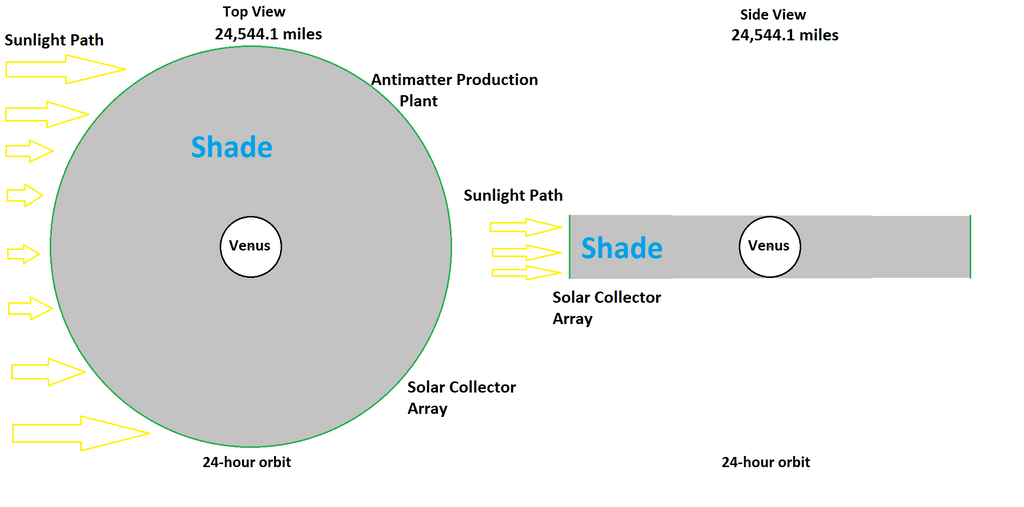
We could do an artificial Sun for Venus, use the shade to collect solar energy, fire lasers at the artificial Sun, have it orbit inside the shade, and maybe have an artificial Moon orbit inside the orbit of the artificial Sun, then we could turn Venus into a Ptolemaic model of the Earth.
#640 Re: Terraformation » Artificial Suns and how to make them » 2016-10-13 11:34:53
So your vision is of Titan as a City Planet like Coruscant in Star Wars.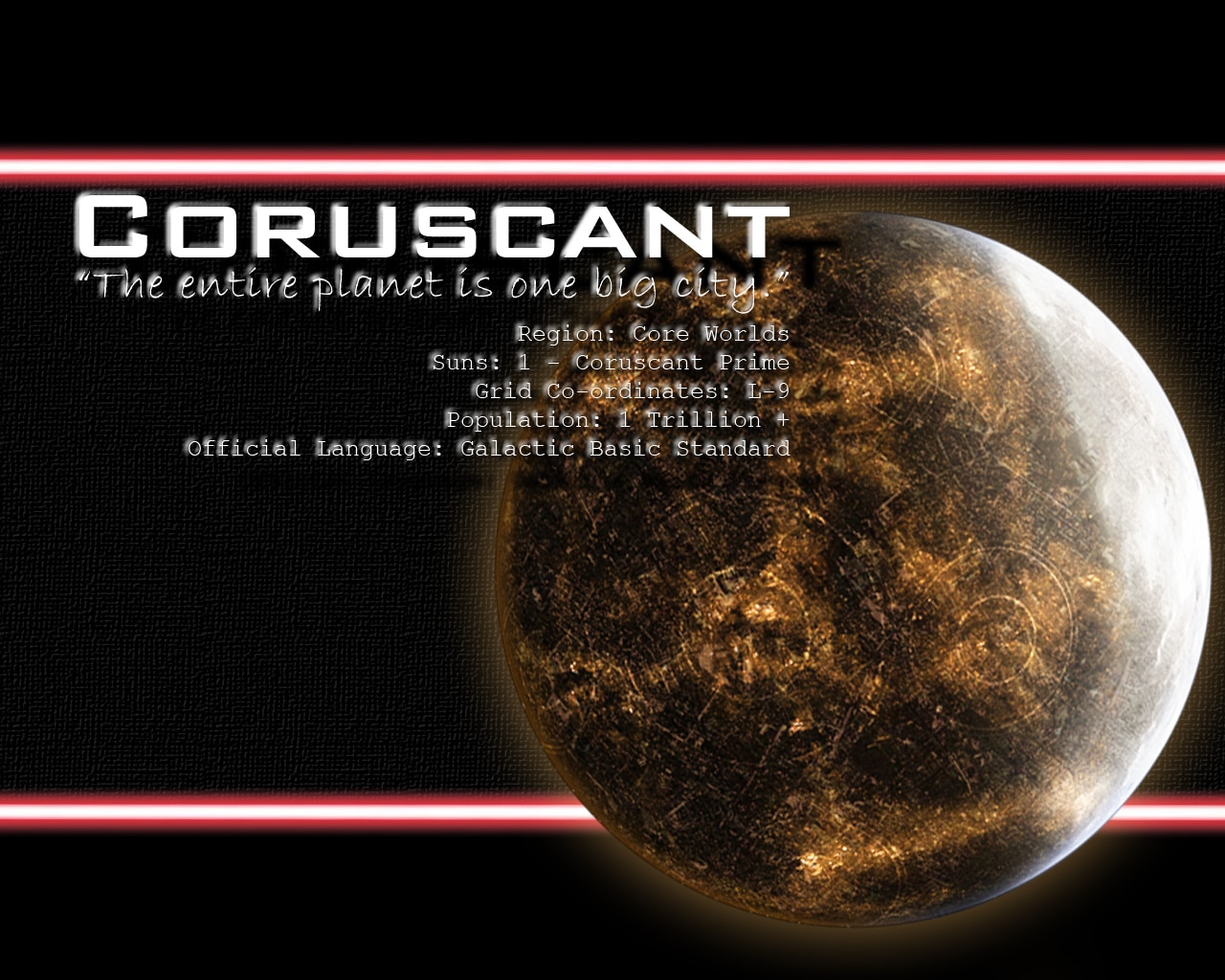
Not exactly my idea of what terraforming would be.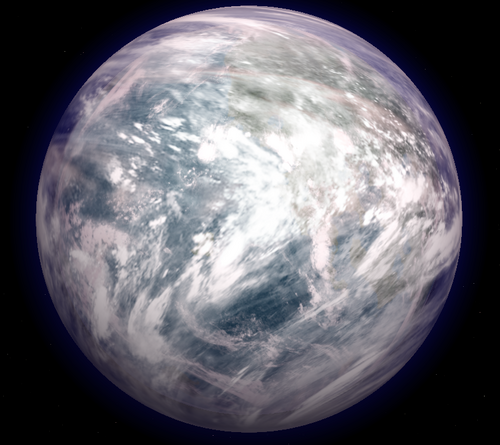
My vision looks more like this. While we could use mirrors, we'd be stuck with a 16 day rotation period if we did. I think we could use solar power to heat up an artificial Sun. Imagine if we were to reverse the paths of light rays so that the go to a surface rather than being emitted from the Sun's surface. If we can achieve the same light intensity at the surface of the Sun, we can heat another object to Solar Temperatures. Once it is hot enough, it ill give off its own illuminations and illuminate Titan.
#641 Re: Terraformation » Artificial Suns and how to make them » 2016-10-13 07:29:41
Half a million Fusion plants? Doesn't sound simple to me, and all those street lights, if one fails, you call the repairman to fix it. How about a million mass drivers instead, orbiting within Saturn's rings, processing the ring material to make pellets and then accelerating them towards the Artificial Sun, the pellets hit, and make a nuclear explosion. If a mass driver fails, it is repaired, the artificial sun continues to radiate its stored heat, and receive hits from other mass drivers to keep it hot, it is a target 100 km in diameter, it shouldn't be that hard to hit.
#642 Re: Terraformation » Artificial Suns and how to make them » 2016-10-12 22:15:31
There are other ways to heat the artificial sun, one way would be impact fusion on the far side of the molten ball of Tungstein, all you need are fusion powered mass drivers in Saturn's rings, accelerate pellets of fusion fuel so they hit the far side of the artificial sun hard enough so as to undergo nuclear fusion, and shower a broad swath of the far side so as to keep the artificial sun at Solar surface temperatures, the 100 km wide sun shields Titan from gamma rays emitted by the nuclear explosions, about half the radiation is wasted, being radiated into space instead of heating the tungsten ball. For autumn and winter, the artificial sun is allowed to cool a bit, for spring and summer the bombardment begins again causing the artificial sun to heat up once more.
#643 Re: Terraformation » Artificial Suns and how to make them » 2016-10-12 09:16:56
Titan's surface area is 32.05 million sq miles (83 million km²), the black hole emits 160 petawatts or 160 × 10^15 W, or 1.6 × 10^17 W. 83 million km² is 8.3 * 10^16 m² this is 2 watts per meter squared of radiation, the Solar Flux on Earth is 1350 watts per meter squared. We will need 690 black holes in this artificial sun to produce the correct power output to terraform Titan, or perhaps a larger black hole with 690 times the mass.
#644 Re: Terraformation » Artificial Suns and how to make them » 2016-10-12 09:02:36
A fission powered sun would tend to leak fission products into space, which are lighter than tungsten and more volatile. If even a fraction of these reached the surface of Titan it would have a compromising effect on the habitability of the place.
A more efficient use of resources would be to build compact gas cooled fast breeder reactors on the surface, close to Titan's lakes. These would then benefit from the excellent heat sink provided by liquid methane, which can be pumped into compact heat exchangers and boiled off. The reactors will then provide lots of cheap electricity that you can use for powering sealed human habitats on the surface, containing locally terraformed environments. With the excellent heat capacity provided by the methane lakes, these could be allowed to grow to enormous sizes and can be cooled by methane evaporation. One can imagine habitats with ecosystems spanning multiple levels and therefore achieving power density that would be impractical in space due to the waste heat problem.
Yes but an artificial Sun would make the entire surface of Titan or whatever world available. I think fission might not be the best way to power the artificial sun, but I can think of something else. a micro-black hole. the kind you would use for a black hole starship would be the kind you'd use to make an artificial Sun.
According to the authors, a black hole to be used in space travel needs to meet five criteria:
1.has a long enough lifespan to be useful,
2.is powerful enough to accelerate itself up to a reasonable fraction of the speed of light in a reasonable amount of time,
3.is small enough that we can access the energy to make it,
4.is large enough that we can focus the energy to make it,
5.has mass comparable to a starship.Black holes seem to have a sweet spot in terms of size, power and lifespan which is almost ideal. A black hole weighing 606,000 metric tons (6.06 × 10⁸ kg), or roughly the mass of the Seawise Giant (the longest sea-going ship ever built) would have a Schwarzschild radius of 0.9 attometers (0.9 × 10⁻¹⁸ m, or 9 × 10–19 m), a power output of 160 petawatts (160 × 1015 W, or 1.6 × 10¹⁷ W), and a 3.5-year lifespan. With such a power output, the black hole could accelerate to 10% the speed of light in 20 days, assuming 100% conversion of energy into kinetic energy. Assuming only 10% conversion into kinetic energy would only take 10 times longer to accelerate to 0.1c (10% of the speed of light).[1]
Getting the black hole to act as a power source and engine also requires a way to convert the Hawking radiation into energy and thrust. One potential method involves placing the hole at the focal point of a parabolic reflector attached to the ship, creating forward thrust. A slightly easier, but less efficient method would involve simply absorbing all the gamma radiation heading towards the fore of the ship to push it onwards, and let the rest shoot out the back.[3] This would, however, generate an enormous amount of heat as radiation is absorbed by the dish.
https://en.wikipedia.org/wiki/Black_hole_starship
It would be easier to make this artificial sun than a starship out of it. The black hole would settle at the center of the Tungsten ball, and start absorbing tungsten surrounding it, on its way down into the black hole, some of the tungstein would get converted into x-rays, that x-rays would be absorbed by the surrounding tungsten and converted into heat. the Hawking radiation emmittend by the black hole would also get absorbed by 50 km of surrounding tungsten an get converted into heat. If the artificial sun it the right size and mass in relation to the power output of the black hole at its center, it will radiate visible light if its surface temperature is the same as the Sun, the bul of it acts as a radiation shield to black the x-rays and gamma rays coming from the black hole, just as the outer layers of the sun does for gamma rays emitted by nuclear fusion at the sun's core. If you get the right mass for the ball of tungstein, it will feed the black hole at its center at the same rate that the black hole converts matter into Hawking radiation, and at that point, you jus keep on adding more tungstein to the artificial Sun at the same rate that the black hole depletes it.
#645 Terraformation » Artificial Suns and how to make them » 2016-10-11 22:32:09
- Tom Kalbfus
- Replies: 34
This idea came out of an idea on how to terraform Titan, the problem here is Titan is ten times as far from the Sun as Earth, the second problem is that Titan orbits Saturn instead of the Sun directly, so that means building giant mirrors to focus sunlight on Titan from the Titan-Sun L1 point is impossible, because there is no Titan-Sun L1 point, there is a Saturn-Sun L1 point but that point is very far away, because the Sun's gravity at this distance is very weak, and you have to travel very far from Saturn to find the balance point between Saturnean and Solar gravity, so any mirror placed there would have to be huge, and would have to track Titan, but there is an easier way, that is to create an artificial sun. I described how to do that in Terraforming Titan, basically it is a ball of molten Tungstein who's temperature is raised to that of the surface of the Sun, so that it glows the same as the Sun. The interesting property here is that Tungstein stays a liquid at the temperature a the surface of the Sun, so surface tension plus its weak gravity could hold it together, if it were a ball of gas, it would just expand into space and dissipate, but as a liquid it keeps its volume, that is a useful property.
This ball of tungstein orbits Titan at a radius of 11,455 km, its mass is 1.1e19 kg, and its radius is 50 km with such a radius and a temperature of 5,772 K this ball will be white hot, and look just like our Sun as seen from Earth. The real trick is how to keep this fromm cooling/
#646 Re: Large ships » What we need to go to Mars - short term projects » 2016-10-11 22:01:55
direct CO2 electrolysis to recover O2 from CO2 currently dumped in space
This won't replace the current life support system, it will augment it. Currently 50% of CO2 recovered from cabin air is dumped in space. The other 50% goes to the Sabatier reactor. Direct CO2 electrolysis only recovers 40% of O2 contained in the CO2, but 40% is better than 0%. This could replenish recycling losses.
Why can't you recover all of the oxygen? If you heat it to a high enough temperature, you can break any chemical bond and recover all of the oxygen!
#647 Re: Science, Technology, and Astronomy » Cartography of M-star tidally locked planets » 2016-10-11 19:14:10
What about a "Wet Venus" Imagine there is a planet that is halfway between Earth and Venus, its oceans haven't boiled away, and its atmosphere is thick with water vapor, as we originally thought Venus would be like. A wet venus might be too hot for a human to live on its surface, but they can live in the upper atmosphere.
#648 Re: Martian Chronicles » Nuclear War on Earth, Astronauts on Mars » 2016-10-11 19:09:48
They would probably see some lights in a realistic situation, not as many as before. Certain countries, such as New Zealand perhaps, might have been overlooked by the warring powers and may have survived. Of course in the countries that got hit, there are likely patches of survivors in fly over country. Cities would be on the target lists, they would go up immediately. Those people that lived far enough away from those cities might survive, they might have other problems with the aftermath, such as lack of food, competition with other starving people, bandits, and radiation areas and the like.
The funny thing about Mars is that in the short term, its probably better for the colonists I they stay on Mars until their supplies are about to run out. Life on Earth in the aftermath of a nuclear war is likely to be harsh, brutal, and short. People on Mars would not be a part of this, while they are on Mars, people on Earth would be dying of various causes, the food distribution network would be blown to hell, there might be cannibalism there would be banditry, people would have to kill to survive perhaps, the population would be in decline for some time after the last city blew up. After a while the population would level off and then the recovery would begin. Probably humans wouldn't venture back into space for a long time after that, with the exception of the humans already in space. If they go back to Earth, they are probably not coming back. the rockets which would take the colonists back to Earth, could do so once, and probably could not life off of Earth after than, there would be no infrastructure to send them back into space again. Much would depend on how self-sufficient the Mars Colony would be. Earth, even after a nuclear war, would probably be more habitable than Mars, the main concern for the colonists would be how long they can afford to live on Mars, while Earth recovers. If they wait too long, they will die on Mars without support from Earth, but I they go too soon, they will rejoin Earth in the midst of its post nuclear horrors, ie radiation, marauders, starvation etc.
#649 Re: Martian Chronicles » Nuclear War on Earth, Astronauts on Mars » 2016-10-11 08:14:51
I think I'm right in saying that it has been shown in small mammals that foetal development is abnormal in microgravity.
So the issue is whether it could be normal in one third G. I would hope so, but hope is not a substitute for fact, and the fact is rather crucial in discussion of this scenario.
As I say, if the colony has not yet established the possibility of reproductionas fact they would need to proceed as quickly as possible. I would have thought it would be better to create the artificial 1G environment (either on the surface or in orbit) rather than assume one third G would be OK.
Other things they colony would no doubt wish to do would be to formulate a "total self-sufficiency" (TSS) plan. They would need to be looking at particular gaps in the colony's internal economy - probably things like computers, copper cabling, PV panels, vital medicines (e.g. if the colonists depend on medicines to stay healthy in one third G), vitamin and mineral supplements, agricultural fertilisers and so on.
They'll want to ensure any electronic documents relating to Earth-accumulated knowledge are properly copied and preserved with back up if possible. If they have limited computer capacity they may have to priotise memory usage. It will of course be important to preserve as much of Earth's cultural store of knowledge as possible (starting with the most recent - more likely to be accurate and working backwards).
Rocketry is probably less important if humanity has been wiped out on Earth. But actually the scenario of a complete wipe out for humanity is probably unlikely. However, if there is thought to be any need to preserve contact with Earth, then securing and or manufacturing rocket parts would become essential.
Terraformer wrote:I think once there's an actual Mars *base*, we will know if mammals can successfully reproduce in Martian gravity, because someone will bring along mice for that purpose. What's a base for, if not for answering such questions? I suspect the required gravity will be more for providing a downward direction than anything else, so I don't think there will be that many problems with gestation. Birth, on the other hand, if the mothers hips are weakened by the lower gravity...
Well the communications system was designed for contact with Mission Control, if that is destroyed, what' on Mars can't pick up radio stations and other incidentals. Just because Earth is silent doesn't mean there I nothing there, its just that no one is trying to contact Mars, they got other concerns right now.
#650 Re: Martian Chronicles » Nuclear War on Earth, Astronauts on Mars » 2016-10-11 00:25:37
There is no reason to suppose they would not be. No one has yet actually tried to get any one pregnant in microgravity, and what's on Mars is not microgravity. I suspect one third gravity would suffice for two having sexual intercourse.