New Mars Forums
You are not logged in.
- Topics: Active | Unanswered
Announcement
#601 Human missions » Giant Metallic Asteroid Psyche may have water » 2016-10-28 00:06:41
- Tom Kalbfus
- Replies: 12
http://www.space.com/34525-giant-metall … water.html
And thus may be a possible place to establish a colony.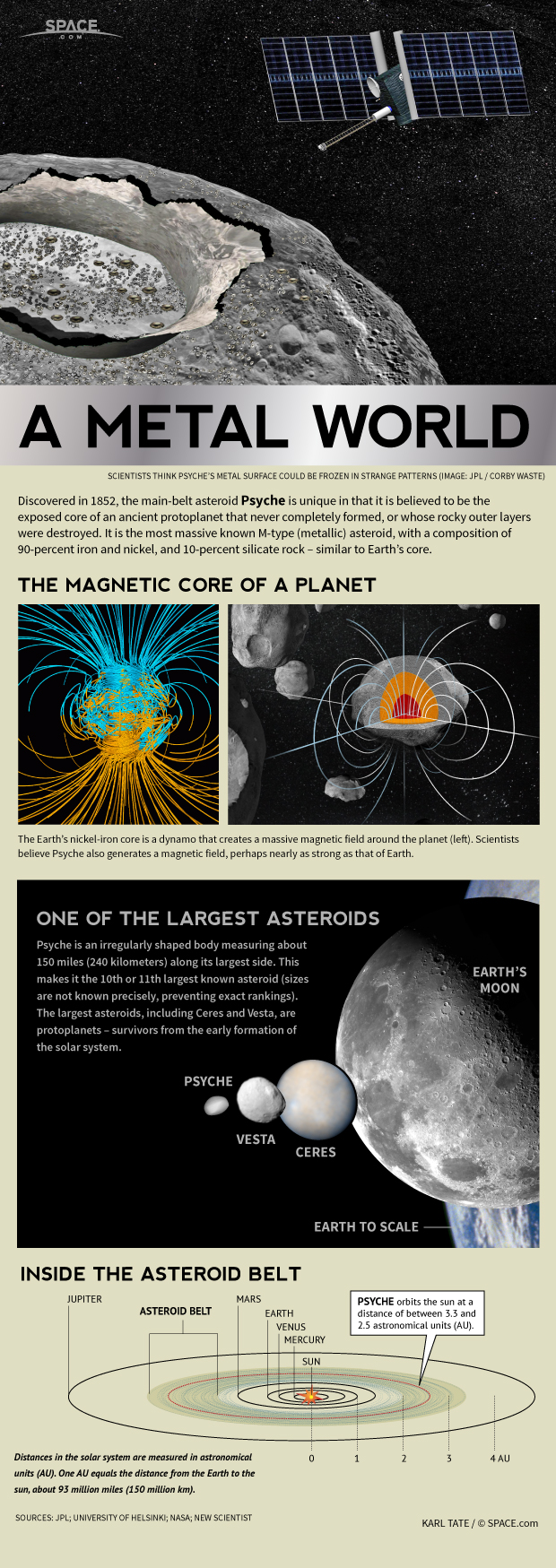
#602 Re: Terraformation » Tharsis Volcanoes and Cement » 2016-10-26 10:23:22
Great but perhaps this should go under Life Support Systems. Building concrete structures on Mars isn't terraforming.
#603 Re: Terraformation » Tharsis Volcanoes and Cement » 2016-10-26 09:04:20
I wonder what this subject has to do with terraforming? We don't need to terraform Mars to make cement. We don't need to make cement to terraform Mars either. If the Tharsis Volcanoes have the stuff needed to make cement, great! But I don't get why this thread comes under the heading of Terraformation. Just thought I'd mention this.
#604 Re: Human missions » Musk's plans for Mars » 2016-10-25 15:49:59
Also there is a good argument no to rush everything the colonists will need to live on Mars along with the colonists. Cargo for instance doesn't need to be rushed quickly to Mars so long as it gets there before the colonists so they can use it. What if you wanted to use an ion drive to deliver a massive payload of supplies to Mars, taking several years to get there ahead of the colonists? The slower you go, the more cargo you can bring!
#605 Re: Martian Politics and Economy » Martian Calender - I have created a martian calender... » 2016-10-25 14:28:38
As above, I still favour four seasons of 167 sols, comprising 16 periods of ten sols (with those 16 periods further sub-divided into quarters of 4 x 10 sols) and a festival period of 7 days. The ten sol periods would be the equivalent of our weeks.
So each sol year would comprise 16 quarters (4 quarters for each of the four seasons), and four festival periods.
Tom Kalbfus wrote:But we associate March with the beginning of spring. Mars has seasons, Earth has seasons, each part of the Earth year has its analog for Mars, so why not use 12 months but make them longer? There are a lot of cultural reasons for this. We are familiar with the month names of January through December, so why not use them for Mars as well? And since Earth Mars month is longer than its equivalent Earth month, we know where to put all the traditional holidays, in the first half of each Mars Month. Christmas would be o December 25th, and then you have half a Mars Month left before you celebrate New Years Day!
Okay, on what date would Martian colonists pop their Champaign corks and celebrate a New Year? When would they celebrate Christmas, Easter, Valentines Day, Halloween, Saint Patrick's Day?
#606 Re: Martian Politics and Economy » Martian Calender - I have created a martian calender... » 2016-10-25 07:42:18
But we associate March with the beginning of spring. Mars has seasons, Earth has seasons, each part of the Earth year has its analog for Mars, so why not use 12 months but make them longer? There are a lot of cultural reasons for this. We are familiar with the month names of January through December, so why not use them for Mars as well? And since Earth Mars month is longer than its equivalent Earth month, we know where to put all the traditional holidays, in the first half of each Mars Month. Christmas would be o December 25th, and then you have half a Mars Month left before you celebrate New Years Day!
#607 Re: Human missions » Musk's plans for Mars » 2016-10-25 07:36:39
Tom Kalbfus wrote:Just a little small detail, we haven't achieved break-even with our fusion programs yet, how are we going to build a fusion rocket I we don't even have that? SLS uses existing technology, it is not a fusion rocket, it is not a space elevator, as you said, it is a reprise of the Apollo Program and it will get us back to the Moon! if we wait for fusion, I may never see a person walking on another World ever again. Fusion will come in time, and we re working on fusion even as we speak, but as they say, "Don't count your chickens before they've hatched," and they haven't hatched yet!
You're not trying to produce electrical power with it, Tom. You're not even trying to contain the superheated plasma. You're intentionally allowing the plasma to escape from the magnetic bottle. As previously stated, there's a big difference between trying to contain a superheated plasma and produce electrical power, which implies Q > 1. You only have to generate enough juice to charge capacitors to compress a pellet and achieve fusion using a thin metal foil wrapper to contain the fusion products, produce a superheated plasma, and use an electromagnet to cause the plasma to be ejected from the combustion chamber.
1. Suck (lithium foil from lithium fuel tank)
2. Squeeze (electromagnetically compact lithium foil onto D-T pellet)
3. Bang (fusion)
4. Blow (electromagnetic rocket nozzle directs the superheated plasma away from the combustion chamber)It is not a continuous reaction that requires more output power than input power to sustain the reaction and it does not try to contain the superheated plasma. We're counting on containment failure to produce thrust and we are not interested in achieving Q > 1 because it's not recharging the capacitor. We're talking about doing that once every ten seconds. If we could do it faster, that'd be great, but unnecessary and we'd have to figure out how to dump the excess heat.
Make sense?
So what happens if you put this on the Launch pad and try to launch if from Cape Canaveral? An explosion every ten seconds?
"Boom, one Mississippi, two Mississippi, three Mississippi, four Mississippi, five Mississippi, six Mississippi, seven Mississippi, eight Mississippi, nine Mississippi, ten Mississippi, Boom!" and then repeat. I don't think this would produce enough thrust to get off the launch pad, you would need at last the bottom stage of the ITS to get it into space first, and then it can have the leisure of having a nuclear explosion every ten seconds.
#608 Re: Terraformation » Terraforming putative Proxima Planet » 2016-10-24 22:42:52
The nearest white dwarf is Sirius B, it is a bit further out than Proxima Centauri. My proposal is simply to use Proxima as an energy source, solar collectors on the star facing side of the inner cylinder would collect Proxima's energy, an use that to generate more white-yellowish light similar to our sunlight, there would be a fictional image of Earth's Moon or some other Moon, since this is an artificial world, tides can be simulated by pumping water into and out of holding tanks at the bottom of seas. The stars would be images of the actual stars as seen from Proxima. The stars you'd see in the projected night sky would be the stars you would see at underside of the opposite side of the ringworld from which you are standing. Stars would wheel around once every 1.8263 days, same as the rotation of the ringworld. It is a small ringworld compared to Niven's, but still plenty huge. It has the approximate surface area of around 30,500 Earths, About 1% of Niven's Ringworld. Still 30,500 Earth's worth of real estate is nothing to sneeze at, and red dwarfs are very common, and they can last for over one trillion years, not that we would likely be around for that long.
#609 Re: Human missions » Musk's plans for Mars » 2016-10-24 12:07:08
Dear kbd: You are assuming, of course, that this fusion engine thing isn't a boondoggle. If we haven't managed a fusion reactor in 50 years, why assume we'll manage a fusion engine first? Either way, you need to confine plasma at high enough temperatures and pressures to allow fusion to occur. We haven't managed to do that yet with 100+ tonne machines and huge supplies of electricity.
I'll stick to chemical, thank you, until fusion advances to the point where someone can actually demonstrate something that almost works. New Horizons left the Earth at a velocity of 36,373 mph and passed the orbit of Mars in 81 days (longer than I said; I just checked). That requires a delta-v from low Earth orbit of about 19,000 mph. With methane/oxygen, that's a mass ratio of about 6 to 1. Even with the Falcon Heavy ($90 million to launch 54 tonnes to LEO without reuse) you could launch about 50 tonnes to Mars with $450 million of propellant; expensive, but a lot cheaper than spending $10 billion developing fusion or fission engines. In ten years Musk won't have the price down to $20,000 per tonne, but there's a good chance he'll have it down below $1,000,000 per tonne, maybe three quarters or half that. And that's assuming you want to send things to Mars at such high speeds. If you want to use a 6-month trajectory, you need maybe 100 tonnes of propellant and staging for every 50 tonnes you send to Mars, and at $1 million per tonne to LEO that's $3 million per tonne to get it to the Martian surface, which is cheaper than launch to low Earth orbit now.
Chemical propulsion works fine, if the cost to low Earth orbit drops enough. Once that happens, it's hard to justify developing the other stuff until you're at the point where the development cost of the alternatives comes down.
SLS will be able to send larger space probes to Uranus, Neptune, and Pluto, We've never sent orbiters to those planets. I would like to see a Titan lander and rover too. Big enormous rockets would be a good help in getting those things there! I think the ITS is further down the pike, we will have the SLS sooner, and we've spent a lot of money on it, hardware exists, we should use that hardware to do some useful things. I think a larger space telescope would be just the thing for finding those exoplanets, I would like to find some planets orbiting Alpha Centauri A and B. Maybe I will find if those planets exist before my natural lifespan runs out. In 21 years I'll be 70 years old, and judging by the pace of our space program, we'd better get cracking!
#610 Re: Human missions » Musk's plans for Mars » 2016-10-24 12:01:54
Just a little small detail, we haven't achieved break-even with our fusion programs yet, how are we going to build a fusion rocket I we don't even have that? SLS uses existing technology, it is not a fusion rocket, it is not a space elevator, as you said, it is a reprise of the Apollo Program and it will get us back to the Moon! if we wait for fusion, I may never see a person walking on another World ever again. Fusion will come in time, and we re working on fusion even as we speak, but as they say, "Don't count your chickens before they've hatched," and they haven't hatched yet!
#611 Re: Human missions » Musk's plans for Mars » 2016-10-24 07:39:54
7. The sending of a large habitat on a roundtrip from Earth to Mars and back. This, too, is a very bad idea, because the habitat will get to be used only one way, once every four years. If we are building a Mars base or colonizing Mars, any large habitat sent to the planet’s surface should stay there so the colonists can use it for living quarters. Going to great expense to send a habitat to Mars only to return it to Earth empty makes no sense. Mars needs houses.
The thing is, some people will want to return to Earth, so we will need ship that can support human life on the way back to Earth. I think we can use both a reusable spaceship. And a second stage that comes in pieces for the transportation of housing structures.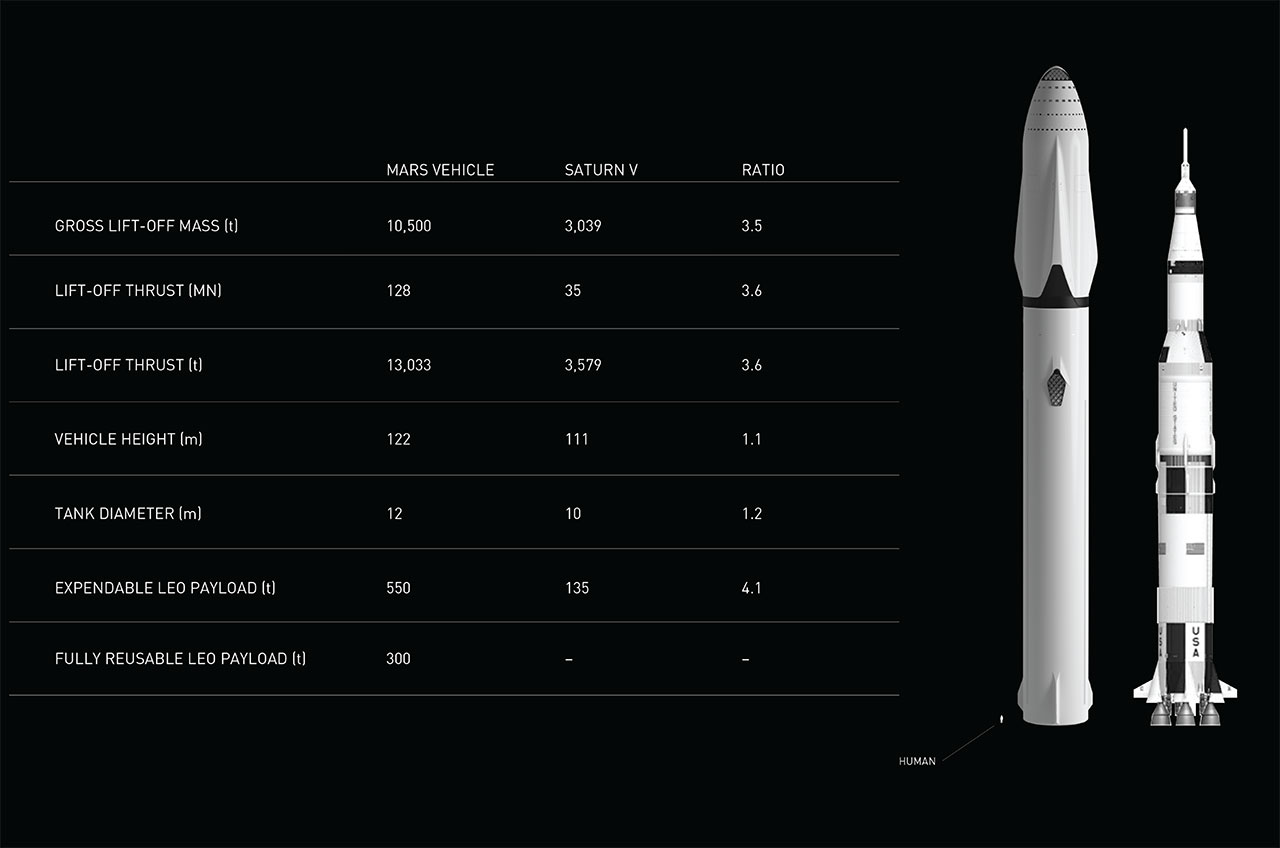
The thing is, as a historical analog, the pioneers that traveled west did not live in Contestoga wagons and railroad cars, once they got there. On the way from Earth to Mars, maybe its necessary to live in a "tin can" on the way, on Mars, people may prefer to live in a more expansive inflatable structure. Having rigid tin cans that were once part of spaceships, might not be the best living quarters, or greenhouses. The passenger module needs to house passengers, the quarters will necessarily be tight if these ships are to carry 100 people at a time. I think once people get to Mars, they might prefer to have more space and more privacy from one another rather than live in some barracks. People will want to raise their families, an a passenger/crew module might not be the best place to do so. Must did say he planned to send a lot of cargo to Mars first in preparation to ending the first humans there. I think they will not need to live in the spaceship that brought them.
#612 Re: Terraformation » Terraforming putative Proxima Planet » 2016-10-23 23:01:51
There is another way to terraform the planet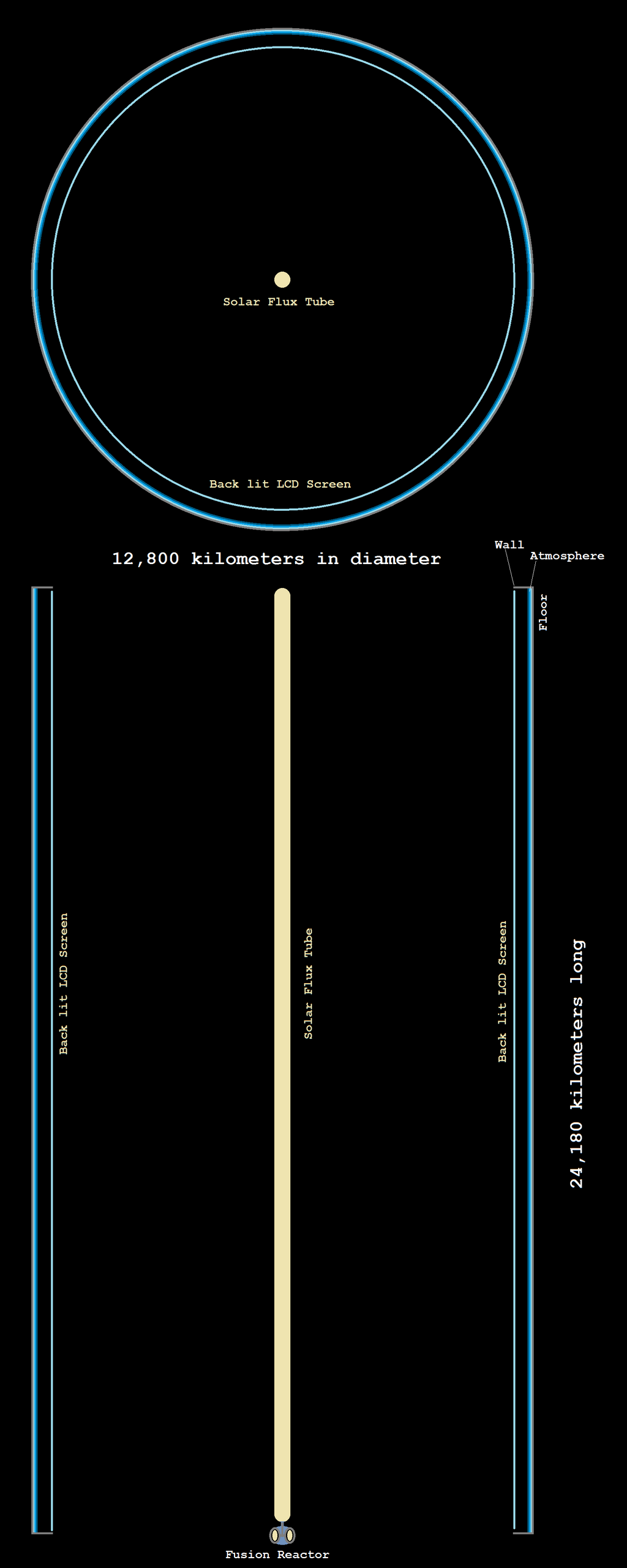
What if we take this idea, make it larger, and replace the Solar Flux tub illuminator and the fusion reactor with Proxima Centauri? What would you call it then? A famous science fiction writer wrote a novel about this sort of world. If Proxima b is like our World, it should have a lot of iron to build this world out of. and remember the metal tungsten has a high melting point.
Melting point
3695 K (3422 °C, 6192 °F)
Boiling point
6203 K (5930 °C, 10,706 °F)
Surface Temperature of Proxima Centauri
3,042 ± 117[10] K
The surface temperature of Proxima Centauri just happens to be below the melting point of Tungsten and carbon by the way. That means these materials can come in contact with the surface of proxima centauri and stay solid. Ergo, we can mine Proxima Centauri for building material, as well as volatile elements such as hydrogen, carbon, nitrogen, and oxygen, all to make our ringworld's atmosphere out of. Lets say wemade a scoop out of tungstein, mined from Proxima b and have it skim Proxima Centauri's atmosphere in an elliptical orbit with enough momentum so it makes it back out with some of proxima's atmosphere, cool it down and see what elements we have. The thing about Proxima is that convection is operative, so what is in its core can end up at its surface and vice versa. In this version of ringworld, the inner cylinder takes the place of the shadow squares, yet it is only about 500 km shorter in radius than the ringworld floor, enough so there is space between the inner cylinder and the atmosphere such that you could fly a spaceship between them in a vacuum. As it my artificial world idea, the inner cylinder is a holographic television or video screen, it produces an image of our sun appropriate for various latitudes on the ringworld's surface, it is a small ringworld. Proxima's bolemetric luminoscity is 0.0017 that of our Sun, by taking the square root and multiplying it by an astronomical unit, we can get a radius of it. 6,184,658 kilometers.
this ringworld would have a tangential velocity of 246.274 km/sec and it rotates once every 1.8263 days to get a centrifugal force of 1-g, its width would be the same as Proxima, about 0.282 the diameter of our Sun, which makes it 392,374.8 km wide. The inner cylinder shields this world from Solar flares, produces a convenient fictional image of the Sun. The radius I so large that there is no perceptible curvature between the ground sky. The sky appears normal, the image of the Sun rises in the east and sets in the west. Northern and southern latitudes are colder than the equator or is we wish, we could havemultiple equatorial, tropical, subtropical, temperate, subarctic, and arctic climate bands. Weather patterns won't resemble Earth, prevailing winds will tend to blow either due south or due north depending on latitude, as this spin of this artificial world is completely perpendicular to its surface, moving north or south produces no cyclonic vortexs, hurricanes jus don't happen here.
#613 Re: Terraformation » core issues » 2016-10-23 05:46:28
I don't think we can do much about the core.
#614 Re: Unmanned probes » ExoMars » 2016-10-22 23:13:25
Is they any clue as to what went wrong? Also I noticed the Russians were participating in it. What is it with the Russians and Mars anyway? Why can't the Russians manage to land a probe on Mars?
#615 Re: Terraformation » Plutoids and Rogue Planets, Titanformation process, a cold treasure? » 2016-10-22 23:06:42
That's very imaginative Tom. Far out. And far out of reach, but I'm not criticizing.
Most things are out of reach for me, I am 1 year shy of 50 years old, My Uncle died at 69, My mother died at 52, My father is still alive in his seventies, my maternal grandmother lived to 94, so I figure I probably have 20 more years of life left in me. So when we talk about terraforming, its all the same to me. I am hoping for some medical miracle, or artificial intelligence in te next 20 years, so that I might live longer and see further progress. Anything that occurs past my natural lifespan is all theoretical to me, just like theoretically, I might live past 100 years old, but I'm not counting on that! I guess what I'm trying to do here is throw some ideas out, so they don't stay in my head when I eventually do die. These ideas might live on past my death, and maybe some future generation might do something with them.
#616 Re: Terraformation » Plutoids and Rogue Planets, Titanformation process, a cold treasure? » 2016-10-22 11:45:18
Well, it's another day.
Thanks, Tom, Mark, Antius.Tom, your designs are getting better, I agree with the double cylinder concept, it is a warping of the toroid habitat design, you just extend the length of the cylinders. In such a design, air pressure pushes compression on the inner cylinder, and tension on the outer cylinder. If you have joining tethers, between them, that could help to give strength.
I am not inclined to be as fond of the illumination method, which is not to say it is wrong, but I would simply put lighting devices on the "Ceiling" (The "Bottom" of the interior cylinder). That way it could be made of stronger materials.
As for how you transform a plutoid into such a machine, your "Inhabitants" would need to have a place to live during the process. Maybe a plutoid with a moon would give them that. Antius has mentioned Charon.
Actually the blue area is the atmosphere, because of the centrifuge, it never gets up high enough to push against the atmosphere. the inner cylinder is just a giant curved television screen, it also hides the landscape above, it redirects the light coming from the central flux tube, to produce fictional images of an Earth like sky. What you would see if you were walking on its surface would appear to be the surface of an Earthlike planet, the only thing that would give it away is if you are on a very flat landscape and can see all the way out to what would be the horizon, in a hilly or mountainous setting, it would look just like the surface of the Earth. the inner surface according to my drawing which is scaled 10 kilometers per pixel, is 510 kilometers above the floor of this cylinder, th atmosphere attenuated to a vacuum before reaching the surface of the inner cylinder, that is why you can fly a spaceship between the top of the atmosphere and the inner cylinder. The outer cylinder would spin around you once every 90 minutes, at about the same relative velocity as a spaceship in a low orbit around Earth. What one would see while between the atmosphere and inner cylinder would be a black sky above with an image of the sun and stars, and landscape and weather below, much the same as one would see while orbiting Earth, the only difference is the curvature of the ground below would be negative instead of positive, it would wrap around the artificial sky above, which is why I think the inner cylinder should not rotate at all because then the spaceship could dock with it, perform maintenance in zero gravity, or close to it.
#617 Re: Martian Politics and Economy » Martian Calender - I have created a martian calender... » 2016-10-21 23:52:52
On the other hand, why not use Month names and double their size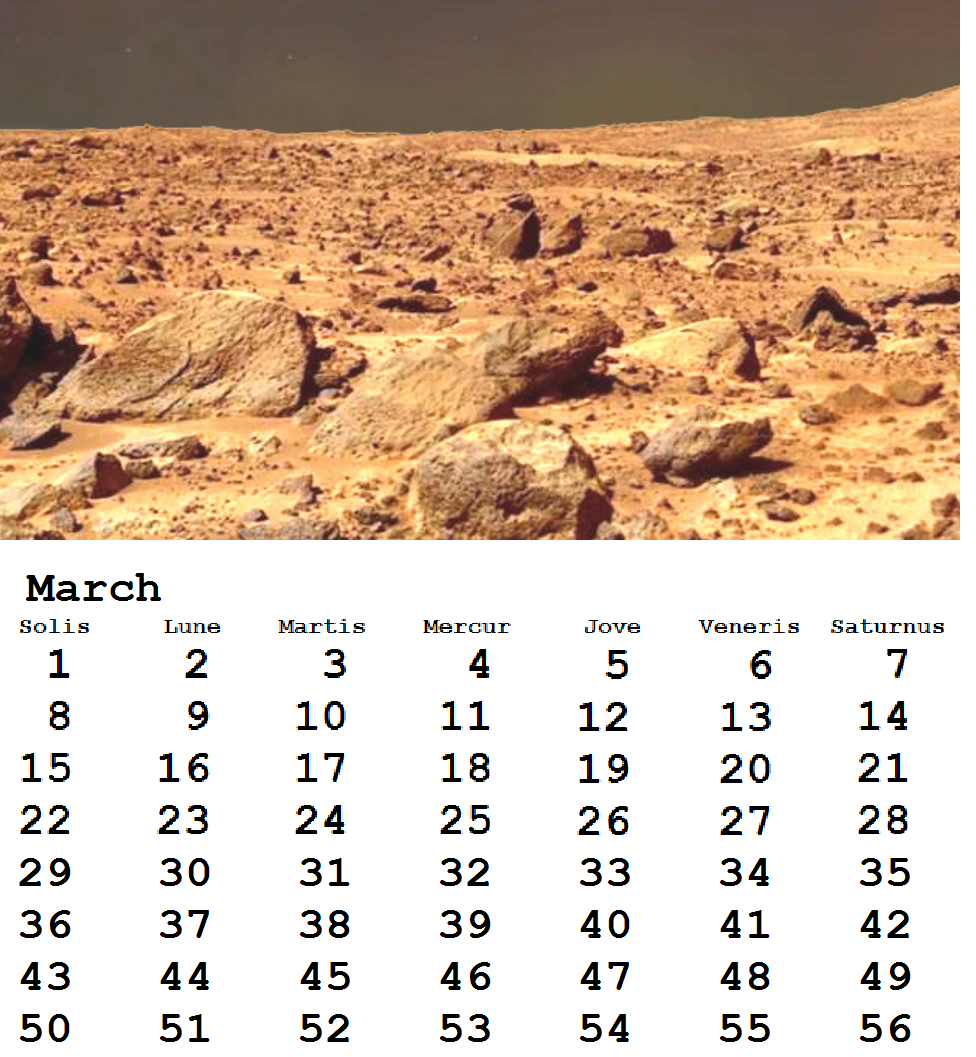
This is the Martian Month of March, the spring Equinox is set on March 20, same as on Earth Calendars. Having more days provides more balance between Month and picture. What do you think? This is also closer to the calendar Zubrin proposed, but I prefer not to name the months after astrological signs.
#618 Re: Martian Politics and Economy » Martian Calender - I have created a martian calender... » 2016-10-21 23:37:36
This is based on the Darrian Calendar:
https://en.wikipedia.org/wiki/Darian_calendar
Here is the first month of my Mars Calendar, this one is designed to hang on the wall and above is a picture of Mars or about Mars.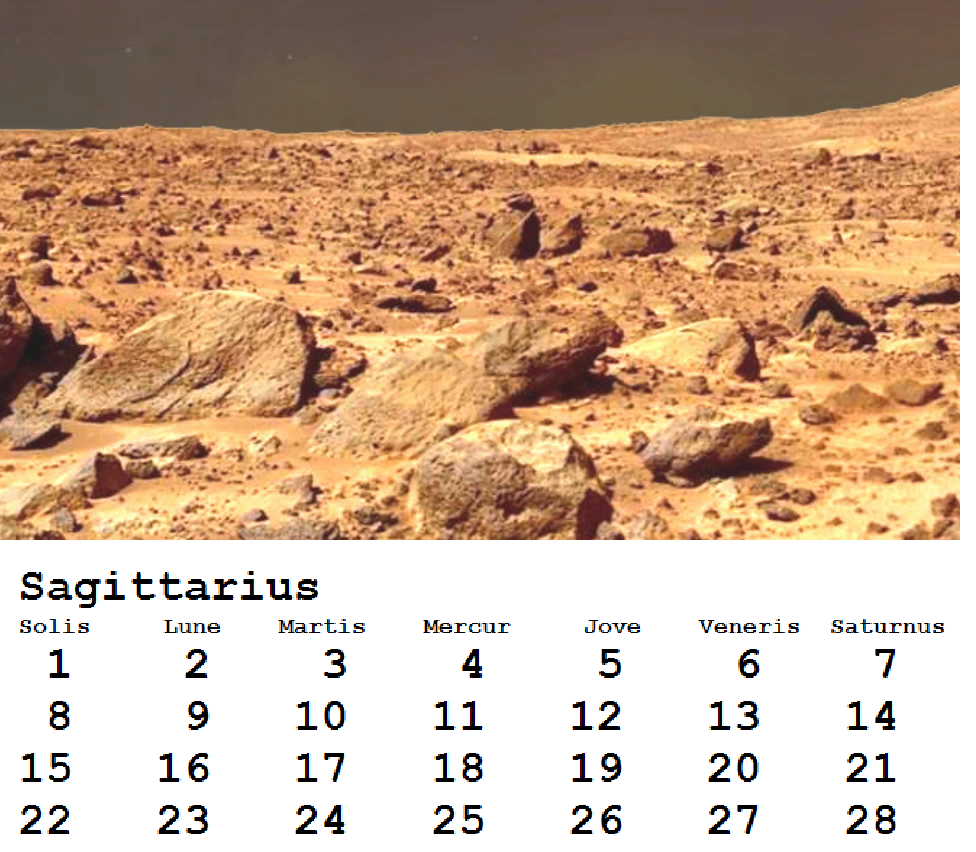
#619 Re: Terraformation » Plutoids and Rogue Planets, Titanformation process, a cold treasure? » 2016-10-21 22:10:24
I think Titan may be a special case. Its escape velocity is 2.3 times greater than Pluto. Even at Titan temperatures, Pluto would lose atmosphere quite rapidly. I do not know what the half life of a 1 bar atmosphere would be, but to produce a 1 bar surface pressure, the column density would need to be ~20x greater than Earths. At such reduced gravity, the scale height would be many times greater than Earth's and the atmosphere would extend a long way out into space. The higher you go, the lower the local escape velocity and Pluto's surface Ve is only 1200m/s.
Thats not to say that Plutoids wouldn't have their own advantages. The abundance of nitrogen ice would provide an excellent heat sink. And any atmospheric pressure at all reduces the difficulty of building a habitat. If a body is dominated by water ice, then habitats could be constructed within ice covered lakes. An atmospheric pressure of 1KPa would be sufficient to suppress evaporation at 0C. Under Pluto gravity, 160m of water would produce a 1bar pressure. Under Sedna gravity, roughly twice that depth would be needed. Pluto may be problematic as its entire crust is dominated by frozen nitrogen, although there are sizable inclusions of water ice floating on the nitrogen crust.
What if you turned Pluto inside out?
Here is a variation of my artificial world idea:
the outer cylinder definitely rotates once every 90 minutes to produce 1-g
the inner optical cylinder might or might not rotate, it is separate from the outer cylinder, it does not need to have gravity, and probably would be easier to build and maintain if it did not. There is a gap between the walls and the inner cylinder, large enough to fly a spaceship through if desired!
The Solar Flux tube is the source of illumination, and at the bottom of this illustration is the fusion reactor that powers it. The fuel tank storage is not shown in this diagram, as this is not a spaceship, the fuel could be stored anywhere and delivered to the fusion reactor as needed. To a person standing on the floor of this cylinder, it would almost appear that he was standing on the surface of a planet, the sky above would be blue, the Sun would appear to rise in the east and set in he west, there would be stars in the night sky. The horizon would be indistinct and a blur if you looked north and south, and the surface would appear to curve upward, to meet a sharper sky horizon as you looked east and west. As you walked further from the equator of the cylinder, the sky would produce an image of the Sun that reaches its zenith lower above the horizon, days would get longer in the summer and shorter in the winter the further north or south you walked away from the equator. if the landscape was rugged, the horizon would be the peaks of mountains and hills in the distance, and the view would be indistinguishable from an Earthly landscape.
#620 Re: Terraformation » Titan Terraformation - Is it possible? » 2016-10-21 08:06:32
Hydrocarbons could be turned into other hydrocarbons which are solid at room temperature.
#621 Re: Terraformation » Artificial Suns and how to make them » 2016-10-20 09:14:18
Yeah.
Like massive maglev bearing.
But I have no idea how to calculate the structure: how thick/massive the non-moving 'topobase' to be etc.
What are the limits?
What if you used tungsten? That is a very dense material, and since weight is not a consideration, I wonder how strong tungsten cables would be? The density of Tungsten is
19.25 g/cm3 or 19.25 tons per cubic meter, it is a very dense material and very tough, We can excavate tunnels within the hull of the cylinder and form ribs that are out of the way. One can have exits and airlocks between the ribs if one wants direct access to space through the floor.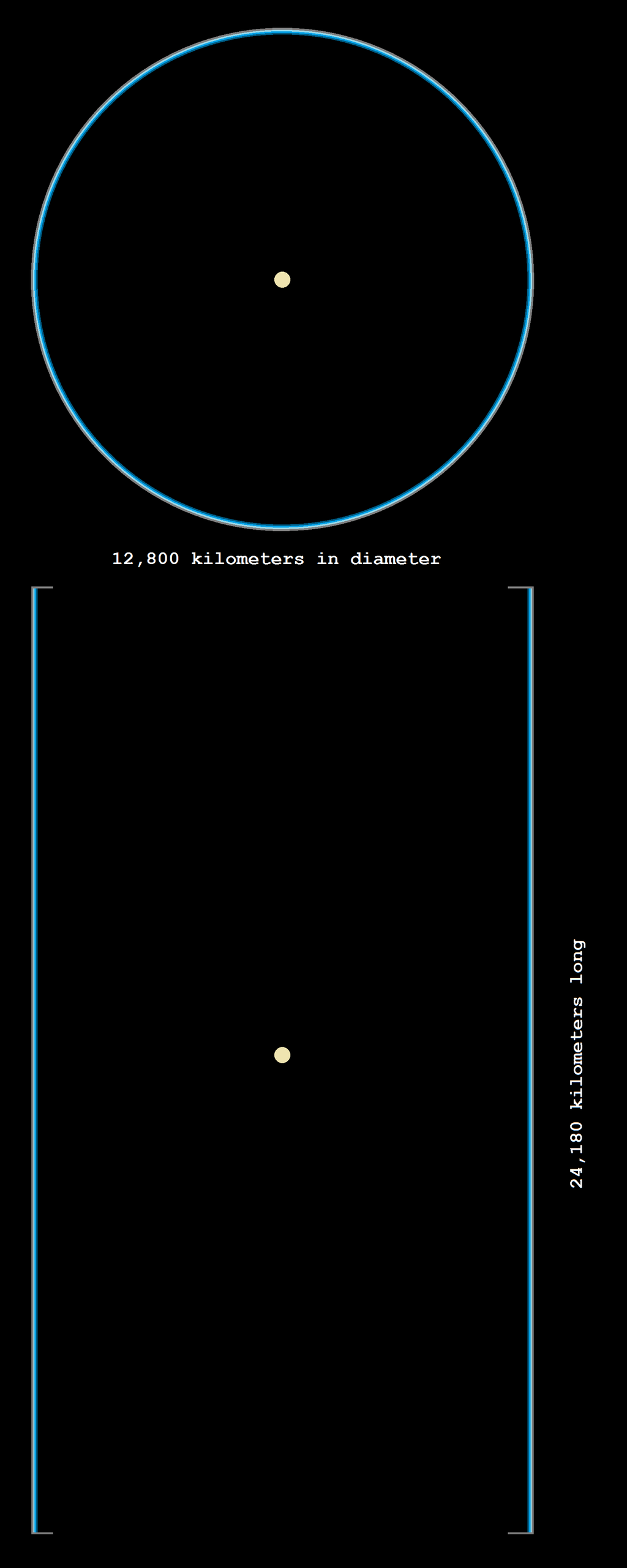
#622 Re: Terraformation » Artificial Suns and how to make them » 2016-10-20 09:05:49
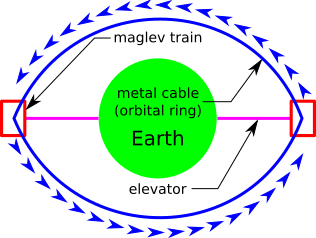
The trick is how do you build it? The International Space Station orbits at 400 kilometers above the Earth's surface. Not the idea appears to be to build two space elevators on opposite ends of the Earth. Preferably over the equator.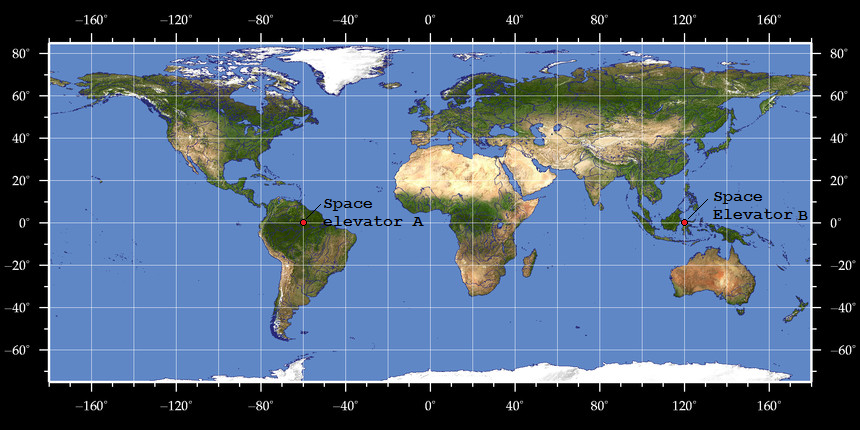
Here are two locations at opposite ends of the Earth where such elevators may be located. coincidently, its hard to find two such areas along the equator that are also on dry land, there are probably the best locations for these elevators. Now if the elevators are to be 400 kilometers high, we need a belt that is in orbit at an altitude that is 400 km above the equator, that also means it has a radius of 400 km + 6400 km = 6800 km, the circumference of the belt would thus be 2 * 6800 km * Pi = 42,725.66 km. If we assign a mass of 10 kg per meter then 1 kilometer would have a mass of 10 metric tons, the entire belt would thus have a mass of 427,256.6 metric tons. this belt would support two space elevators at opposite ends of the Earth. I suppose this would be useful for Venus and other bodies that don't rotate much. You could do this with Saturn, it would be a much bigger belt of course, and there is ring material to work with Two tethers can dip into Saturn's atmosphere One can dangle a colony from each of these tethers. You could probably suck in hydrogen and use it to power your fusion reactors.
#623 Re: Terraformation » Artificial Suns and how to make them » 2016-10-19 22:29:55
Tom,
From.:
<<<
DISTANT STAR
The Electronic Magazine of the Living Universe Foundation
January 15, 2001
The Use of Nanofibers in Space Construction
The Highest Home: Super Colonies and the Ultimate Human Habitat
By Eric Hunting
>>>A colony structure like this would be easier to build if one could eliminate the mirrors and windows. This could be done by replacing the windows with a big optical diffuser running down the core of the cylinder. This would be made from ultra-light holographic membrane. A relatively small window in one end cap could provide entry for light collected by a much larger Sun-facing, non-rotating solar collector mirror in the manner of a Cassegranian teoptics telescope
orrrr, focused light from any source.
BUT, I think your tube is too wide, to structurally tolerate 1G inner-surface centrifugal force.
from.: http://www.orionsarm.com/fm_store/CEMS% … t%20...pdf
pages 6 & 7
6.1 Rotating Space Habitats
Suitable locations for space colonies include orbits around the Earth-Moon Lagrange points. Consider a large
fat cylinder rotating on its axis (Fig 6.2); a landscape of seas, plains and mountains girdles it within, while
sunlight, reflected from external mirrors, enters through the end caps.
Paper read to BIS/CEMS Syposium "Bringing Worlds to Life" at Birkbe... http://www.paulbirch.net/CustomPlanets.html
8 of 16 10/27/2006 11:09 PM
The total mass of the habitat works out at around 40 tonnes per square metre of habitable land, more or less
equally divided amongst atmosphere, crust, geosphere base and toposphere (Fig 6.3).
The geosphere base uses a low-density fractal architecture to keep the structural mass low, slotted together
out of strong but readily available fractal blocks of fused rock (Fig 6.4). This is a constructional technique
equally suitable for supramundane planets and rotating space habitats; it provides strength in tension as well
as compression whereas normal masonry construction only has strength in compression.
The maximum size of conventional rotating space colonies is determined largely by the strength of available
structural materials. The limit is about 250 km radius for quartz, 1000 km for sapphire, and 2500 km for
diamond. That last case is actually pretty big, a colony equalling the land area of the Earth. Even so, most
conventional space colonies will be considerably smaller than natural planets.
To some extent we can get around the size limit by making colonies longer, because the constraint is on the
radius not the length. An extreme example is the macaroni habitat (Fig 6.5), an ultra-long habitat with a
sunshine tube down the middle, if we loop it all the way round a star the total habitable area may be around
2000 times that of the Earth. And if we stretch a macaroni tube along tramlines between one star and another,
the habitat area becomes something like 100 million Earths. There is sufficient material in the solar system to
construct macaroni habitats thousands of light years long.
Even the largest diamond colony or the longest macaroni habitat is not a planet, though, because planets have
horizons and you live on the outside, whereas space colonies have the outside on the inside!max. 500 km wide for quartz
max. 1000 km wide for sapphire
max. 5000 km wide for carbon
You are forgetting that the whole structure doesn't have to rotate, those parts that have no rotation have no weight, but they still have tensile strength.
Now imagine either the train or the track is rotating, but not both. Whatever is not rotating has no weight because it is not subject to centrifugal force, lets suppose it is the track that is not rotating, and lets bend both the track and the train into a circle. the train goes round and round in a circle on the inside of the track, the track stays put. The track supports the train and bends its path into a circle. Since the track does not have to support its own weight, it can easily support the weight of the train, if the train weighs too much for the track to support, you simply make the track thicker, with the increased thickness of the track you get greater tensile strength at no cost in extra weight.
So lets say the track is made out of carbon, if it is rotating to produce 1-g it can support its own weight up to 5000 km. Lay out a track of sufficient thickness that forms a circle 12,800 km in radius, then on the inside you have a cylinder that is slightly less than that it radius, the track supports the weight of the cylinder spinning once every 90 minutes. You can create a ribcage of 12,800 km wide circular tracks, you could even embed them within the hull structure of the cylinder so the tracks are neither visible from the outside or the inside. If you look at it from the outside, it appears to be a single object that is rotating as a piece in space. The tracks are buried within the thickness of the hull within evacuated tunnels.
#624 Re: Terraformation » Titan Terraformation - Is it possible? » 2016-10-19 07:55:55
Now we get to the idea of terraforming Saturn. Saturn has a rotational period of 10.2336 hours, it has gravity nearly equal to Earth, and at some latitudes, exactly equal to the Earth due to the planet's rotation, and I don't think that could be said for any other planet in the Solar System. So we build an artificial sun, place it in orbit around Saturn in the direction of the planet's rotation. So Saturn rotates 360 degrees in 10.2336 hours, so how many degrees will it rotate in 24 hours? 24*360/10.2336=844.2777 degrees Subtract 360 degrees from that, and we need an object which orbits 484.2777 degrees in a 24 hour period, from the "surface" of Saturn, this Sun will appear to rise, set, and rise again in 24 hours, its distance would be defined by its orbital period. So if this Sun requires 24 hours to orbit 484.2777 degrees, its actual orbit period would be 360*24/484.2777=17.841 hours for an orbit. This orbit's radius would be 158,300 km, about the orbit distance of Epimetheus which is about 138 km in diameter. Clearly not big enough for this job. We need to generate 95.181 times the sunlight tat falls on the Earth to cover Saturn, we need an object that is large enough to appear the size of the Sun seen from Earth, how big would that be? The Sun is 150,000,000 km from Earth, and the orbit in question is 1000 times closer to Saturn. Since our Sun is 1,391,400 km in diameter, our artificial Sun will have to be 1,400 km in diameter to appear about the same size as our Sun. It seems that Rhea will do as it is 1530 km in diameter.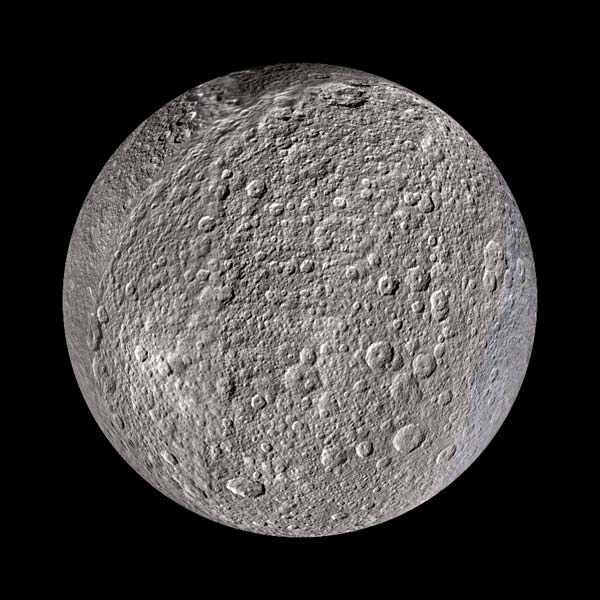
This is Rhea, looks round enough, it is bigger than we need, and this is good, since we are going to move it closer to Saturn and heat it up to the temperature of the Surface of the Sun, much of it is water ice, strip off the hydrogen and use it to fuel a fusion reactor. Heat up the rest of rhea to incandescence, and we have ourselves a Sun for Saturn, which at the distance of 158,300 km rises and sets on a 24-hour schedule.
#625 Re: Terraformation » Artificial Suns and how to make them » 2016-10-18 15:10:40
So what would you put here?
this is a complete artificial world, basically a giant O'Neill cylinder the size of but not the mass of the Earth. I think it might need some counter-rotated buttress bands to augment the tensile strength of the hull. Lots of carbon in diamond or nanotube form to hold it together. It rotates once every 90 minutes, the atmosphere piles up against the hull due to rotation, The walls at the edges are 500 km high to retain atmosphere, the rest is open to space. that ball in the center I estimate would be about 200 km in diameter to appear the same size as the Sun at the substellar point, the further you move towards the ends, the lower the angle of the Sun, and also the smaller the Sun appears because it actually is farther away. My feeling is you might want to draw a smaller cylindrical shade around this Sun for night, and also the night shade contains lasers or some other heating device to heat up the Sun for the next day. Maybe there is a long rod connecting the shade to a power planet or a very large solar power station. the Cylinders are maneuvered to keep the Sun in the center, as it isn't attached to anything. My choice would be to have the artificial sun at the same temperature as the surface of the real Sun. Tungsten is a liquid at this temperature, so if it won't hold a shape, it will at least hold a volume in the shape of a ball of liquid metal. I don't believe carbon liquefies in vacuum but Tungsten does. At a lower temperature, you can have a glowing solid. 15,000 - 27,000 K seems extremely hot, maybe a Type B star perhaps I wonder how an LCD screen have the same temperature as the Sun's surface.