New Mars Forums
You are not logged in.
- Topics: Active | Unanswered
Announcement
#526 Re: Exploration to Settlement Creation » WIKI Project Designing for Mars » 2026-01-12 09:38:00
Scientists and engineers have proposed several methods and "equipment" concepts for making bricks on Mars using local resources (in-situ resource utilization), primarily Martian regolith (soil). A key discovery is that simple compression, without binders or heat, can create bricks stronger than steel-reinforced concrete.
Proposed Equipment and Methods
Since transporting all construction materials from Earth would be prohibitively expensive, research focuses on using the iron oxide-rich Martian soil itself.
High-Pressure Mechanical Press/Hammer:
The most promising method uses sheer pressure. Researchers at UC San Diego accidentally discovered that by enclosing Mars simulant in a flexible container (like a rubber tube) and applying high pressure, they could form solid, strong pellets which can be cut into brick shapes. The necessary "equipment" could be a robotic, high-pressure compacting device or even a simple hammering mechanism operated by future astronauts.
3D Printing Systems:
This is a major focus of ongoing research.
Regolith melting: One idea involves melting the regolith with lasers or focused solar energy and pouring it into molds, though this requires significant energy.
Binder extrusion:
Regolith could be mixed with a binder (polymer or even human-derived materials like blood plasma protein or urea) and extruded through a 3D printer to build structures autonomously.
Kilns/Furnaces:
Early proposals suggested using a nuclear-powered or solar furnace to bake the bricks, similar to ancient Earth methods. This method would require a significant power source and complex equipment to capture any released water for reuse.
The equipment needed to create hot sulfur regolith bricks for Martian in-situ buildings involves machinery for excavation, processing, mixing, heating, and molding the materials. A 1200°C kiln is used for sintering processes with other potential binders, but for sulfur concrete, the required temperature is much lower (around 120°C to melt the sulfur).
Materials Acquisition & Processing
Excavation and Sifting Equipment:
Robotic excavators or rovers with digging mechanisms to collect the Martian regolith. Sifting or refining machinery may be needed to achieve the optimal particle size distribution for the aggregate.
Sulfur Extraction and Refining Unit:
A chemical processing plant to extract elemental sulfur from Martian sources (sulfides/sulfates), likely involving high-temperature oxidation and reduction processes.
Storage Tanks/Hoppers:
Secure storage for both the raw regolith powder and the extracted, refined sulfur (solid and liquid).
Brick Production & Molding
Heated Mixer (e.g., Pugmill or Drum Mixer): An industrial mixer capable of hot-mixing the dry regolith aggregate with molten sulfur (liquid at ~120°C). The mixer must have robust seals to handle the abrasive dust and potentially a controlled atmosphere (CO₂-rich).
Heating System/Kiln:
While a 1200°C kiln is used for other methods like sintering, sulfur bricks only need a melting temperature of around 120°C. This heating could be powered by a solar furnace or a nuclear reactor's waste heat. The system needs precise temperature control to prevent boiling and ensure uniform heating.
Molding/Casting System:
Molds (potentially made from 3D printed durable thermoplastics like PEEK or metal) or a robotic extrusion system (like a 3D printer) to form the liquid mixture into desired brick shapes.
Curing Area:
A controlled environment where the bricks can cool and solidify (harden through physical crystallization, not hydration).
Power Supply:
A robust, reliable power source (e.g., solar panels with battery storage or a fission reactor) capable of powering all machinery autonomously.
Ancillary and Support Equipment
Autonomous Robotic Systems:
The entire process is envisioned to be highly automated due to limited human labor on Mars.
Dust Mitigation Systems:
Given the pervasive, fine nature of regolith dust, equipment must incorporate advanced seals and filtration to prevent damage and contamination.
Quality Control and Testing Apparatus:
Equipment to test the compressive and flexural strength of the final bricks to ensure they meet structural requirements.
Thermal Management Systems:
Equipment to manage the significant temperature variations and maintain consistent operating temperatures
Biomaterial Production Systems: Emerging research involves using synthetic biology, like engineered lichens or bacteria, to create a self-growing, concrete-like material from the Martian soil. This would require specialized bioreactor equipment and the necessary organic inputs.
Key Advantage
The simple, no-bake, no-binder method using a mechanical press is a leading candidate because it requires the least amount of complex machinery, energy, and additional materials transported from Earth, making it highly practical for initial manned missions
While no operational 3 m diameter TBM specifically for Mars currently exists, the development of such equipment is a key concept in proposed strategies for establishing a Martian colony.
Current Status of Mars Tunneling Equipment
Conceptual Stage:
Current discussions revolve around the concept of using tunneling technology for Mars habitats, providing protection from cosmic radiation and micrometeorites, and leveraging the thermal stability of the subsurface.
Earth-based Prototypes:
Companies like The Boring Company (TBC) are developing advanced, all-electric Tunnel Boring Machines (TBMs) for Earth-based projects (e.g., the Prufrock series, which creates a tunnel approximately 3.7m/12ft in diameter).
Technology Transfer:
While TBC's current machines are unlikely to be deployed on Mars without significant modification, the technology and engineering experience gained (such as automation and faster boring speeds) are seen as foundational for developing future off-world systems.
Prototype Drills:
Research has been conducted on smaller-scale "3-meter-class Mars drill prototypes" for scientific exploration of the shallow subsurface, but these are for drilling, not large-scale tunneling for habitats.
Transportability:
A 3m-class TBM (or its segments) is considered potentially transportable by a SpaceX Starship, which has an 8m diameter cargo bay.
Key Challenges for Martian TBMs
Atmosphere:
Earth TBMs use significant amounts of water for cooling and other operations, which would be a major challenge in Mars's cold, near-vacuum atmosphere.
Automation:
Due to communication delays and the need for efficient pre-human construction, Martian equipment would require a high degree of automation and robotic operation.
Geology & Materials:
The machines would need to be adapted to Mars's unique rock and soil conditions. Also, instead of concrete segments (which are heavy to transport), innovative methods like sintering the excavated rock or using local materials for tunnel lining would be necessary.
In short, 3 m diameter equipment for Mars is an active area of conceptual development and technological aspiration, leveraging Earth-based innovations, but is not yet a developed or deployed product.
#528 Re: Science, Technology, and Astronomy » Manufacturing in Space » 2026-01-11 19:16:51
That's good as I recall the first crystal formation failed to get purity due to the vibrations within the ship.
#529 Re: Human missions » Starship is Go... » 2026-01-11 19:10:23
Why Elon Musk now says it would be a 'distraction' for SpaceX to go to Mars this year
SpaceX is unlikely to attempt a Mars mission in 2026 after all, according to CEO Elon Musk, marking a setback in his plans to colonize the planet.
“It would be a low-probability shot and somewhat of a distraction,” Musk told entrepreneur Peter Diamandis in a podcast recorded in late December and published this week.
In September 2024, Musk discussed SpaceX’s plans to send an uncrewed Starship rocket to Mars this coming year. At the time, Musk said the mission would test how reliably SpaceX could land its vehicles on the planet’s surface. If things went well, he estimated SpaceX could send crewed missions as soon as 2028.But Musk has dialed back his optimism over the past year. In May, he gave his company a 50% chance of being ready for a launch in late 2026, which would coincide with a narrow window that occurs every two years when Mars and Earth align. A few months later, he said the uncrewed flight would “most likely” happen in 2029.
August 2025, Musk said there was a “slight chance” of a Starship flight to Mars in November or December 2026 crewed by Optimus, the humanoid robots being developed by Tesla “A lot needs to go right for that.”
A mission to Mars hinges on SpaceX being capable of refueling Starship’s upper stage in orbit, a complicated task that Musk told Diamandis could be achieved toward the end of 2026. Accomplishing orbital refueling is also crucial for SpaceX to complete a recently reopened contract to carry NASA astronauts to the moon.
SpaceX was on track to demonstrate its process — which involves launching tanker versions of Starship into orbit — in 2025, a NASA official said the year before. But the company missed that target and now plans to attempt its first orbital-refueling demonstration between Starship vehicles in June, according to internal documents viewed by Politico.
SpaceX, which is now developing the third generation of the reusable 404-foot Starship rocket, has also had difficulty testing its vehicle. Its first three flights of 2025 were failures, while the remaining two launch attempts were much more successful. The next iteration of Starship will be a “massive upgrade” over its predecessor, Musk has said.SpaceX was on track to demonstrate its process — which involves launching tanker versions of Starship into orbit — in 2025, a NASA official said the year before. But the company missed that target and now plans to attempt its first orbital-refueling demonstration between Starship vehicles in June, according to internal documents viewed by Politico.
SpaceX, which is now developing the third generation of the reusable 404-foot Starship rocket, has also had difficulty testing its vehicle. Its first three flights of 2025 were failures, while the remaining two launch attempts were much more successful. The next iteration of Starship will be a “massive upgrade” over its predecessor, Musk has said.
In addition to preparing for Mars and lunar missions, SpaceX dominates the commercial launch industry and runs a successful satellite-internet business. It plans to go public later this year in what could be a record-breaking listing that could help fund its plans for Starship as well as for space-based data centers.
Although SpaceX probably won’t be headed to the red planet in 2026, twin spacecraft will make the journey this year. Blue and Gold, a pair of satellites developed by Rocket Lab were launched into space last November by Amazon founder Jeff Bezos’s Blue Origin to fulfill NASA’s Escapade mission.
The spacecraft are expected to attempt a trans-Mars injection engine burn in November 2026 and arrive at the planet in September of next year, according to NASA. The satellites will be operated by the Space Sciences Laboratory at the University of California, Berkeley, and will gather data that could help humans land on or even settle Mars.
This guy might be the first
#530 Re: Exploration to Settlement Creation » WIKI Starship repurposed to make or build what we need » 2026-01-11 18:53:11
A 100-meter diameter, 20-meter or taller 304L stainless steel dome with a 3-meter regolith radiation shield is a highly challenging, but theoretically plausible, conceptual design for a Martian habitat, primarily utilizing in-situ resources for the shielding.
Feasibility and Challenges
The feasibility hinges on several critical engineering and logistical considerations:Radiation Protection: The 3 meters of regolith (Martian soil) is an effective and essential radiation shield against both galactic cosmic rays (GCRs) and solar energetic particles (SEPs). Studies indicate this thickness can significantly reduce radiation exposure to safe levels for long-term habitation.
Structural Integrity: The primary structural challenge on Mars is not external loads like wind (which are minor) but the immense outward pressure from maintaining an Earth-like internal atmosphere. This places the dome under significant tensile stress. While 304L stainless steel is a suitable material with known tensile strength properties at low temperatures, a structure of this size would require substantial engineering to manage these forces.
Construction Logistics: Transporting the vast amount of steel required from Earth to Mars would be prohibitively expensive and logistically impossible with current technology. The construction would necessitate advanced robotic systems and require developing in-situ resource utilization (ISRU) capabilities to extract and refine steel from available Martian resources (e.g., meteoritic iron, or processed ore). NASA's MMPACT (Moon-to-Mars Planetary Autonomous Construction Technology) project is actively researching such methods.
Regolith Management: Moving the estimated millions of tonnes of regolith needed for the shield is a massive undertaking, requiring specialized heavy-duty robotic equipment and significant power infrastructure.
Sealing and Atmosphere Retention: The dome must be hermetically sealed to prevent catastrophic air loss, a major engineering hurdle. The pressure differential is several orders of magnitude greater than that of inflatable domes on Earth.
Thermal Stress: Mars experiences extreme temperature variations, which would induce significant thermo-elastic loads on metallic structural members, a factor that requires careful design consideration.
In summary, while the design addresses a critical need for radiation shielding, its realization depends entirely on developing robust, autonomous, and large-scale manufacturing and construction capabilities on Mars, a goal of ongoing research and development efforts
#531 Re: Meta New Mars » Housekeeping » 2026-01-11 18:30:35
DreamHost experienced a major Denial of Service (DoS/DDoS) attack targeting its DNS servers in August 2017, which caused widespread outages for many of its customers' websites, including the Newmars forum. The attack overwhelmed DreamHost's infrastructure, making websites inaccessible by preventing them from resolving their IP addresses.
Details of the Incident
Nature of the Attack: The attacks were a large-scale Distributed Denial of Service (DDoS), which is designed to knock websites offline by overloading servers with malicious traffic.
Target: The primary targets were DreamHost's DNS (Domain Name System) servers (ns1, ns2, and ns3.dreamhost.com), which are essential for directing internet traffic to the correct websites.
Impact on Newmars Forum: As the Newmars forum likely used DreamHost's DNS services, it was one of the many sites affected by the resulting downtime.
DreamHost's Response: DreamHost acknowledged the powerful DDoS attack and worked to mitigate the issue. The company's acceptable use policy explicitly prohibits any activity that results in their servers becoming the target of a DoS attack.
Current Status
The 2017 incident was resolved a short time after it occurred. If you are experiencing current issues with the Newmars forum, it is recommended to check the DreamHost Status page for any ongoing incidents
he query refers to a specific discussion or incident on a forum related to the "New Mars Image Server" and a potential phpBB3 denial of service issue at DreamHost.
Based on search results, the issue appears to be a forum-specific problem where bots/crawlers caused high server load, which the site administrator addressed by blacklisting IP addresses, rather than a large-scale attack on DreamHost's infrastructure. DreamHost has, however, experienced large-scale, unrelated DDoS attacks targeting their DNS servers in the past (e.g., in August 2017).
Details of the Incident
Nature of the Issue: The problem at the "New Mars Image Server" (newmars.com) was likely caused by automated bots or scrapers, rather than a malicious, coordinated denial-of-service attack. These bots generated excessive traffic and server load by repeatedly requesting non-existent files or creating new sessions, leading to service interruptions.
Mitigation: The forum administrator implemented a fix by identifying specific bot user-agent strings and blacklisting problematic IP addresses, which successfully stopped the issue. They also discussed implementing Q&A CAPTCHAs to prevent spam registrations and closing the board during maintenance as prevention methods.
DreamHost's Stance: DreamHost prohibits all forms of denial of service attacks and related activities under its Acceptable Use Policy. If abuse is detected, they may take action to secure the account, including suspension or termination of service.
General Guidance
If you are experiencing similar issues on a phpBB board hosted by DreamHost:
Check logs: Review your access logs for unusual activity, especially repetitive requests from specific IP addresses or abnormal user-agent strings.
Configure phpBB settings: Utilize phpBB's built-in spam prevention tools, such as Q&A CAPTCHAs, and configure spider/robot settings to handle legitimate bots efficiently.
Update software: Ensure your phpBB installation, themes, and any plugins are kept up to date to patch known vulnerabilities that could be exploited to cause a DoS.
Contact Support: If you suspect an ongoing attack affecting your server performance, you should contact DreamHost support immediately. They can help identify the cause and potentially whitelist ModSecurity rules or apply server-level mitigation if necessary
#532 Re: Meta New Mars » Housekeeping » 2026-01-11 18:26:31
Denial of service?
A website crash due to "too many connections" in the log file typically means your database server has reached its maximum connection limit. This can be caused by unoptimized code, connection leaks, or a sudden spike in traffic.
Here are the steps to diagnose and resolve the issue:
Immediate Stabilization
Restart the Application/Database Server: The quickest way to clear all current connections and restore service is to restart your web application or database server. This immediately closes all existing connections.
Manually Kill Idle Connections: If you have administrative access (e.g., via the MySQL command line), you can connect and terminate "sleeping" or idle processes.Log in to MySQL: mysql -u root -p
View active connections: SHOW PROCESSLIST;
Kill specific connections: KILL <process_id>; (replace <process_id> with the actual ID from the list)
Temporarily Increase the Connection Limit: To prevent the crash from recurring immediately, you can temporarily increase the max_connections variable.
In the MySQL client, run: SET GLOBAL max_connections = [desired new number];
This is a temporary fix and will revert on the next server restart unless made permanent in the configuration file.Long-Term Solutions
Identify the Root Cause: The primary goal is to determine why so many connections are being opened or staying open.
Check logs for slow queries: Use the SHOW PROCESSLIST; command to identify any long-running queries that are tying up connections.
Enable the slow query log in your MySQL configuration file to help pinpoint inefficient queries.Optimize Application Code and Queries:
Ensure connections close properly: Verify your application code closes database connections after use. Many modern frameworks and languages have features like context managers (Python) or specific close functions ($conn->close() in PHP) to handle this.
Use connection pooling: Implement a connection pool in your application. This reuses a set number of open connections instead of opening a new one for every request, which is much more efficient.Adjust Server Configuration (Permanently):
Edit your MySQL configuration file (commonly /etc/my.cnf or /etc/mysql/my.cnf).
Under the [mysqld] section, add or update the max_connections line: max_connections=[new value].
Consider reducing the wait_timeout setting to automatically close idle connections more quickly (e.g., to 300 seconds or 5 minutes, down from the default 8 hours).Restart the MySQL service for these changes to take permanent effect.
Monitor and Scale:
Set up monitoring tools (e.g., Nagios, Prometheus) to track connection usage, CPU/memory usage, and other performance metrics.
If you consistently experience high traffic and the above optimizations aren't enough, you may have outgrown your current hosting plan (e.g., shared hosting) and should consider upgrading to a Virtual Private Server (VPS) or a dedicated server, or implementing load balancing.
Use a Content Delivery Network (CDN) to offload static assets (images, CSS, JS), which reduces the load on your primary server
#533 Re: Exploration to Settlement Creation » WIKI Project Designing for Mars » 2026-01-11 16:28:55
Objective
Produce 2,300,000 kg of stainless steel on Mars from regolith, using equipment delivered from Earth, and estimate equipment mass and power needs.
High-level production chain
[]1. Regolith mining & hauling – dig and move ore-bearing regolith
[]2. Crushing & grinding – reduce to fine particles
[]3. Beneficiation – concentrate iron-bearing fraction
[]4. Chemical reduction – convert oxides to metallic iron
[]5. Alloying & melting – add Cr/Ni, refine to stainless
[]6. Casting & forming – ingots, beams, plates, structural members7. Power, gases & thermal control – keep everything running continuously
Throughput assumptions
[]Target steel mass: 2,300,000 kg
[]Campaign duration: ~5 years of operation
[]Steel per year: ~460,000 kg/year (~460 t/year)
[]Steel per day (operational): ~1,300 kg/day (assuming ~350 days/year uptime)
Regolith and ore requirements
Assume:
[]Effective Fe-bearing fraction in processed regolith: ~15%
[]Overall recovery to usable iron: ~50–60%
[]Net iron yield from regolith: ~8–9% by mass
[]Stainless steel composition: mostly Fe, with Cr/Ni/Mn partly imported from Earth (or from richer local ores later)
Approximate regolith mass needed per kg of stainless steel:
[]Regolith per kg steel: ~7–8 kg/kg steel (iron from regolith + imported alloying elements)
[]Total regolith for 2,300,000 kg steel: ~16,000,000–18,000,000 kg (16,000–18,000 t)
[]Regolith per year: ~3,200–3,600 t/year
[]Regolith per day: ~9–11 t/day
This is a modest daily tonnage by terrestrial mining standards, but on Mars it still demands robust, autonomous equipment.
Energy and power budget (order-of-magnitude)
Primary steelmaking on Earth typically consumes on the order of 20–35 MJ/kg of steel (mining + beneficiation + reduction + melting). Mars will be less efficient at first, so assume:
Specific energy for Mars stainless steel: ~25–40 MJ/kg steel (including overheads)
For 2,300,000 kg of steel:
[]Total energy: ~58,000,000–92,000,000 MJ
[]In joules: ~5.8×10¹³–9.2×10¹³ J
Spread over 5 years of operation:
[]Seconds in 5 years (approx): ~1.6×10^8 s
[]Average continuous power: ~360–580 kW (ideal)With inefficiencies, downtime, and margins: design for ~2–3 MW continuous electrical + substantial thermal handling
Equipment breakdown: mass and power (delivered from Earth)
All masses are dry hardware masses, not including packaging; add ~20–30% for shipping overhead when planning cargo.
[]1. Regolith mining & hauling system
[]Function: Excavate ~10 t/day of ore-bearing regolith, transport to plant
[]Elements: 3–4 autonomous electric loaders, small dozers, haulers, maintenance shelter
[]Mass (hardware): ~40–60 tPower (peak while operating): ~150–250 kW
[]2. Crushing & grinding
[]Function: Jaw crusher + ball/rod mill to reduce regolith to fine powder
[]Mass: ~15–25 t
[]Power: ~200–300 kW
[]3. Beneficiation & separation
[]Function: Magnetic separation, density separation, dust handling, feed hoppers
[]Mass: ~25–40 t
[]Power: ~300–400 kW
[]4. Chemical reduction furnaces
[]Function: Reduce iron oxides to metallic iron (e.g. hydrogen or CO-based direct reduction, or carbothermal)
[]Hardware: One or two shaft/rotary furnaces, preheaters, gas recirculation, refractory linings
[]Mass: ~60–100 tPower (electrical + thermal equivalent): ~800–1,200 kW
[]5. Alloying, melting & refining
[]Function: Electric arc or induction furnace to melt iron, add Cr/Ni/Mn, refine to stainless
[]Mass: ~30–50 t
[]Power: ~400–700 kW (high peak, lower average with batching)
[]6. Casting, rolling & forming
[]Function: Continuous or batch casting, rolling mill for beams/plates, cutting and shaping
[]Mass: ~40–70 t
[]Power: ~300–500 kW
[]7. Process gases & consumables production
[]Function: ISRU plant for H2, CO, O2 (electrolysis, Sabatier/Reverse Water Gas Shift), water handling
[]Mass: ~50–80 t
[]Power: ~400–600 kW
[]8. Power generation & storage
[]Option A – Nuclear:
[]Type: Modular fission reactors totaling ~3–4 MWe
[]Mass (reactors + radiators + shielding): ~150–250 t
[]Option B – Solar + storage (harder on Mars):
[]Array size: ~25–35 MWp (to cover night, dust, and storage losses)
Mass (panels, structure, batteries/flywheels): ~300–500 t
[]9. Thermal management & radiators
[]Function: Reject waste heat from furnaces, power systems, electronics
Mass: ~30–50 t
[]10. Control, robotics, spares & infrastructure
[]Function: Control rooms, electronics, cabling, structural frames, assembly tools, spare parts, inspection robots
Mass: ~50–80 t
Total equipment mass (hardware only)
[]Process + mining + ISRU + forming: ~310–475 t
[]Power system (nuclear or solar): ~150–500 t (depending on architecture)
[]Thermal + control + spares: ~80–130 t
[]Subtotal hardware: ~540–1,100 tWith packaging, launch adapters, margins (+20–30%): ~650–1,400 t to be delivered from Earth
You can tune this range depending on how aggressive you are with:
[]Automation level: more robots vs. more human labor
[]Power choice: nuclear (lower mass, higher complexity) vs. solar (higher mass, simpler tech)Throughput: longer campaign (lower power) vs. shorter campaign (higher power)
Cargo delivery concept (Earth → Mars)
Assuming a heavy cargo architecture (e.g. multiple large cargo landers or Starship-class vehicles):
[]Total delivered mass for steelmaking complex: ~650–1,400 t
[]Per-cargo-ship mass (if ~100 t landed per flight): ~7–14 cargo flights
[]Staging:[]Wave 1: Power, basic ISRU, initial mining & crushing (~200–300 t)
[]Wave 2: Full beneficiation, reduction furnaces, first melting/casting line (~250–400 t)
[]Wave 3: Expanded rolling/forming, additional power, redundancy, spares (~200–400 t)
Direct answer to your question
For producing ~2,300,000 kg of stainless steel from Mars regolith:
[]Equipment types needed:
[]Mining & hauling robots
[]Crushing & grinding plant
[]Beneficiation/separation line
[]Reduction furnaces
[]Alloying/melting furnaces
[]Casting & rolling/forming line
[]ISRU plant for H2/CO/O2
[]Power generation & storage
[]Thermal management & radiatorsControl, robotics, spares, structural frames
[]Mass per type (typical ranges):
[]Mining & hauling: ~40–60 t
[]Crushing & grinding: ~15–25 t
[]Beneficiation: ~25–40 t
[]Reduction furnaces: ~60–100 t
[]Alloying/melting: ~30–50 t
[]Casting & forming: ~40–70 t
[]ISRU gases plant: ~50–80 t
[]Power system: ~150–500 t
[]Thermal management: ~30–50 tControl & spares: ~50–80 t
[]Power needs:
[]Average continuous process power: ~2–3 MWe (including mining, ISRU, furnaces, forming)
[]Peak process power (melts, startup): up to ~4–5 MWe
[]Total installed generation (with margin): ~3–6 MWe equivalent
without bbcode formating
Objective
Estimate equipment types, mass, and power needed—delivered from Earth—to use Mars regolith to produce about 2,300,000 kg of stainless steel for building structures.
Production scale and material flow
Target steel:
Total stainless steel: 2,300,000 kg
Campaign assumption:
Operating duration: ~5 years
Steel per year: ~460,000 kg/year (~460 t/year)
Steel per operational day (≈350 days/year): ~1,300 kg/day
Regolith requirement (order-of-magnitude):
Effective iron-bearing fraction in processed regolith: ~15%
Overall recovery to usable iron: ~50–60%
Net iron yield from regolith: ~8–9% by mass
Regolith per kg of finished stainless (iron from regolith + imported alloying elements): ~7–8 kg/kg steel
So:
Total regolith processed: ~16,000,000–18,000,000 kg (16,000–18,000 t)
Per year: ~3,200–3,600 t/year
Per day: ~9–11 t/day
Energy and power (order-of-magnitude)
Primary steelmaking on Earth is roughly 20–35 MJ/kg of steel (including mining, reduction, melting). Mars will be less efficient initially, so assume:
Specific energy for Mars stainless steel: ~25–40 MJ/kg
For 2,300,000 kg of steel:
Total energy: ~58,000,000–92,000,000 MJ (≈5.8×10¹³–9.2×10¹³ J)
Spread over 5 years of operation (~1.6×10⁸ seconds):
Ideal average power: ~360–580 kW
With inefficiencies, downtime, and margin: design for roughly 2–3 MW continuous electrical, plus substantial thermal management capacity
Major equipment types, mass, and power
All masses are dry hardware estimates; real cargo planning would add ~20–30% for packaging, structure, and integration.
1. Regolith mining and hauling
Function: Excavate ~10 t/day of ore-bearing regolith and deliver it to the plant
Elements: 3–4 autonomous electric loaders/haulers, small dozer, maintenance shelter
Mass: ~40–60 t
Power (while operating): ~150–250 kW
2. Crushing and grinding
Function: Jaw crusher + mill to reduce regolith to fine powder
Mass: ~15–25 t
Power: ~200–300 kW
3. Beneficiation and separation
Function: Magnetic and/or density separation, dust handling, feed hoppers
Mass: ~25–40 t
Power: ~300–400 kW
4. Chemical reduction furnaces
Function: Reduce iron oxides to metallic iron (e.g., hydrogen or CO-based direct reduction, or carbothermal)
Hardware: One or two shaft/rotary furnaces, preheaters, gas recirculation, refractory linings
Mass: ~60–100 t
Power (electrical plus thermal equivalent): ~800–1,200 kW
5. Alloying, melting, and refining
Function: Electric arc or induction furnace to melt iron, add Cr/Ni/Mn, refine to stainless
Mass: ~30–50 t
Power: ~400–700 kW (high peak, lower average due to batch operation)
6. Casting, rolling, and forming
Function: Casting of ingots/billets, rolling mill for beams/plates, cutting and shaping
Mass: ~40–70 t
Power: ~300–500 kW
7. Process gases and consumables (ISRU)
Function: Produce H₂, CO, and O₂ from Martian resources (water electrolysis, Sabatier/RWGS, gas handling)
Mass: ~50–80 t
Power: ~400–600 kW
8. Power generation and storage
Two broad options:
Option A – Nuclear
Type: Modular fission reactors totaling ~3–4 MWe
Mass (reactors, radiators, shielding, power conditioning): ~150–250 t
Option B – Solar plus storage
Array size: ~25–35 MWp (to cover night, dust storms, and storage losses for a ~2–3 MW average load)
Mass (panels, structure, batteries/flywheels): ~300–500 t
9. Thermal management and radiators
Function: Reject waste heat from furnaces, power systems, and electronics
Mass: ~30–50 t
10. Control systems, robotics, spares, and infrastructure
Function: Control rooms, electronics, cabling, structural frames, assembly tools, inspection/maintenance robots, spare parts
Mass: ~50–80 t
Totals and cargo delivery from Earth
Process, mining, ISRU, and forming equipment:
Mining and hauling: 40–60 t
Crushing and grinding: 15–25 t
Beneficiation: 25–40 t
Reduction furnaces: 60–100 t
Alloying/melting: 30–50 t
Casting and forming: 40–70 t
ISRU gases plant: 50–80 t
Thermal management: 30–50 t
Control, robotics, spares, infrastructure: 50–80 t
Subtotal (process + support): roughly 340–555 t
Power system:
Nuclear option: ~150–250 t
Solar + storage option: ~300–500 t
So:
Total hardware mass (process + power + support): about 500–800 t (nuclear-heavy) up to 650–1,050 t (solar-heavy)
With packaging, structure, and margin (+20–30%): roughly 650–1,400 t delivered from Earth
If a single cargo vehicle can land ~100 t on Mars, you’re looking at on the order of:
About 7–14 dedicated cargo flights to deliver a full stainless-steel production complex capable of producing ~2.3 million kg of stainless steel over ~5 years.
Mars in-situ regolith mining equipment involves robotic excavators (like RASSOR/Razer), drilling/microwave probes for volatiles, and processing units for extracting water, metals (iron/steel), and oxygen, using systems like Solid Oxide Electrolysis Cells (SOEC) (MOXIE heritage) and 3D printing for construction materials, with key technologies focusing on automation, heat recycling, and handling abrasive Martian dust for ISRU (In-Situ Resource Utilization).
Key Equipment & Technologies
Excavation & Collection:
Robotic Excavators/Rovers: Systems like RASSOR 2.0 and Razer use counter-rotating drums or buckets for digging in low gravity, designed for high volume and autonomous operation.
Microwave Probes: Non-excavation method to heat subsurface ice, turning it into vapor for collection, reducing mass/cost of heavy machinery.
Processing & Extraction (ISRU):
Water/Volatiles: Extraction from regolith via microwave sublimation or drilling, followed by purification (membranes, distillation) and electrolysis to produce hydrogen (fuel) and oxygen (life support).
Metals & Oxygen: Systems (like MMOST) use electrolysis and reduction processes (e.g., using H₂/CO) to extract iron, steel, and oxygen from iron oxides in regolith.
Sifting/Refining: Machinery to achieve optimal particle size for construction aggregates, often involving heating and mixing with binders like sulfur.
Manufacturing & Construction:
3D Printers: Use processed regolith (sintered, mixed with binders) to build structures, reducing reliance on Earth-imported materials.
Sulfur Concrete Units: Heated mixers (pugmills) to combine regolith aggregate with molten sulfur (around 120°C) for bricks.
Key Processing Units:
Solid Oxide Electrolysis Cells (SOEC): Efficiently split water and CO₂ into constituent gases (H₂, O₂, CO) for chemical processing.
Heated Mixers/Kilns: For creating construction materials like sulfur concrete or sintering regolith.
Challenges & Considerations
Automation: Mining must be fully robotic and autonomous due to distance and communication delays.
Abrasion: Martian dust is highly abrasive, requiring robust seals and durable components.
Power & Logistics: Requires reliable, renewable power and efficient transport/storage systems.
High-Fidelity Simulants: Accurate testing relies on materials like MGS-1C (clay-rich) and MGS-1S (sulfate-rich) to mimic real Martian conditions.
Example System (Conceptual)
An integrated system might include a Razer excavator, feeding a processing unit that uses SOECs and heat recycling to produce oxygen, water, and metal powders, with a 3D printer using these materials to build habitats.
To build with Mars regolith, milling equipment (like vibratory/planetary ball mills) reduces particle size, while separation methods use techniques like laser sintering, cold sintering (CSP), polymer binders, or microwave systems to bind or melt regolith into structures, often requiring 3D printers for shaping, aiming for materials like bricks, shielding, or metal parts from extracted elements like iron/titanium. Key processes involve size reduction (milling) and consolidation (sintering/binding) to create usable materials like "Mars concrete" or fused components, with focus on robotic, energy-efficient systems.
Milling Equipment & Processes
Ball Milling (Planetary/Vibratory): Used to reduce particle size (PSD) of raw regolith simulant, with planetary mills being faster but roller banks better for large slurries.
Sieving: Separates milled particles into specific size ranges (e.g., 60-mesh).
Separation & Consolidation Technologies
Laser Sintering: Uses high-power lasers to melt and fuse regolith into solid layers, creating paving or structural elements.
Cold Sintering (CSP): Binds regolith with water/alkaline solutions at low temperatures (under 250°C) and pressure, forming strong bricks or blocks.
Polymer Binders: Mixes regolith with polymers (made from Martian CO2/water) for 3D printing concrete-like materials.
Microwave/Solar Sintering: Alternative methods to use focused energy for hardening regolith.
Metal Extraction: Processes like carbonyl metallurgy or vapor deposition extract iron and other metals for 3D printing steel parts.
Additive Manufacturing & End Products
3D Printing (Extrusion/Powder Bed): Deposits processed regolith/binders layer-by-layer, building structures like domes, habitats, tools, or rebar.
Products: Sintered bricks, concrete-like blocks, radiation shielding, metal components (rebar, gears, tools), and coatings.
Key Considerations
In-Situ Resource Utilization (ISRU): The core principle, maximizing use of Martian soil.
Energy Efficiency: Focus on low-energy methods like cold sintering.
Robotics: Automation is crucial for mining, milling, and construction
Final product sizes and applications
0–5 mm: Manufactured sand for concrete, dry-mix mortar, asphalt mix
5–10 mm: High-grade road base, permeable concrete
10–20 mm: Municipal projects, ready-mix concrete plants
20–31.5 mm: Railway ballast, highway base, mass concrete
>31.5 mm: Returned for re-crushing to ensure proper gradation
#534 Re: Exploration to Settlement Creation » WIKI Project Designing for Mars » 2026-01-11 16:27:10
In-situ (Latin for "on-site" or "in its original place") in the context of Mars construction refers to the practice of using local Martian resources, rather than transporting all materials and equipment from Earth. This is officially called In-Situ Resource Utilization (ISRU).
The core concept is "living off the land" to drastically reduce the enormous cost and logistical challenge of sending supplies across vast distances from Earth.
The idea that you would have no equipment at all is generally not feasible; some minimal, specialized equipment and robotic systems would be sent from Earth to act as the initial "factories" and "builders". How ISRU Addresses the "No Equipment" Constraint (Relatively) The goal is to minimize the mass and volume of material that must be launched from Earth, not to eliminate equipment entirely. Specialized, compact, and often autonomous, equipment would be sent first to leverage local materials.
The strategy involves: Sending minimal, critical machinery: Instead of sending heavy raw materials like concrete or steel beams, lightweight robotic equipment, 3D printers, and processing hardware are sent.
Utilizing local materials: The robots would use abundant Martian resources, primarily the soil (regolith) and atmosphere, to produce usable products.
Automated construction: The construction process would likely be managed by autonomous or semi-autonomous robots before humans arrive, allowing for the creation of habitats and infrastructure in advance.
Examples of In-Situ Resources for Construction With specialized equipment,
Mars offers several resources: Regolith (Martian soil): This can be used as a primary building material. Processes like sintering (fusing with heat) or mixing with binding agents (like an epoxy or sulfur) can create bricks, ceramics, and concrete-like structures for radiation shielding and general construction..
Water ice: Found below the surface, water is a critical resource. Once extracted, it can be used for life support (drinking water, growing food), split into hydrogen and oxygen (for breathing air and rocket propellant), or used in industrial processes.Atmospheric \(\text{CO}_{2}\): The Martian atmosphere is mostly carbon dioxide. Equipment like the MOXIE experiment on the Perseverance rover can extract oxygen from the atmosphere for life support and as an oxidizer for rocket fuel.
Basalt: Basaltic rocks are abundant and can be processed into glass or glass fibers, which have good insulating properties and can be used for construction. Essentially, "in-situ construction" is the practice of building with what you have on Mars, which is crucial for long-term sustainability and survival when resupply from Earth is nearly impossible
Basalt is a very hard, abrasive rock, so its processing for 3D printing requires robust, industrial-grade crushing and grinding machinery to produce the necessary fine powder or granule sizes. Typical crushing sequences involve multiple stages of specialized equipment, rather than a single machine.
Equipment for Basalt Crushing
A multi-stage process is typically used to break down large basalt rock into fine powder or granules suitable for applications such as fiber production or as an aggregate in 3D printed concrete.
Primary Crushing: Jaw Crushers
Purpose: The first stage of size reduction for large, raw basalt pieces.
Description: Jaw crushers are built strong with a deep crushing chamber to handle large, tough lumps of rock effectively, reducing them to sizes manageable by the next stage (e.g., from a meter down to a few inches).
Secondary/Tertiary Crushing: Cone Crushers or Impact Crushers
Purpose: To further reduce the basalt to a more uniform, smaller aggregate size (e.g., down to 0-40mm).
Description:
Cone crushers are highly recommended for hard, abrasive materials like basalt due to their durability and efficiency in producing a uniform, cubic product with lower wear rates than impact crushers.
Impact crushers can also be used, especially for shaping the material into a cubical form, but they tend to experience higher wear when processing hard basalt.
Fine Grinding (Milling): Ball Mills or Vertical Roller Mills
Purpose: To achieve the fine, micron-level powder needed for specialized 3D printing material composites, fillers, or fiber production.
Description: These machines use balls or high pressure to pulverize the basalt into the extremely fine particles required for additive
manufacturing processes.
Screening and Classifying Equipment
Purpose: To sort the crushed material by size and ensure the final product meets the required specifications for 3D printing projects.
Description: Vibrating screens are used after each crushing stage to separate the desired product sizes from oversized material, which is then recirculated for further crushing. Air classifiers or washers may also be used to remove impurities and achieve specific material properties.
Considerations for 3D Printing Projects
Particle Size and Shape: 3D printing requires a consistent and specific particle size distribution (PSD). The equipment used must be able to produce material within narrow tolerances.
Material Abrasiveness: Basalt is highly abrasive, with a Mohs hardness of 5-9. Equipment must have heavy-duty construction and wear-resistant liners (e.g., tungsten carbide components) to withstand the wear and tear.
Scale: For hobbyist or small-scale projects, small-scale jaw crushers might be available, though they are primarily industrial machines. For industrial 3D printing applications (e.g., large-scale additive construction using basalt-based concrete), a full production line is required.
Companies like Rubble Master, Zoneding Machine, and FTM Machinery manufacture industrial basalt processing equipment, and platforms like Alibaba.com list a variety of crushers and mills
A comprehensive iron ore processing and steel production facility on Mars would require an integrated suite of mining, comminution, beneficiation, and refining equipment. A 200-meter diameter is a massive scale, likely referring to the entire facility's footprint rather than a single piece of equipment, and would enable significant production capacity.
Required Equipment: The equipment would function in a sequence from raw material extraction to finished product, much like on Earth, but adapted for the Martian environment and the use of in-situ resources.
1. Mining and Raw Material Handling Excavation and Loading: Robotic rovers and excavators with magnetic systems could collect iron-rich regolith or access concentrated ore deposits.
Transportation: Robust, self-driving transport systems (e.g., heavy-duty rovers or a rail system) to move ore from the mine to the processing plant.
Crushing and Grinding: Equipment such as jaw crushers, hammer mills, and ball mills would be needed to break down the iron ore into fine particles for processing.
2. Beneficiation and Concentration Sizing and Screening: Vibrating screens and classifiers to sort particles by size.
Separation: Magnetic separators are key for iron ore beneficiation, potentially complemented by flotation equipment, to increase the iron concentration in the ore.
Dewatering/Filtration: Equipment like filter presses or vacuum filters would be necessary if wet processing is used, to remove water from the concentrated ore.
3. Iron & Steel Production Martian steelmaking would likely favor direct reduction or electric arc furnaces over traditional blast furnaces due to the lack of abundant coking coal and the availability of atmospheric \(\text{CO}_{2}\) and water ice for reactants/power generation.
Ore Agglomeration: Pelletizing or sintering machines to form the fine concentrate into larger, usable pellets.
Reduction Reactors/Furnaces:Direct Reduction Kiln: Equipment to reduce iron oxides using hydrogen and/or carbon monoxide derived from Martian resources.
Electric Arc Furnace (EAF): An EAF would melt the sponge iron (produced from direct reduction) and allow for the controlled addition of carbon (extracted from the Martian atmosphere's \(\text{CO}_{2}\)) and other alloying elements to produce specific steel grades.
Continuous Caster/Molds: Machinery to form the molten steel into basic shapes (e.g., billets, slabs) for further processing.
Ladle Furnace: Used for final refining of the steel.
4. Manufacturing and Finishing Rolling/Finishing Mills: Large mills to shape the raw steel into plates, sheets, beams, or pipes.
Additive Manufacturing (3D Printing): Metal powder bed fusion or directed energy deposition machines could use the produced steel powder for on-site fabrication of parts and infrastructure. Infrastructure and Support Equipment Power Systems: The entire process requires enormous amounts of power, suggesting large-scale nuclear fission reactors or extensive concentrating solar power (CSP) fields and storage systems.
Gas Processing Plant: A complex system involving electrolysis cells (like NASA's MOXIE technology) and chemical reactors (e.g., Sabatier reaction) to produce the necessary oxygen, hydrogen, and carbon monoxide from the Martian atmosphere and water ice.Habitat and
Maintenance Facilities: Pressurized environments, repair shops, and storage facilities for personnel and spare parts.Fume Extraction Equipment: Systems to manage and clean process gases, essential for operational efficiency and safety in a closed environment
#535 Re: Exploration to Settlement Creation » WIKI Project Designing for Mars » 2026-01-11 16:27:03
A Mars crew 10-20 life support system needs highly reliable, closed-loop air/water recycling, CO2 scrubbing, radiation shielding (using water/materials), robust food systems (ISRU potential), efficient power, and sophisticated waste management for oxygen, water, food, thermal control, and pressure, all crucial for survival and minimizing resupply, relying heavily on technologies like Sabatier reactors and advanced water recovery, with significant mass allocation for consumables and shielding.
Key Life Support System (LSS) Requirements
Atmosphere Management:
Oxygen: Generation (e.g., water electrolysis) and CO2 removal (e.g., Sabatier reactor to make water/methane).
Pressure/Humidity: Maintain Earth-like cabin pressure, temperature, and humidity.
Trace Contaminants: Filter methane, ammonia, and other metabolic byproducts.
Water Management:
Recycling: High-efficiency recycling of urine, hygiene water, and humidity condensate (aiming for >93% recovery).
Storage: Supply potable water for drinking, food prep, and hygiene.
ISRU Potential: Use Martian water ice for life support and fuel.
Food:
Storage: Carry sufficient supplies for the mission duration.
Production: Future systems aim for bioregenerative food growth.
Waste Management:
Solid/Liquid: Systems for managing feces, urine, wipes, etc., using airflow (space toilets) for collection and storage/processing.
Metabolic Products: Treat all waste to minimize risk and recover resources.
Environmental Control & Radiation:
Temperature/Humidity: Maintain comfort.
Radiation Shielding: Use water, polyethylene, or dedicated shielding materials, often integrated into habitat structure (e.g., water tanks).
Power:
Significant power needed for LSS, potentially 10-20 kW for 10-20 crew (extrapolated).
Requires robust power generation and storage for transit and surface operations.
Reliability & Redundancy:
High reliability with backup systems (dissimilar redundancy) and spare parts.
Closed-loop testing essential for long missions.
Habitat Design:
Adequate space for work, exercise, sleep, and equipment.
Ability to rotate for artificial gravity (for transit) or handle lower gravity (on Mars).
Mass & Logistics:
Minimizing launched mass is critical (e.g., water for shielding reduces resupply).
Repurposing hardware (like Starships) for storage/habitation on Mars
A 100-person Mars mission's life support needs massive closed-loop systems for air (CO2 scrubbing, O2 generation), water (recycling), food (production/storage), waste, thermal control, and radiation shielding, requiring high reliability (two-fault tolerance), spares, and robust power (>>~200 kW) to handle the long transit and surface stay without resupply, integrating In-Situ Resource Utilization (ISRU) where possible for sustainability.
Core Requirements
Air Revitalization: Remove CO2, control humidity (20-40%), maintain temperature (22-25°C), manage odors/VOCs, and generate oxygen.
Water Management: Recycle all water, including urine, hygiene water, and humidity condensate.
Food: Supply sufficient calories (>>~2,500/day/person), quality, and variety, potentially using bioregenerative systems.
Waste Management: Process solid and liquid waste, potentially for resource recovery.
Thermal Control: Manage heat from crew, equipment, and habitat.
Radiation Protection: Shield the crew from galactic cosmic rays and solar particle events.
System Design Principles
Closed-Loop Systems: Maximize recycling (>>~90%+) for air and water.
Reliability: Design for two-fault tolerance (FFMEA) and have redundant systems/spares for critical components.
ISRU: Use Martian resources (water ice, atmosphere) for oxygen and fuel when possible.
Power: High demand (>>~200 kW) for systems; nuclear or large solar arrays needed.
Key Challenges for 100 Crew
Scale: Systems must handle 100 people for years without resupply, magnifying failure impacts.
Power: An order of magnitude more power than a small crew, requiring substantial power generation.
Mass/Volume: Large habitats with extensive life support, radiation shielding, and storage.
Reliability & Maintenance: Systems must be highly maintainable and repairable in situ, potentially using 3D printing for parts
A 200-person Mars colony life support system needs highly reliable, largely closed-loop systems for air (O2/CO2), water, and waste, focusing on regeneration (like ISS ECLSS) plus bioregenerative elements (plants) for food, atmospheric balance, and psychological health, all supported by substantial power and In-Situ Resource Utilization (ISRU) for oxygen/water extraction from Mars, minimizing Earth resupply reliance for multi-year sustainability, with robust radiation shielding and medical support. Core Requirements Atmosphere: Maintain Earth-like pressure, O2 levels, CO2 scrubbing, inert gas balance, and toxic contaminant control.Water: Highly efficient recycling (urine, humidity, hygiene water) and sourcing from Martian ice.Food: Production via bioregenerative systems (plants) supplemented by stored supplies.Waste Management: Complete recycling and treatment of solid and liquid waste.Power: Significant, reliable energy for all systems (ISRU, habitat, lighting).Reliability: Extreme redundancy (dissimilar systems) and spares; no quick Earth return.Health: Radiation protection, medical facilities, psychological support. Key Systems & Technologies Physical-Chemical Life Support (PCLS): Similar to the ISS, but scaled up, using Sabatier reactors, CO2 scrubbers, and water processors.Bioregenerative Life Support (BLSS): Plants for food, O2 generation, CO2 absorption, and water transpiration, crucial for long-term sustainability.In-Situ Resource Utilization (ISRU): Extracting water ice and generating oxygen (e.g., from \(\text{CO}_{2}\) or \(\text{H}_{2}\text{O}\)) using local Martian resources.Habitat & Shielding: Pressurized, radiation-shielded structures, likely using Martian regolith.Waste Processing: Systems to reclaim water and nutrients from wastewater and solid waste. Challenges for a 200-Person Colony Scale: Dramatically increased power, consumables, and processing volumes compared to ISS or small crew missions.Self-Sufficiency: Achieving near-total closure (90%+), relying less on Earth resupply.Reliability: Designing systems to last years without failure, requiring extreme testing and backup.Integration: Complex interplay between physical, chemical, and biological systems.Energy: Massive power demands necessitate efficient solar, nuclear, or ISRU-derived power
Design of a Human Settlement on Mars Using In-Situ Resources
INSITU is often see plus a few others for making use of mars natural resources.
#536 Re: Exploration to Settlement Creation » WIKI Project Designing for Mars » 2026-01-11 16:26:52
Mars settlement projects typically progress through phases from initial robotic exploration and small outposts (Pre-settlement) to permanent, growing settlements with developing infrastructure (In-settlement), culminating in self-sufficient, potentially terraformed societies (Post-settlement), focusing first on establishing basic life support, resource utilization (ISRU), energy, and habitats before expanding to a city-like presence with economic independence. Key stages involve robotic reconnaissance, crewed landings, building propellant plants, establishing habitats, developing local agriculture, mining, and transitioning to self-sufficiency, requiring advances in transportation, closed-loop life support, and energy systems.
Key Phases & Stages
1. Pre-Settlement (Robotic & Early Outpost):
• Robotic Reconnaissance: Detailed surveys, sample collection (e.g., Perseverance), testing technologies for fuel/oxygen production from the atmosphere.
• Cargo Pre-Deployment: Sending autonomous cargo, including fuel production equipment, before human arrival.
• First Crewed Missions: Establishing a rudimentary base, completing the propellant plant for return fuel, and testing life support.
2. In-Settlement (Permanent & Growing Colony):
• Infrastructure Development: Building habitats, mining water, growing crops, creating power systems (solar/nuclear).
• Resource Utilization (ISRU): Extracting and processing Martian resources (water, metals, minerals) for construction and fuel.
• Population Growth: Increasing crew sizes, developing a local economy, and establishing governance.
3. Post-Settlement (Self-Sufficiency & Beyond):
• Industrial Independence: Scaling up mining, manufacturing (3D printing, metals, plastics) to reduce Earth reliance.
• Societal Development: Growing into towns/cities, developing unique Martian culture, governance, and potentially independent political structures.
• Terraforming (Long-Term): Modifying the environment to create breathable air and habitable zones, a highly speculative long-term goal.
Key Technologies & Goals
• Transportation: Reliable, efficient Earth-Mars transport (e.g., SpaceX Starship).
• Life Support: Perfecting closed-loop systems for air, water, and food.
• Energy: Sustainable power generation (solar, nuclear).
• ISRU: Water extraction, atmospheric processing for fuel/oxygen, material processing.
• Habitats: Durable, radiation-shielded shelters (surface and underground)
Mars settlement projects, like SpaceX's vision, progress through phases: pre-settlement (outposts), in-settlement (permanent bases), and post-settlement (self-sufficient society), aiming for crewed landings in the late 2020s/early 2030s and self-sufficiency by mid-century, requiring massive initial cargo (Starships carrying 100+ tons) for habitats, life support, and resource utilization (ISRU) like water and fuel production from Martian air and ice, with the ultimate goal of a large, self-sustaining population.
Phases of Development (Conceptual)
1. Pre-Settlement (Exploration & Outpost)
• Focus: Robotic missions, establishing basic infrastructure, resource identification (water ice, minerals).
• Key Tech: Advanced rovers, ISRU (In-Situ Resource Utilization) for oxygen/methane (fuel/air).
• Timeline: Current robotic exploration, early cargo missions (late 2020s).
2. In-Settlement (Permanent Base)
• Focus: First human landings, establishing initial habitats, expanding resource production (ISRU, agriculture), reducing Earth dependency.
• Key Tech: Habitable modules, power systems, water processing, basic manufacturing.
• Timeline: First crewed landings (early 2030s), developing permanent presence.
3. Post-Settlement (Self-Sufficient Society)
• Focus: Large-scale population, full industrialization, economic self-sufficiency, cultural development.
• Key Tech: Advanced manufacturing, large-scale life support, robust local economy, potential for terraforming elements.
• Timeline: Decades-long process, aiming for self-sufficiency by 2050+.
Timeline & Mass Estimates (SpaceX Example)
• Early Missions (2020s-2030s): Cargo & Crew via Starship (100+ tons capacity).
• Cargo: Essential for habitats, initial supplies, ISRU equipment.
• Crew: Small groups (4-10+), increasing over time.
• Self-Sufficiency: Goal by 2050, requiring a million people using numerous Starships over many launch windows (every ~26 months).
Mass Requirements & Challenges
• High Mass: Water, air (oxygen/nitrogen), fuel, food, equipment, habitats.
• ISRU Critical: Extracting water ice and using atmospheric CO2 for oxygen and methane fuel (CH4) is essential to reduce launch mass from Earth.
• Example: Water is heavy; a Starship (100 tons payload) could carry enough water for 20 people for years, but continuous resupply is needed.
In essence, Mars settlement requires a phased approach, leveraging current tech like Starship for massive cargo delivery, transitioning from outposts to permanent bases, and finally, fostering self-sufficiency through local resource utilization to support a growing population
Establishing a Mars propellant plant to refuel a Starship for a return trip likely requires several cargo missions, with estimates suggesting 2 to 6+ ships to deliver necessary infrastructure (solar panels, mining equipment) and initial fuel stocks. While some scenarios suggest 3-4 ships can enable a return via in-situ resource utilization (ISRU), initial, safer approaches might use 6+ tankers to establish necessary infrastructure.
Infrastructure Requirements: A fully operational plant capable of producing 1,000+ tons of propellant (methane and oxygen) for a return journey requires substantial power, estimated at 5 GWh, needing ~250 metric tons of equipment, equivalent to 2+ fully loaded cargo Starships.
Fuel Mining & Production: The process involves extracting water ice and capturing \(CO_{2}\) from the atmosphere.
Alternative/Interim Methods: Rather than immediate, full ISRU, early missions might rely on landing 3-4 Starships, where 3 are drained to fuel 1 for the return trip, or using 4-6 ships to establish a rudimentary plant.
Scale: SpaceX aims to send at least 2 uncrewed cargo ships before the first crewed mission to set up power, mining, and life support. Ultimately, the number of ships depends on the efficiency of the ISRU plant, the power capacity installed, and the willingness to risk the first crew's return capability
Water source from Korolev Crater
Based on current SpaceX Mars mission architecture, establishing a propellant plant on Mars to refuel a Starship for a return journey, utilizing water ice, requires a multi-stage, cargo-heavy operation. Initial Setup Phase: To establish the necessary propellant plant (Sabatier reactors, mining equipment, solar arrays) at a location like Korolev Crater, early, uncrewed missions would need to land several cargo Starships (potentially 2–5) containing roughly 100+ tons of equipment each.Propellant Production Requirement: To refuel a single Starship for a return journey, the plant must produce approximately 1,200 metric tons of propellant (methane and oxygen).Operational
Requirement: While early estimates suggested 1–2 cargo ships worth of equipment could start production, a more robust and faster turnaround (within one synod, or 26 months) likely requires at least 3-4 cargo ships to be active to ensure enough power and water processing capability to produce the ~1,200+ tons of fuel. In summary, to start a plant, 2-5 dedicated cargo Starships are required to land the equipment, with at least 3-4 of them acting as operational plant components/fuel depots to reliably produce enough fuel for one return trip.
Key considerations: Water Source: Korolev Crater is an ideal, high-latitude location (\(73^{\circ }\text{N}\)) with large, accessible, near-surface water ice deposits, reducing the need for deep drilling.
Power: The limiting factor will be the mass of solar panels or nuclear reactors required to power the electrolysis process to turn that water into hydrogen, requiring significant cargo mass for power generation.
Launch Windows: These cargo ships must arrive at least one, if not two, synodic periods (26–52 months) before the crew arrives, to ensure the tanks are full
#537 Re: Exploration to Settlement Creation » WIKI Project Designing for Mars » 2026-01-11 16:25:09
A project design for experimentation missions follows a structured planning guide, crucial for valid results, starting with defining the problem and clear objectives, identifying independent/dependent variables, formulating a testable hypothesis, selecting an appropriate experimental design (e.g., factorial), determining factors/levels, planning sample size/runs, ensuring a reliable measurement system, and outlining the analysis method, with key phases including planning, screening, optimization, and verification for robust, reproducible insights.
Key Planning Stages & Components
Define the Problem & Objectives:
Clearly articulate the specific question or improvement opportunity.
Identify the process/system under study and symptoms of the problem.
Identify Variables & Hypothesis:
Independent Variables (Factors): Inputs you control (e.g., phone use time).
Dependent Variables (Responses): The outcomes you measure (e.g., sleep hours).
Hypothesis: A specific prediction about the relationship between variables.
Design the Experiment:
Factors & Levels: List potential factors and their specific settings (levels) to test.
Experimental Design Type: Choose a structure like full factorial (all combinations) or fractional factorial (subset) to efficiently test interactions.
Control & Randomization: Include control groups and randomize treatment assignment to minimize bias.
Sample Size: Calculate necessary runs for statistical significance.
Measurement & Data Collection:
Metrics: Define primary, secondary, and guardrail metrics to track.
Measurement System: Ensure your system for measuring the response is reliable (adequate measurement system).
Data Collection Plan: Detail how, when, and by whom data will be collected.
Analysis & Interpretation:
Method: Plan statistical analysis (e.g., ANOVA) to interpret results.
Decision Matrix: Establish criteria for success and next steps.
Phases of DOE Projects
Planning: The foundational phase detailed above.
Screening: Identifying the most influential factors.
Optimization: Finding ideal settings for factors to meet goals (e.g., maximize yield).
Verification: Confirming optimized results with a final run.
By following these steps, you create a robust framework for missions, ensuring valid, actionable insights rather than just data
Project design goals for Mars construction center on sustainability, autonomy, and protection, focusing on using local resources (regolith) via 3D printing, pre-fabrication, and robotics to build habitats resistant to radiation, dust, and extreme temperatures, ensuring life support while minimizing Earth-based supplies and maximizing habitat modularity and long-term functionality for crew safety and expansion.
Core Design Goals
1. In-Situ Resource Utilization (ISRU):
• Use Regolith: Harvest Martian soil (regolith) as the primary building material for 3D printing structures.
• Create Building Materials: Develop methods (like laser sintering) to turn regolith into strong, durable construction materials (e.g., ceramic-like structures).
2. Autonomy & Robotics:
• Autonomous Construction: Deploy robotic swarms to excavate sites, print structures, and prepare habitats before astronauts arrive.
• Versatile Robots: Use robots with interchangeable tools for various tasks, including printing, sensing, and repair.
3. Environmental Protection:
• Radiation Shielding: Design structures with thick regolith shells or underground placement to shield against cosmic radiation.
• Thermal Management: Build to withstand extreme temperature fluctuations.
• Dust Mitigation: Incorporate robust designs and materials to handle corrosive Martian dust.
4. Sustainability & Efficiency:
• Minimize Earth Cargo: Reduce reliance on Earth by building with local materials.
• Energy Efficiency: Optimize shapes and use materials to minimize energy needed for construction.
• Waste Repurposing: Recycle waste into new furniture or parts using 3D printing.
5. Habitability & Modularity:
• Modular Design: Create connectable habitat units for easy expansion and resource sharing.
• Zoned Interiors: Separate wet (lab, kitchen) and dry (bedroom, workstation) areas for efficient resource use.
• Pressurized Cores: Use inflatable or prefabricated modules for the core pressurized areas, covered by the 3D-printed regolith shell.
6. Long-Term Viability:
• Durability & Repairability: Design components for long operational lifetimes and ease of onsite repair.
• Scalability: Create systems that can grow from initial outposts to larger settlement
#538 Re: Exploration to Settlement Creation » WIKI Project Designing for Mars » 2026-01-11 16:24:48
The concept of using a Starship cargo lander as a long-term habitat on Mars, sometimes called a "caretaker" or base camp, is central to {Link: NASA and SpaceX's Mars colonization vision, involving converting the massive lander into a livable base after its initial cargo delivery, with conceptual studies exploring how to offload and configure these huge structures, potentially using other Starships or specialized equipment for setup.
Key Concepts & Plans
Starship as Lander & Habitat: Starship's enormous payload capacity (up to 150+ metric tons) allows it to deliver not just supplies but also become a primary habitat on Mars after landing.
NASA's Common Habitat Architecture: NASA studies, like the "Common Habitat," envision using SLS core tanks or Starship-derived modules as large, long-duration habitats, leveraging the work on Starship landers for delivery and setup on the Moon and Mars.
Phased Deployment: Early cargo Starships land, offload equipment, and then potentially serve as initial shelters, with later, larger modules or converted Starships forming the core of a permanent base.
Deployment & Setup: A major challenge is getting the habitat off the lander and onto the surface, with studies exploring cranes, jib systems, or even other Starships to maneuver and position these massive structures.
Caretaker Role: The lander itself, or a dedicated Starship habitat, would provide immediate shelter, life support, and a base of operations, acting as a "caretaker" until larger, purpose-built habitats are established.
How it Works (Conceptual)
Launch & Transit: A modified Starship carries cargo and/or habitat components to Mars.
Landing: The Starship performs a powered landing on Mars.
Habitat Activation: The vehicle is configured (potentially by another Starship or robotic systems) to become a habitable zone, with internal decks, life support, and living quarters.
Expansion: Subsequent Starship deliveries bring more components to build out a larger, more permanent base around the initial lander habitat.
This approach leverages Starship's unique capabilities to drastically reduce the complexity and cost of establishing a long-term human presence on Mars
Project design for exploratory missions involves defining clear objectives, assembling diverse expert teams, developing concepts of operation (ConOps), conducting trade studies (AoA), identifying risks, and iteratively planning detailed activities using specialized software, all within structured life cycles (like NASA's) to move from initial ideas to a flight-ready plan, focusing on flexibility and measurable success. Key steps include envisioning, building minimum viable products (MVPs) for testing, deploying, observing, and deciding whether to cancel or productize the concept, all while managing constraints and contingency needs.
Key Stages & Activities
Concept & Definition (Envisioning):
Define Purpose & Objectives: Establish clear, SMART (Specific, Measurable, Attainable, Relevant, Time-bound) goals (e.g., scientific discovery, tech advancement).
Stakeholder Engagement: Involve science experts, engineers, project managers, and users to capture needs and goals.
Develop ConOps: Outline how the mission will operate, from launch to data collection.
Design & Analysis (Build & Observe):
Trade Studies (AoA): Evaluate alternatives for systems, trajectories, and operations.
Technology Development: Test hypotheses through building and deploying MVPs (Minimum Viable Products).
Risk Identification: Classify and identify initial technical risks.
Software Tools: Utilize tools like NASA's GMAT for trajectory design or SPICE for observation planning.
Planning & Iteration (Deploy & Productize):
Detailed Planning: Create specific activity plans, including contingency plans (e.g., backup Trajectory Correction Maneuvers - TCMs).
Flexibility: Use flexible plans that allow for adjustments (e.g., MAPGEN for Mars rovers).
Testing & Validation: Perform operational readiness tests (ORT).
Iterative Cycles: Loop back to refine plans based on observations and actual constraints.
Core Principles
Iterative & Adaptive: Plans evolve to meet changing constraints and priorities.
Data-Driven: Observation and measurement guide decisions.
Cross-Disciplinary: Success requires integrating science, engineering, and operations.
Risk Management: Proactive identification and mitigation of risks are crucial.
Example Frameworks
NASA's Lifecycle: Moves from concept to formulation, development, and operations.
Disciplined Agile (DA): Uses an exploratory lifecycle with envision, build, deploy, observe, and cancel/productize phases.
The primary project design goals for Mars construction management are centered on sustainability, self-sufficiency, safety, and efficient resource utilization due to the extreme and isolated environment. These goals ensure human survival, scientific advancement, and a foundation for a potential long-term settlement.
Key design goals include:
Survival and Safety
Radiation Protection: Designing structures, often buried or semi-buried, that provide robust shielding from the high radiation levels in the Martian environment.
Environmental Protection: Protecting crew, hardware, and electronics from extreme temperature variations, atmospheric differences, and micrometeorites.
Structural Integrity and Pressurization: Engineering buildings capable of withstanding the internal pressure of a breathable atmosphere within the thin Martian atmosphere, managing associated tensile stresses.
Reliable Life Support Systems: Integrating robust and redundant life support systems (oxygen generation, water recycling, waste management) to create a self-sustaining environment.
Resource and Efficiency
In-Situ Resource Utilization (ISRU): Minimizing the mass of materials transported from Earth by leveraging local Martian resources (regolith, basalt, water ice, etc.) for construction, which is a major cost and logistics driver.
Additive Construction (3D Printing): Utilizing autonomous or semi-autonomous 3D printing technologies to build infrastructure (landing pads, habitats, roads) with minimal human involvement and using local materials.
Energy Efficiency and Generation: Designing systems that require minimal energy consumption for material processing and operations, while integrating reliable surface power sources, such as nuclear power.
Functionality and Habitability
Scalability and Adaptability: Designing initial systems that can be incrementally expanded and modified to meet the needs of a growing population with minimal recurring development effort.
Maximizing Interior Space and Habitability: Creating functional layouts that maximize usable space and provide a psychologically comfortable living and working environment to support long-duration missions and a healthy work-life balance.
Support for Science and Operations: Ensuring infrastructure supports a wide range of activities, including scientific research, testing, and eventual industrialization, beyond just basic survival.
Autonomy: Developing construction hardware and processes that can operate autonomously or be managed with minimal oversight from Earth, given the communication delays and operational challenges.
These goals require collaboration across multiple disciplines, including civil and aerospace engineering, architecture, and material science, often utilizing advanced technologies and rigorous project management methodologies to control cost, schedule, and risk. NASA's Moon to Mars Planetary Autonomous Construction Technology (MMPACT) project is actively developing many of these capabilities on the Moon as a stepping stone for future Mars missions
Living and Working on Mars
Oxygen
The Mars Oxygen In-Situ Resource Utilization Experiment, or MOXIE, is helping NASA prepare for human exploration of Mars by demonstrating the technology to produce oxygen from the Martian atmosphere for burning fuel and breathing.
Food
Astronauts on a roundtrip mission to Mars will not have the resupply missions to deliver fresh food. NASA is researching food systems to ensure quality, variety, and nutritional values for these long missions. Plant growth on the International Space Station is helping to inform in-space crop management as well.
Water
NASA is developing life support systems that can regenerate or recycle consumables such as food, air, and water and is testing them on the International Space Station.
Power
Like we use electricity to charge our devices on Earth, astronauts will need a reliable power supply to explore Mars. The system will need to be lightweight and capable of running regardless of its location or the weather on the Red Planet. NASA is investigating options for power systems, including fission surface power.
Spacesuits
Spacesuits are like “personal spaceships” for astronauts, protecting them from harsh environments and providing all the air, water, biometric monitoring controls, and communications needed during excursions outside their spaceship or habitat.
Communications
Human missions to Mars may use lasers to stay in touch with Earth. A laser communications system at Mars could send large amounts of real-time information and data, including high-definition images and video feeds.
Shelter
An astronaut's primary shelter on Mars could be a fixed habitat on the surface or a mobile habitat on wheels. In either form, the habitat must provide the same amenities as a home on Earth — with the addition of a pressurized volume and robust water recycling system.
The logistics of providing sewer service, heating, water, power, communications and interior structures (ie, living and retails space) seem to lead toward solving the issue for large person population problem before advancing to something greater.
Habitat Technology: Developing durable habitats that protect inhabitants from radiation, maintain pressure integrity, and ensure overall livability.
Life Support Systems: Perfecting closed-loop life support systems that can reliably sustain human life through resource recycling and regeneration.
Habitat Technology: Developing durable habitats that protect inhabitants from radiation, maintain pressure integrity, and ensure overall livability.
Transportation: Enhancing spacecraft technology for more efficient, safe, and feasible transportation between Earth and Mars, such as through the MFPD we discussed below.
Entry, Descent, and Landing (EDL): Achieving reliable and precise EDL systems for safely landing payloads and humans on the Martian surface.
Resource Extraction and Utilization: Establishing viable technologies and methodologies for extracting and utilizing Martian resources (e.g., water-ice).
Energy Production: Ensuring sustainable and reliable energy production on Mars, potentially harnessing solar and nuclear power.
Countermeasures: Developing effective countermeasures against the detrimental effects of microgravity and radiation exposure on human health.
Medical Facilities: Establishing comprehensive medical facilities and protocols to manage health contingencies.
Geological Studies: Conducting thorough geological studies to understand Mars' terrain, subsurface, and potential resources.
Search for Life: Further exploration to understand the Martian environment, mainly focusing on life's potential existence or historical presence.
Crew Selection and Training: Establishing robust selection, training, and support frameworks for astronaut crews to manage psychological and social dynamics.
Mission Simulations: Conducting extensive mission simulations to understand and prepare for various mission scenarios and challenges.
Supply Chains: Establishing reliable supply chains, ensuring the consistent availability of essential resources and spare components.
Communication Systems: Developing robust communication systems to facilitate effective communication with Earth despite the substantial delay.
International Partnerships: Fostering international collaborations to pool resources, expertise, and share responsibilities and benefits.
Knowledge Sharing: Enabling a global knowledge-sharing framework to enhance collective understanding and technology development.
Public Engagement: Engaging with the global community to establish a collective vision and gain public support for Martian settlements.
Cultural Preservation: Considering how to preserve and convey Earth's cultural and biological heritage on Martian settlements.
Humans can safely stay on the Mars surface for a maximum of approximately four years before cumulative radiation exposure from cosmic rays and solar particles becomes too dangerous. While short-term, unprotected exposure would cause death from freezing or suffocation in seconds, long-term, unshielded surface survival is limited by high-energy radiation to about four years.
Key factors and findings regarding radiation on Mars:
Total Mission Time: Studies suggest a round-trip mission (including transit and stay) should be kept under four years to avoid exceeding safe, long-term exposure limits.
Radiation Source: The primary dangers are Galactic Cosmic Rays (GCRs) and solar particle events, which are not blocked by the thin Martian atmosphere.
Surface Risks: Without adequate shielding (e.g., habitat shielding), a person would face high cancer risks and potential acute radiation sickness over long durations.
Mitigation: Optimal mission timing during the "solar maximum" can provide some protection, as the sun's activity helps deflect harmful cosmic rays.
Without a protective spacesuit, an individual would instantly succumb to Mars' near-vacuum atmosphere and freezing temperatures. The four-year limit specifically refers to the cumulative dose of radiation, not immediate, acute, unprotected, unshielded environmental conditions
Radiation mitigation for a first human mission to Mars is a critical "showstopper" challenge, with crew exposures during a 3-year round trip expected to exceed standard safety limits (600 mSv), likely requiring an exception to current regulations and an reliance on "buying down" risks through advanced shielding. The strategy for a first mission will likely be a, combination of passive shielding (materials), operational mitigation (timing/scheduling), and natural terrain protection on the surface.
Key Radiation Mitigation Strategies
Optimal Mission Scheduling (Solar Max): Launching during the solar maximum (when the Sun is most active) is counter-intuitively the best strategy, as the increased solar wind deflects the more dangerous Galactic Cosmic Rays (GCRs). While this increases the risk of Solar Particle Events (SPEs), they are easier to shield against than GCRs.
Hydrogen-Rich Materials: Passive shielding is more effective using low-atomic-mass materials (hydrogen, plastics, rubber, synthetic fibers) rather than metals like aluminum, which can generate dangerous secondary radiation when struck by GCRs. Polyethylene is a top candidate for lining spacecraft.
Martian Regolith Shielding: On the surface, placing 2–3 meters of Martian soil (regolith) over habitats can significantly reduce radiation exposure.
Natural Terrain Shelter: Using natural geological features, such as lava tubes, cliffs, or canyons, offers significant, immediate reduction in radiation, with data showing a 4% reduction in dose simply by parking near a small butte.
"Storm Cellar" Design: Creating a heavily shielded, specialized, and compact area within the spacecraft or habitat to protect the crew during high-energy solar storms.
First Mission Challenges and Risks
Secondary Radiation: High-energy particles can cause a cascade of radiation when they hit shielding, which can be worse than the initial exposure.
Prohibitive Mass: Bringing massive amounts of shielding from Earth is cost-prohibitive, making the use of in-situ resources (like Martian soil) essential.
Health Consequences: Beyond radiation sickness, the primary risks are increased long-term cancer, cardiovascular disease, central nervous system damage, and cognitive decline.
While active shielding (using magnetic fields to deflect particles) is considered the ultimate goal, it is not considered practical for the first, near-term, missions due to power and structural requirements
Protecting crew members from space radiation is a critical "showstopper" for long-duration missions to Mars, as they will be exposed to high-energy Galactic Cosmic Rays (GCRs) and unpredictable Solar Particle Events (SPEs). Mitigation strategies focus on a combined approach of passive shielding, in-situ resource utilization (ISRU), and advanced, low-atomic-number materials to minimize secondary radiation.
Key Radiation Mitigation Strategies
Passive Shielding with Hydrogen-Rich Materials: Hydrogen-rich materials are the most effective at blocking GCRs without producing dangerous secondary radiation. Ideal materials include water, specialized plastics like polyethylene, and hydrogenated boron nitride nanotubes.
In-Situ Resource Utilization (ISRU): To avoid the massive cost of transporting shielding material, habitats will likely be covered with 2–5 meters of Martian regolith (soil).
Spacecraft and Habitat Design:
Storm Shelters: A heavily shielded "safe room" inside the spacecraft or habitat will be necessary to protect the crew during solar particle events, with shielding equivalent to 40 grams per square cm.
Fuel/Water Storage: Placing water or fuel tanks around the crew habitat acts as an effective, passive shield.
Subterranean Habitats: Utilizing natural features like lava tubes or cliffs can provide significant protection from above.
Operational Procedures: Minimizing Extra Vehicular Activities (EVAs) and avoiding surface operations during solar storms.
Active Shielding (Future Concept): Research into superconducting magnets to generate a localized magnetic field (a "mini-magnetosphere") to deflect charged particles is ongoing but not yet mature for flight.
Protection During Transit
Shielding Optimization: Spacecraft walls will be designed to maximize shielding, potentially using advanced composites rather than just aluminum, which can generate harmful secondary radiation upon impact.
Transit Time: Reducing the total travel time (e.g., using nuclear thermal-electric propulsion) is considered one of the best methods to reduce cumulative dose.
Real-time Dosimetry: Real-time monitoring of radiation exposure using personal dosimeters, such as those tested on the ISS, will be essential.
Protection on the Surface
Regolith Protection: Covering habitats with thick layers of Martian soil (5+ meters for long-term bases) is the primary method for long-term surface habitation.
Subsurface Living: Placing habitats inside natural caves or lava tubes can significantly reduce the radiation dose.
Biological Mitigation
Radioprotectors: Research into medications that boost the body's natural defense mechanisms against radiation damage.
Nutritional Countermeasures: Specialized diets to help the immune system manage radiation exposure.
Challenges and Future Directions
Secondary Radiation: Dense materials like aluminum can actually increase radiation doses by producing secondary particles (neutrons, hadrons) upon impact.
Weight Constraints: Massive shielding is too heavy for launch; therefore, leveraging ISRU (using Mars' own resources) is necessary.
Data Acquisition: Current missions are measuring the radiation environment on the surface (e.g., with the RAD detector) to refine future shielding designs.
Ultimately, the first crewed mission to Mars will likely rely on a combination of hydrogen-rich materials for the spacecraft and thick, localized regolith covering for the habitat
The radiation showstopper for Mars exploration
Beating 1 Sievert: Optimal Radiation Shielding of Astronauts on a Mission to Mars
Moon 2 Mars Space Radiation Protection “Buying Down” Risks to Crew
#539 Re: Exploration to Settlement Creation » WIKI Project Designing for Mars » 2026-01-11 16:24:16
Exploration Mission
Population Needed: 4–6
Dependency on Earth: Total
Key Requirements: Transit vehicles, short stays
Research Outpost
Population Needed: 20–50
Dependency on Earth: High
Key Requirements: ISRU demos, basic agriculture
Semi-Independent Settlement
Population Needed: 100–500
Dependency on Earth: Moderate
Key Requirements: Local manufacturing, robust life support
Self-Sustaining Colony
Population Needed: 1,000–5,000
Dependency on Earth: Low
Key Requirements: Full industry, generational planning
Independent Civilization
Population Needed: 10,000–100,000
Dependency on Earth: None
Key Requirements: Cities, culture, economy
Designing a Mars mission involves defining clear goals (e.g., find life, establish presence), setting specific objectives (e.g., collect samples, test life support), choosing mission types (robotic, human, precursor cargo), and detailed planning for technology, logistics (launch, propulsion, landing), science operations, and risk management, all within budget and schedule constraints, following a phased approach like NASA's Moon to Mars strategy.
Types of Mars Missions
Robotic Landers/Rovers: Focus on remote science (habitability, past life, geology), sample collection (Perseverance), and preparing sites for humans (e.g., Mars 2020).
Cargo Missions: Pre-position supplies, habitats, and infrastructure before human arrival (e.g., NASA's 2033 plan).
Crewed Missions (Opposition/Conjunction Class): Long-duration missions with humans, requiring advanced life support, propulsion, and significant pre-placed assets.
Orbiter Missions: Study Mars from orbit, mapping, atmospheric analysis, and supporting surface operations (e.g., Indian Space Research Organisation's MOM).
Goals & Objectives
Overarching Goals: Discover past/present life, understand Mars's evolution, learn to live and work on other planets, prepare for sustained human presence.
Science Objectives: Identify key measurements, samples, landing sites for specific science campaigns (e.g., searching for biosignatures).
Technology Objectives: Develop and demonstrate new systems for propulsion, life support, surface power, entry/descent/landing (EDL).
Planning & Design Principles
Objective-Based Approach: Start with the "what" (goals/objectives) and work backward to design the "how".
System of Systems: Integrate various elements (launch vehicles, transit habitats, landers, surface assets) into a cohesive architecture.
Constraints: Design within strict mass, power, budget, and schedule limits.
Phased Approach: Utilize precursor robotic missions to pave the way for human exploration (Moon to Mars Strategy).
Risk Management: Address environmental factors (radiation, dust, communication lag) and engineering challenges.
Key Planning Stages & Elements
Define Science & Exploration Goals: What do we want to learn/achieve?.
Develop Mission Architecture: How will we get there and operate (split vs. single launch, propulsion, vehicles)?.
Technology Development: Build necessary tech (e.g., advanced engines, habitats).
Mission Operations: Plan for launch windows, transit, landing, surface activities, and sample return.
Instrumentation & Site Selection: Choose instruments and landing spots to meet objectives.
Collaboration & Public Engagement: Work with partners (international, industry) and build support
Human Mars Mission Design – The Ultimate Systems Challenge
NASA Space Mission Life Cycles
NASA project life cycles are divided into two primary phases: Formulation and Implementation.
Formulation Phase (Planning and Technology Validation)
Pre-Phase A: Concept Studies and Mission Definition - Broad ideas are produced and alternatives for missions are analyzed to confirm the mission need and feasibility.
Phase A: Concept and Technology Development - The feasibility of the suggested system is determined, and initial requirements and architecture are developed to establish a baseline for funding.
Phase B: Preliminary Design and Technology Completion - The project is defined in enough detail to establish an initial baseline and mitigate technical and programmatic risks.
Implementation Phase (Building, Launch, and Operation)
Phase C: Final Design and Fabrication - The system design is finalized, and hardware fabrication and assembly begin.
Phase D: System Assembly, Integration & Test, Launch - The system is assembled, integrated, tested, and prepared for launch/deployment.
Phase E: Operations and Sustainment - The mission is actively flown, and data is analyzed and sustained.
Phase F: Closeout - The system is retired after meeting its operational objectives.
This structure allows managers and stakeholders to assess technical progress and make informed decisions at key decision points (KDPs) separating each phase
Based on current SpaceX projections and studies of the Starship vehicle, the crew size for a mission to Mars is designed to be highly scalable, ranging from small, specialized teams for early missions to over 100 passengers for colonization.
Starship Mars Mission Crew Size Chart (Projected)
Mission Phase Estimated Crew Size Primary Focus
Initial Crewed Missions (2028-2030s) 6 – 15+ Pathfinders, base construction, infrastructure setup
Mature/Mid-Term Missions ~12 – 50 Increased operational efficiency and cargo capacity
Colonization Era (Long Term) 100 – 200+ Rapid, high-volume, cost-effective transportation
Key Factors Impacting Crew Size
Design & Comfort: With 1,000 m³ of usable space, the Starship can accommodate 10–15 people with private cabins and common areas.
Safety & Logistics: Early missions will likely use lower crew numbers (6–8) to prioritize safety, consumables management, and payload for return fuel.
Mission Profile: Initial missions will focus on landing, setting up in-situ resource utilization (ISRU) for fuel, and testing habitation systems.
First Mission Target: Estimates suggest 12 people on the first landing, likely accompanied by 2 or 3 total ships for redundancy.
Note: The first crewed missions are officially targeted for 2028 or late
1. Knowing that Starship plans to send 4 cargo and 2 crewed for the mars first mission of 20 crew means that outgoing will only use 1 starship for the return flight to earth. It would need to do initial setup of fuel factory along with the science and site exploration for the future flights going to the same site.
Crew & Cargo Requirements (Initial Mission Concept):
Crew: Two Starships for crew, potentially 10-20 people per ship, though future missions aim for 100+.
Cargo: Four Starships for supplies (habitat, ISRU equipment, food, etc.), carrying about 100 tonnes each (400 tonnes total).
2. keeping to the same ship cadence means only the shift of crew count to 100 to consumables will change for the out going with a similar return single ship for earth return leaves another starship crewed vehicle with 4 cargo on the surface. The early construction is for a care taker population that works to get a functioning greenhouse structure built.
For a second, larger human mission to Mars as outlined in potential SpaceX plans, the required number of Starships is expected to be a fleet including two crewed Starships and four cargo Starships. These are part of an overall mission architecture to build a self-sustaining city on Mars.
Mission Details
Crew Starships: Two Starships would transport crew, with an estimated capacity of 100 people per ship, though initial missions might carry a smaller number (around 12-36). The crew ships are designed for a faster, more direct trajectory to minimize health risks like radiation exposure.Cargo Starships: Four cargo-only Starships would be sent on a slightly longer, more energy-efficient (low-energy) trajectory to carry necessary equipment and supplies. Each cargo ship can carry over 100 metric tons of payload.
Primary Objective: A key function of the initial cargo missions is to pre-position infrastructure, especially the equipment to produce propellant (methane and oxygen) from local Martian resources (in-situ resource utilization or ISRU). This is essential for the return journey to Earth and future missions.
Operational Requirements
To execute this mission architecture, extensive in-orbit refueling is necessary:
Each crewed Starship would require approximately 15 refueling launches in Low Earth Orbit (LEO) before departing for Mars.
Each cargo Starship would require about 4 refueling launches in LEO.
Ultimately, for a fully self-sufficient Mars city, Elon Musk has stated that a fleet of 1,000 Starships would be needed to transport a million people and millions of tonnes of cargo over several transfer windows that occur every approximately 26 months.
3. this is to establish small colony as food production will be set aside for more building materials for building the exploration construction base. It will of course keep to the same ship cadence for the out with crew of 200 split between the 2 crewed ships with hopefully both coming back leaving only 4 cargo ships to make use of on the next cycle.
Designing construction on Mars focuses on using local resources (regolith), autonomous 3D printing robots for habitats, and innovative materials like "Marscrete" or fungi (mycelium), aiming for self-sufficiency by reducing Earth-launched materials, with key challenges including radiation, logistics, and creating sustainable living spaces. Designs often blend robotic 3D printing of outer shells with pre-fabricated inflatable cores, creating radiation-shielded, multi-functional habitats before crew arrival.
Key Design & Construction Principles:
• In-Situ Resource Utilization (ISRU): Using Martian soil (regolith) and elements like sulfur to create building materials is crucial.
• Additive Manufacturing (3D Printing): Autonomous robots print structures using Martian materials, reducing costs and labor.
• Robotic Swarms: Modular, intelligent robots with interchangeable tools can build, repair, and reconfigure structures.
• Hybrid Approaches: Combining 3D-printed regolith shells with inflatable modules (pre-fab from Earth) for core living spaces.
Materials & Methods:
• Marscrete: A sulfur-based concrete using Martian simulant, hardened by heat, ideal for 3D printing.
• Mycelium/Fungi: Growing habitats from fungi, potentially self-healing and providing insulation and filtration.
• Chitin-based Materials: Experiments with insect exoskeletons to create strong, low-energy building materials.
Habitat Features:
• Radiation Shielding: Thick regolith shells or water layers protect against cosmic radiation.
• Double-Shell Designs: For improved insulation and structural integrity.
• Integrated Systems: Incorporating labs, kitchens, and living spaces, often with aesthetic considerations for psychological well-being.
Project Examples:
• NASA's 3D-Printed Habitat Challenge: Competitions driving innovation in Martian construction.
• MARSHA (AI SpaceFactory): A cylindrical, 3D-printed habitat design using Martian polymers.
• Foster + Partners' Mars Habitat: A design using autonomous robots to excavate and build a crater for inflatable modules.
Future Vision:
• Goals extend beyond habitats to self-sustaining Martian cities, utilizing advanced rocketry (like SpaceX's Starship) for mass transport
Building on Mars requires using local resources like soil, basalt, or ice for strong, radiation-shielded structures, often 3D printed with sulfur-based "Marscrete" or fungi, while also needing robust life support, sustainable energy (solar/nuclear), efficient recycling, and advanced environmental control systems to overcome extreme temperatures, low pressure, and high radiation for self-sufficiency.
Key choices involve leveraging In-Situ Resource Utilization (ISRU) for materials, designing for harsh conditions (underground/buried), integrating closed-loop life support, and developing autonomous construction and power systems.
I. Material Choices (In-Situ Resource Utilization - ISRU)
Martian Soil/Regolith: Used for "Earth bagging," shielding, or mixed with binders.
Basalt: Volcanic rock, abundant on Mars, can be processed.
Martian Concrete/Sulfur Concrete: Sulfur (abundant) mixed with regolith, printable with 3D printers.
Ice: Water ice can be melted, used as a binder, or for life support/propellant.
Fungi/Mycelium: Genetically modified fungi to bind soil into strong, moldable materials.
II. Construction Techniques & Design
3D Printing: Robotic arms printing with sulfur concrete or regolith-based materials.
Underground/Buried Habitats: Using lava tubes or burying structures for natural radiation and temperature shielding.
Modular Systems: Inflatable or prefabricated modules (like Lavapolis/Hexamars) for expansion.
Earth bagging: Filling bags with Martian soil for cheap, stable walls.
III. Essential Systems & Infrastructure
Energy: Solar, nuclear (fission), or potentially wind.
Life Support: Closed-loop systems for air, water, and waste recycling.
Water: Locating and extracting subsurface ice.
Agriculture: Growing food, possibly using hydroponics or suitable plants like duckweed in controlled environments.
IV. Environmental Considerations
Radiation Shielding: Critical due to high Galactic Cosmic Rays (GCRs) and UV.
Temperature Control: Habitats must withstand extreme cold and large diurnal swings.
Low Pressure: Structures must be airtight and durable in Mars' thin atmosphere.
V. Key Requirements for Self-Sufficiency
Resource Independence: Reducing reliance on Earth supplies.
Durability & Resiliency: Materials and designs must withstand the harsh Martian environment.
Expandability: Modular designs for growth
Mars regolith is a fine-grained, highly basaltic soil covering the planet's surface, consisting primarily of silicon dioxide (
), ferric oxide (
), aluminum oxide (
), calcium oxide (
), and magnesium oxide (
). Key minerals include pyroxene, plagioclase, olivine, and iron oxides (magnetite). The soil is enriched with toxic, soluble salts like sulfates, chlorides, and perchlorates.
Key Compositional Details:
Mineralogy: Dominated by basaltic rock components, specifically pyroxene, olivine, and feldspar.
Major Elements: Iron oxides (
) give the soil its red color, often occurring as magnetite.
Chemical Components: High concentrations of Silicon (
), Iron (
), Magnesium (
), Calcium (
), Sulfur (
), and Chlorine (
).
Salts & Toxins: The soil contains high concentrations of magnesium, calcium, and iron sulfates, along with hazardous perchlorates.
Particle Size: The average grain size is roughly
, with a range from
.
Global Homogeneity: While local variations exist due to weathering and geology, the fine dust coating the surface is remarkably consistent across the planet.
Comparison to Earth:
Martian regolith is similar to weathered basaltic soils found in Hawaii but lacks organic matter and is generally more oxidized and enriched in sulfur and chlorine. It is often described as a toxic, iron-rich sand rather than true, nutrient-rich soil, requiring significant processing for in-situ resource utilization (ISRU)
#540 Re: Exploration to Settlement Creation » WIKI Project Designing for Mars » 2026-01-11 16:23:55
NASA takes years, often decades, to plan Mars missions, developing concepts, technologies (like the Artemis program for lunar practice), and identifying locations through extensive studies, with initial human missions aimed for the late 2030s, building on learning from robotic explorers and lunar experiences for exploration and science goals. The decision process involves long-term strategic planning, refining objectives, and overcoming massive technical hurdles over many years before a specific mission is finalized.
Key Factors & Timelines:
Long-Term Vision: NASA's strategy uses the Moon (Artemis Program) as a testbed for deep space operations, with plans stretching over 20 years to prepare for Mars.
Technology Development: Years are spent developing crucial systems for life support, propulsion, and power, with breakthroughs needed before missions can launch.
Mission Formulation: Identifying specific locations and scientific goals involves extensive study and planning, with rough outlines for crewed missions developed years in advance.
Current Goals: NASA aims to send humans to Mars in the 2030s, using lessons from Artemis to inform these future deep-space endeavors.
In essence, the "how many years" isn't a fixed number but a multi-decade commitment, evolving from initial ideas to concrete plans, with decisions on specific locations and 'whys' refined over time as technology and understanding advance
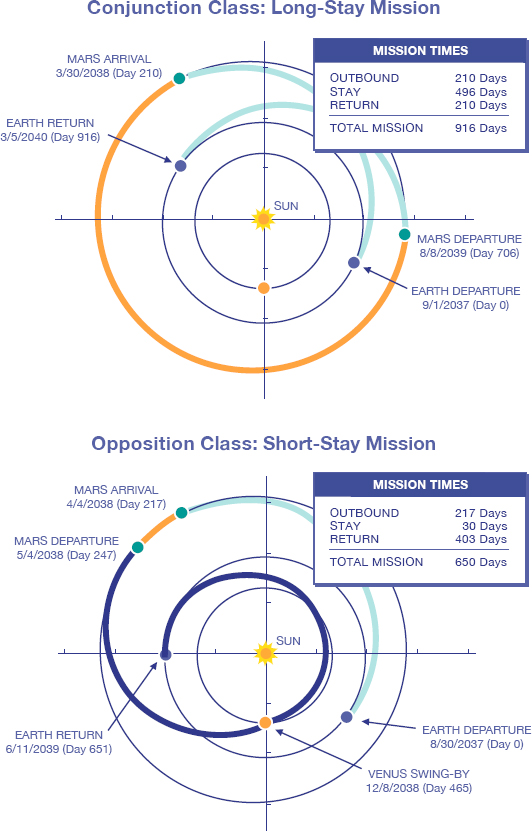
Mars missions for human spaceflight are primarily categorized into two types based on their trajectories and duration: Conjunction-class (long-stay) and Opposition-class (short-stay). Missions are constrained by the relative orbits of Earth and Mars, with launch windows occurring roughly every 26 months (the planets' synodic period).
Conjunction-class missions are generally favored in many studies because they offer significantly more time for surface exploration at a lower fuel cost and reduced crew exposure to the risks of prolonged zero-gravity and deep-space radiation.
Opposition-class missions, while having a shorter overall mission duration, require more advanced propulsion and expose the crew to more time in space and harsher conditions.
Mission Cycles
Launch Windows: Due to the relative orbits of Earth and Mars, launch windows (times of minimum energy transfer) open approximately every 26 months, or 780 days.
Optimal Windows: The specific energy requirements and travel times vary over a larger, roughly 15-year cycle, with certain windows offering the most optimal conditions (e.g., opposition occurring when Mars is closest to the Sun).
Solar Cycle: Mission planning must also consider the approximately 11-year solar cycle. Launching during a solar minimum helps mitigate the risks from solar storms and radiation exposure to the crew
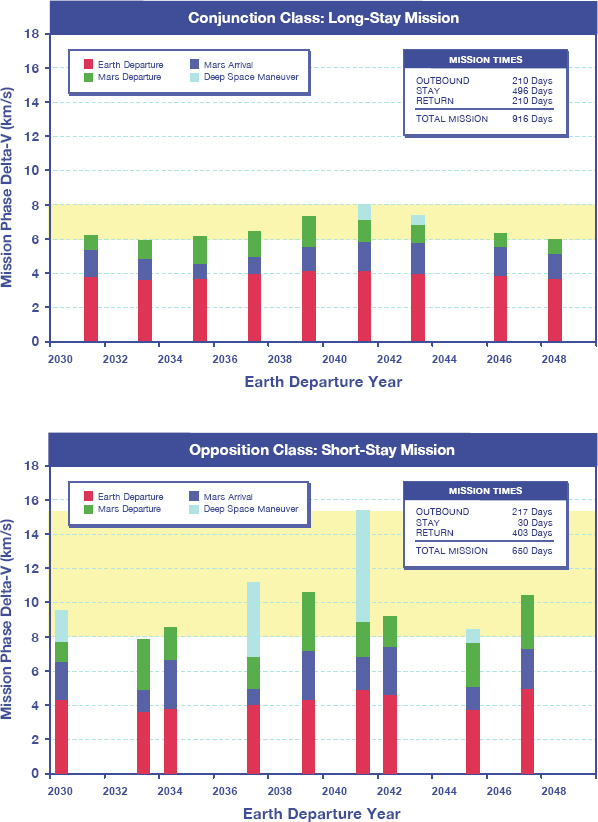
Earth to Mars Mission Opportunities 2026 to 2045
Earth to Mars—2026 Opportunity
Earth to Mars—2028 Opportunity
Earth to Mars—2031 Opportunity
Earth to Mars—2033 Opportunity
Earth to Mars—2035 Opportunity
Earth to Mars—2037 Opportunity
Earth to Mars—2039 Opportunity
Earth to Mars—2041 Opportunity
Earth to Mars—2043 Opportunity
Earth to Mars—2045 Opportunity
A 4-year round-trip mission to Mars represents a long-duration, high-safety-margin, or potentially, a lower-energy, extended-stay scenario often discussed in human spaceflight studies. While, theoretically, minimum-energy missions (Hohmann transfers) take roughly 2-3 years, a 4-year limit is proposed to mitigate cosmic radiation exposure. A typical 3-year mission involves a 6-9 month transit each way with a long, ~18-month, stay.
Radiation Safety Limits: Research indicates that limiting the total round-trip, including the surface stay, to roughly 4 years is crucial to keep astronaut radiation exposure within acceptable limits.
Mission Structure: A 4-year timeframe allows for a more relaxed, extended scientific exploration on the Martian surface compared to "short-stay" missions that only last 2 years but are higher-risk, faster transits.
Alternative Mission Durations: While 4 years is a safe, long-duration option, most near-term mission architectures with current chemical technology focus on 2 to 3-year round trips to manage logistical constraints.
The extended duration of a 4-year mission provides more time for surface operations and potentially reduces the fuel required for rapid orbital maneuvers, at the cost of increased health risks from radiation, which requires robust shielding solutions
knowing where on mars we want to go to is one of the key factors for mission planning.
The ideal site would be:
(1) Not too far from the equator, avoiding extreme cold in winter and at night.
(2) Close to a source of geothermal energy.
(3) Nearby access to liquid brine or at least easily accessible water ice.
(4) Would allow easy excursions to other parts of the planet, i.e avoid deep ravines and other natural barriers.
(5) Would have low altitude, maximising atmospheric shielding and atmospheric braking potential.
(6) Lower susceptability to impact by dust storms.Whilst we could in theory build a base anywhere, I suspect there are few locations that meet all of these criteria and there may indeed be none.
Criteria 1 is important, as a base too far from the equator would experience extreme cold and darkness for half of the year. If we are planning on using surface domes or polytunnels for agriculture, that is undesirable.
Criteria 2 is a nice bonus. It allows heating of surface structures, provides a source of low grade heat for multiple activities and adds an option for power production.
Criteria 3 is essential. Don't bother considering sites that don't have access to water. Liquid water, even if salty and cold, would be far more useful than ice. But abundant accessible ice is a minimal requirement.
Criteria 4 is important both for scientific exploration and for the city to develop as a hub for resource development. We are going to need minerals of every element on the periodic table. A lot easier if we aren't stuck at the bottom of a ravine.
Criteria 5 makes shipping resources from Earth easier and also makes surface activities less risky.
Criteria 6 is essential. A base site that is regularly engulfed in dust is a bad place to do anything. Solar panels stop working, crops stop growing, dust gets blown into moving parts and people will get lost and die.
#541 Exploration to Settlement Creation » WIKI Project Designing for Mars » 2026-01-11 16:23:34
- SpaceNut
- Replies: 69
NOT A DISCUSION TOPIC
Project design is the crucial early phase of outlining a project's "why" and "what"—defining goals, scope, resources, deliverables, and success criteria before detailed planning—to create a strategic blueprint for stakeholders, often using visuals like flowcharts to align teams and guide execution. It establishes the conceptual foundation, differing from detailed project planning which focuses on "how" tasks get done.
Key components
• Goals & Objectives: What the project aims to achieve (SMART goals are ideal).
• Scope & Deliverables: Boundaries of the project and tangible outputs.
• Methodology & Strategy: High-level approach and chosen processes.
• Resources & Budget: People, tools, budget estimates, and constraints.
• Success Criteria & KPIs: How success will be measured.
• Risks: Potential issues and mitigation strategies.
Purpose
• Alignment: Gets everyone (team, stakeholders) on the same page.
• Foundation: Creates a clear, agreed-upon path before detailed work begins.
• Visualization: Uses tools (Gantt, Kanban) to make strategy transparent.
• Buy-in: Secures stakeholder approval for the overall direction.
Process steps (simplified)
1. Define the core problem/opportunity.
2. Establish clear goals and SMART objectives.
3. Identify key deliverables and success metrics.
4. Map out required resources and budget.
5. Identify potential risks and constraints.
6. Create visual aids (flowcharts, mockups) to communicate the design.
7. Get stakeholder feedback and approval.
Project design provides the strategic "why" and "what," leading into the detailed "how" of project planning, with outputs like project charters and plans built upon this initial framework
Project design concepts are the foundational ideas, principles, and high-level plans guiding a project, defining its goals, structure, and key features before detailed planning, using visuals like flowcharts and mood boards to align stakeholders on the 'why' and 'what,' ensuring a shared vision for success. Key elements include defining outcomes, identifying stakeholders, exploring options (like sustainability or accessibility), and establishing success criteria, serving as the blueprint for later execution.
Core Components of Project Design Concepts
• Goals & Objectives: What the project aims to achieve (e.g., "sleek and minimalist" for a phone).
• Target Audience & Problem: Who it's for and the problem it solves.
• Scope & Deliverables: What's included and what will be produced (e.g., sketches, prototypes, reports).
• Guiding Principles: Overarching ideas like sustainability, accessibility, or efficiency.
• Visuals & Mood Boards: Mood boards, sketches, flowcharts to convey aesthetics and process.
How They Work
1. Early Stage: Happens before detailed planning or charter development.
2. Blueprint: Creates a broad overview (the "what" and "why").
3. Exploration: Involves generating and evaluating multiple design options.
4. Stakeholder Alignment: Gets buy-in by presenting choices and setting expectations early.
Examples of Design Principles & Concepts
• Product: "Safe and reliable" (car) or "Intuitive user experience" (app).
• Architecture: Integrating local culture, sustainability, or maximizing natural light.
• Process: Using Agile principles or a specific project management methodology
In essence, a project design concept is the strategic "big picture" that transforms abstract goals into a tangible vision, guiding the entire project from its inception to successful completion.
Project design phases generally move from understanding the problem to creating detailed solutions, often covering Programming/Pre-Design, Schematic Design, Design Development, Construction Documents, Bidding, and Construction Administration, though models vary (like the AIA's 5 phases or broader project management cycles). Key stages define scope, develop concepts, produce technical drawings, select builders, and oversee building, ensuring a structured path from idea to reality.
Here's a common breakdown, blending architectural and project management steps:
1. Programming/Pre-Design (Problem Seeking): Define project goals, needs, budget, site analysis, and scope.
2. Schematic Design (Concept): Develop broad concepts, sketches, and basic layouts to explore possibilities.
3. Design Development (Refinement): Flesh out the chosen schematic design with materials, systems, and detailed plans.
4. Construction Documents (Technical Drawings): Create detailed blueprints and specifications for construction.
5. Bidding/Negotiation: Solicit and select contractors.
6. Construction Administration (Building): Oversee the building process, ensuring it matches the design.
Variations & Other Models:
•
Engineering:
Includes research, feasibility, concept generation, detailed design, and production planning.
•
Design Thinking:
Focuses on empathy, defining problems, ideating, prototyping, and testing (Discover, Define, Develop, Deliver).
•
Project Management Lifecycle:
Broader stages like Initiation, Planning, Execution, Monitoring & Control, and Closure.
No matter the model, the goal is to break a complex project into manageable steps, moving from abstract ideas to concrete results
Teacher Notes: Building on Mars, Instruction Sheet and Guidance
Starting a mission with goals of building—whether a physical structure, a community, or an organization—begins with defining your core purpose and values. This involves answering fundamental questions about who you are, what you do, why you do it, and for whom you do it.
Here is a step-by-step guide to where to start, based on established, mission-driven planning processes:
1. Define the Core Purpose and Vision
Identify the "Why": Before building, clarify the problem you are solving or the need you are addressing.
Draft a Mission Statement: Create a concise summary of your purpose, priorities, and daily actions to reach your goals.
Develop a Vision Statement: Describe the ideal, long-term, future outcome you want to achieve.
Identify Core Values: Determine the principles that will guide your decisions.
2. Set Strategic Goals (The "What" and "How")
Define Goals: These are general statements of what needs to be accomplished (e.g., "Build a community center," "Create a sustainable, low-income housing project").
Set SMART Objectives: Ensure your goals are Specific, Measurable, Achievable, Relevant, and Time-bound.
Develop a Strategy: Determine the unique approach you will take to achieve the vision, such as how you will use resources or build partnerships.
3. Build the Initial Framework
Identify Stakeholders: Identify who will be affected by or involved in the project (e.g., community members, investors, partners).
Establish a Team/Core Group: Identify key people who will help drive the mission, as collaboration is essential for long-term success.
Engage the Community: For building projects, start by gathering insights from the community to ensure the project meets actual needs.
4. Create an Actionable Plan
Perform a Feasibility Study: Assess the project’s feasibility, including funding, legal requirements, and potential risks.
Build an Initial Task Backlog: Break down your goals into specific, actionable steps.
Outline Resources: List the materials, finances, and skills required for the project.
5. Launch and Iterate
Run a Kickoff Meeting: Clearly communicate the mission to all stakeholders to ensure everyone is aligned.
Start Small: Rather than trying to achieve the entire vision immediately, start with a pilot project or a small, tangible goal to build momentum.
Monitor and Adjust: Regularly review progress and adjust your plans as you gain new information.
Key Takeaway: A mission-driven project starts by ensuring the "why" (mission) is in the driver's seat, ensuring that every building block contributes to the overall purpose
#542 Re: Not So Free Chat » NASA's Jared Isaacman new leader makes his priorities clear on day one » 2026-01-11 15:35:38
I would be remiss if I did not mention the role that NASA's and DOE's partnership programs as the genesis for the commercialization of a lot of these lab curiosities. Science for its own sake still matters, but so does directed science, aka "engineering", aimed at solving real world problems. NASA helps industry develop the basic "know-how" to retire risk to begin to apply aerospace technologies to the ordinary everyday world that the majority of us inhabit.
Something that others seem to be forgetting when they look at political power, control and funding.
Part of why the locations of of nasa offices and others that do these things.
#543 Re: Not So Free Chat » Politics » 2026-01-11 15:22:03
What only a 3 way split???
#544 Re: Human missions » Interview on Fox News with Jared Isaacman » 2026-01-11 15:16:49
original is in the not so free chat due to politics influence this position as does the others in the senate and house plus the states that have business within them.
So lets stay focused on the interview if possible.
#545 Re: Life support systems » Power generation on Mars » 2026-01-11 15:14:10
Guessing how much power means under sizing which causes overheating of it with constant breakdown or over estimating the system making it to heavy to deliver.
Re-read the quote possible power sources as those are all different for how they are configured and while they give power output you will still need to build converting systems to match the devices that you are powering.
Some will require transformers for step-up and some for down before being made use of.
Think about you computer and you cellphone they both have battery but are they the same size in voltage or power. Yes they have converting transformers and circuitry to interface back to you outlet but they do not conform in any other way.
The cables outside the controlled temperatures of a garage or dome will need different specifications as the cold will make some materials brittle.
So no there is no one forced standard
So the number of watts for creation is not even known?
No list of equipment to make use of those watts?
How much is to be fore personal use?
No list of stuff needing heavy load powered versus items needing next to nothing?
Each building and sections there in are going to needed specifics to solve to what each will need to have configured for use and connection layout.
#546 Re: Life support systems » Power generation on Mars » 2026-01-11 14:50:53
They are earth safety standards for consumer use...
The specifics are based on wiring diagramming of how the power is to be used which is from the interface circuit breaker box system that you should be aware of.
For a Mars garage, power systems need reliability in dust and cold, likely combining solar arrays with advanced batteries (like Lithium-ion or supercapacitors) for peak loads and consistent energy, supplemented by Radioisotope Thermoelectric Generators (RTGs) or future Nuclear Fission Reactors for baseline power, especially during dust storms and night, alongside energy storage and distribution systems (PMAD) to manage variable demands for tools and habitat functions.
Primary Power Sources
Solar Arrays (Photovoltaics): Efficient when sunlight is available but challenged by dust accumulation and reduced intensity during Martian winter/storms, requiring regular cleaning.
Radioisotope Thermoelectric Generators (RTGs): Use natural decay of plutonium to generate continuous heat and electricity, providing reliable, long-term power independent of sunlight, excellent for baseline needs.
Nuclear Fission Reactors: For larger, sustained power needs (like industrial processes or larger habitats), small fission reactors offer high power output but require significant shielding for radiation.
Energy Storage & Management
Batteries: Rechargeable lithium-ion batteries (like those used on rovers) handle peak power demands, while advanced alternatives like graphene supercapacitors offer faster charging and wider temperature tolerance.
Power Management & Distribution (PMAD): Essential systems to convert, condition, and distribute power from sources to loads, handling start-up, shutdown, and dynamic events.
Supporting Technologies
Waste Heat Utilization: Nuclear systems produce excess heat, which can be converted to electricity or used for habitat/regolith heating, improving efficiency.
In-Situ Resource Utilization (ISRU): Solar concentrators could use sunlight for heating and 3D printing/sintering, potentially reducing reliance on pure PV cells.
Advanced Motors/Generators: Electric motors are preferred over combustion engines due to simplicity; next-gen storage like supercapacitors could revolutionize rapid power delivery.
Considerations for a Mars Garage
Dust Mitigation: Systems to clean solar panels and protect equipment from fine dust are crucial.
Thermal Management: Dealing with extreme cold (using waste heat or electrical heaters) is vital for equipment and battery health.
Scalability: A mix of sources (solar for peak, nuclear for baseline) offers the best resilience, from small tools to large fabricators
As you can see they are not standard
#547 Re: Not So Free Chat » NASA's Jared Isaacman new leader makes his priorities clear on day one » 2026-01-11 14:45:51
I am very enthusiastic with the appointment of Jared Isaacman as NASA Administrator!
Here's a link to this excellent interview!
Sorry that the name was not in my original title but we know this as being more politically delivered than anything else.
#548 Re: Human missions » Why Artemis is “better” than Apollo. » 2026-01-11 14:43:26
That's going to happen when management tries to be engineers looking at balance sheets rather than performance.
So which shield type is this one as I remember the original PICA version was dismissed for the honey combo hand inserted materials to which this one makes me wonder...
#549 Re: Human missions » Why Artemis is “better” than Apollo. » 2026-01-11 14:39:53
The odds favor their survival, but the lethal uncertainty is nowhere near zero. Initially, the excuse was eliminating the skip and just going for direct entry. I do not see anything of that plan in the recent stories. This reminds me eerily of Challenger and Columbia.
I am still disappointed seeing the entire debate framed only as "fly what you have" vs "total redesign". Total redesign is NOT required, all they need to do is go back to the labor-intensive hand-gunned heat shield. There is NO REDESIGN associated with that! They already HAVE that design! They already flew it!
Doing that would enable them to work out how to cast those tiles with the hex cores in the them, and fly such a thing, even as a subscale test article, to see it actually work right. I already showed how to do that revised processing with an extrusion press, here on these forums, and I already sent that idea to them via a contact I knew within NASA, who has since retired. I NEVER EVER heard back from their heat shield people, to whom my contact forwarded my materials. "Not invented here" is a real flaw shared by lots of big organizations!
But it would definitely work, because the fibrous nature of the charred hex helps tie the otherwise weak carbon char together. It's a composite material that is better than just the carbon char from the polymer alone. I know that because of my experience with ablatives in ramjets and solid rockets. If you cannot reinforce the char, it goes away too quickly, in one fashion or another. Which experience goes way beyond sample testing in an arc jet tunnel, and running CFD codes that usually do not deserve to be believed, without confirmation testing! I'm talking real burn experiences with real motors and engines here!
The Artemis 1 failure already proved that fiber reinforcement contention of mine! The only difference between Artemis 1 and the first Orion that flew was that they deleted the hex to cast the tiles instead of hand-gunning the polymer into a hex core already attached to the capsule, like Apollo. Which is what flew on the first Orion. That's NOT a FULL re-design of anything, it's only a variation on the cast tile processing they now prefer (at the risk of the crew's lives, I might add, if they don't do something to reinforce that char).
GW
#550 Re: Meta New Mars » Housekeeping » 2026-01-11 13:16:38
off topic solving of potential failures within a project is just what the fishbone is for..
Fishbone theory, or the Fishbone Diagram (also known as an Ishikawa Diagram or Cause-and-Effect Diagram), is a visual tool for root cause analysis that maps out potential causes of a problem in a fish-skeleton-like structure, helping teams brainstorm, categorize, and identify underlying issues, not just symptoms, for better problem-solving in quality control and management. The problem is the "head," and major causes branch off the "backbone" as "ribs," with sub-causes extending further, revealing hidden linkages and process bottlenecks for future improvements.
you have you own topic of import everything to do you process within to make the garage that you want on mars.
I have already shown that import everything on the first connex box transport is not sustainable as the equipment gets larger to perform the task of building increases.