You are not logged in.
- Topics: Active | Unanswered
Announcement
#26 Terraformation » Venus Deeps » 2016-11-27 03:57:54
- karov
- Replies: 11
http://www.nextbigfuture.com/2016/11/th … gfuture%29
It shouldn't be the case that the same ( at least few oceans-full of water in the mantle ) is not present inside Venus.
Regardless of the 'resurfacing' which happens every other few hundreds of millions of years.
So, together with the Outer system (slow), and plasma mining the Sun (requiring huge pan-SolSys mass-energy-momentum infra to be present), the Venus interior is also the third legitimate source of Hydrogen to look at.
Untapping it could be done by light. From the sun - 'uncooked' focused one, or solaser.
#27 Terraformation » Flux Tube Auroral Artificial Suns? » 2016-10-20 06:45:43
- karov
- Replies: 0
I have in mind Io.
https://www.google.bg/search?q=io+flux+ … MhFonaM%3A
1-2 TWs of power.
How bright the polar aurorae of Io could be made if almost all of this utilized for a giant https://en.wikipedia.org/wiki/Fluorescent_lamp
In fact two such lamps ... north and south Io poles' ones.
Orrrr ... the plasma torus to be compacted and glown brighter via using the proposed by Alexander Bolonkin 'plasma cord' way - reminder: he states that by axially rotating a plasma 'line' it gets confined and compacted. ( https://arxiv.org/pdf/physics/0701058.pdf )
The TWs ( more then mere 1-2? how? ) could be mirror focused / tracking the other 3 Galileans: Europa, Ganymede and Calisto.
At destination the areal on-surface light distributions - again by optics.
The 3 Galileans aside Io have 0.375 Earth areas.
200-ish trillion sq.m.s
hmmmm ... too little.
#28 Re: Terraformation » Artificial Suns and how to make them » 2016-10-20 02:01:16
Tom,
btw, carbon incandescent filaments charged as elecrodynamic tethers from planetary / brown dwarf dynamos fit quite nicely with optimization of the emitted light if sheath-ed with rotating colony.
Like.: http://www.iase.cc/openair.htm - aka "Bishop rings" which seamlessly may grow into macaroni hab of arbitrary length.
Using orbital rings the linear electric 'lampage' could be provided with current not from deorbiting mass but from despinning the big central body.
like this.:
[image]https://upload.wikimedia.org/wikipedia/ … ng.svg.png[/image]
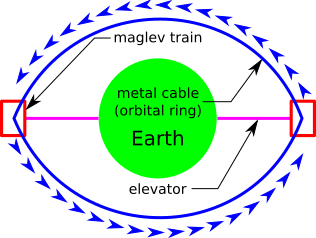
where the red rectangles are the habitats.
At the lowest points the orbital rings could in fact dip into the atmosphere and to exchange mass - to excavate up and to download.
The carbon illumination filament centered as a colony's axis would be the stator and the orbital ring the rotor of a massive electric generator converting the planetary spin into helluva electric power...
#29 Re: Terraformation » Artificial Suns and how to make them » 2016-10-20 01:47:51
Yeah.
Like massive maglev bearing.
But I have no idea how to calculate the structure: how thick/massive the non-moving 'topobase' to be etc.
What are the limits?
#30 Re: Terraformation » Artificial Suns and how to make them » 2016-10-19 15:03:21
Tom,
I can't really calculate it but I guestimate that made from carbon, at 1/4 Gees (??) the tensile strength of the material will withstand the centrifugal force of your 12800km wide one and about one rotation per ~2.8 hours ?>
#31 Re: Terraformation » Artificial Suns and how to make them » 2016-10-19 12:14:10
Tom,
From.:
<<<
DISTANT STAR
The Electronic Magazine of the Living Universe Foundation
January 15, 2001
The Use of Nanofibers in Space Construction
The Highest Home: Super Colonies and the Ultimate Human Habitat
By Eric Hunting
>>>
A colony structure like this would be easier to build if one could eliminate the mirrors and windows. This could be done by replacing the windows with a big optical diffuser running down the core of the cylinder. This would be made from ultra-light holographic membrane. A relatively small window in one end cap could provide entry for light collected by a much larger Sun-facing, non-rotating solar collector mirror in the manner of a Cassegranian teoptics telescope
orrrr, focused light from any source.
BUT, I think your tube is too wide, to structurally tolerate 1G inner-surface centrifugal force.
from.: http://www.orionsarm.com/fm_store/CEMS% … t%20...pdf
pages 6 & 7
6.1 Rotating Space Habitats
Suitable locations for space colonies include orbits around the Earth-Moon Lagrange points. Consider a large
fat cylinder rotating on its axis (Fig 6.2); a landscape of seas, plains and mountains girdles it within, while
sunlight, reflected from external mirrors, enters through the end caps.
Paper read to BIS/CEMS Syposium "Bringing Worlds to Life" at Birkbe... http://www.paulbirch.net/CustomPlanets.html
8 of 16 10/27/2006 11:09 PM
The total mass of the habitat works out at around 40 tonnes per square metre of habitable land, more or less
equally divided amongst atmosphere, crust, geosphere base and toposphere (Fig 6.3).
The geosphere base uses a low-density fractal architecture to keep the structural mass low, slotted together
out of strong but readily available fractal blocks of fused rock (Fig 6.4). This is a constructional technique
equally suitable for supramundane planets and rotating space habitats; it provides strength in tension as well
as compression whereas normal masonry construction only has strength in compression.
The maximum size of conventional rotating space colonies is determined largely by the strength of available
structural materials. The limit is about 250 km radius for quartz, 1000 km for sapphire, and 2500 km for
diamond. That last case is actually pretty big, a colony equalling the land area of the Earth. Even so, most
conventional space colonies will be considerably smaller than natural planets.
To some extent we can get around the size limit by making colonies longer, because the constraint is on the
radius not the length. An extreme example is the macaroni habitat (Fig 6.5), an ultra-long habitat with a
sunshine tube down the middle, if we loop it all the way round a star the total habitable area may be around
2000 times that of the Earth. And if we stretch a macaroni tube along tramlines between one star and another,
the habitat area becomes something like 100 million Earths. There is sufficient material in the solar system to
construct macaroni habitats thousands of light years long.
Even the largest diamond colony or the longest macaroni habitat is not a planet, though, because planets have
horizons and you live on the outside, whereas space colonies have the outside on the inside!
max. 500 km wide for quartz
max. 1000 km wide for sapphire
max. 5000 km wide for carbon
#32 Re: Terraformation » Artificial Suns and how to make them » 2016-10-18 13:24:32
https://en.wikipedia.org/wiki/Color_temperature
Carbon is better then tungsten.
Higher melting point.
Helluva cheaper.
Temperature Source
1700 K Match flame, low pressure sodium lamps (LPS/SOX)
1850 K Candle flame, sunset/sunrise
2400 K Standard incandescent lamps
2550 K Soft white incandescent lamps
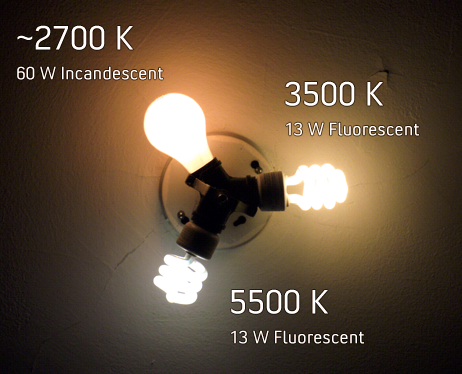
2700 K "Soft white" compact fluorescent and LED lamps
3000 K Warm white compact fluorescent and LED lamps
3200 K Studio lamps, photofloods, etc.
3350 K Studio "CP" light
4100 – 4150 K Moonlight [2]
5000 K Horizon daylight
5000 K Tubular fluorescent lamps or cool white / daylight
compact fluorescent lamps (CFL)
5500 – 6000 K Vertical daylight, electronic flash
6200 K Xenon short-arc lamp [3]
6500 K Daylight, overcast
6500 – 9500 K LCD or CRT screen
15,000 – 27,000 K Clear blue poleward sky
These temperatures are merely characteristic;
considerable variation may be present.
---
At 3000K it will be good global high-class white light illumination.
[image]https://upload.wikimedia.org/wikipedia/ … arison.png [/image]
#33 Re: Terraformation » Artificial Suns and how to make them » 2016-10-18 11:38:32
3550 o
Data Zone
Classification: Carbon is a nonmetal
Color: black (graphite), transparent (diamond)
Atomic weight: 12.011
State: solid
Melting point: 3550 oC, 3823 K
#34 Re: Terraformation » 2014-UZ224: New Dwarf planet » 2016-10-18 05:39:25
Where was the estimate about uranium/torium abundance in 'cometary material' ?
#35 Re: Terraformation » Artificial Suns and how to make them » 2016-10-18 05:38:09
I think the hill sphere of Titan would be greater than the 24-hour orbit radius, so you can just have the orb orbit the moon. Anyway if placed at L1 with a moon that is tidally locked would create the same situation that supposedly exists on Proxima b.
If the 'incandescent sun' rather uses 'lightbulb filament' configuration it could be wraped around the illuminated body.
or
if point-like - then - statite mirrors / annular 'photonic parachute mirror' for the 'dark side'.
#36 Re: Terraformation » 2014-UZ224: New Dwarf planet » 2016-10-17 15:21:15
I enjoy your work.
Yes. I enjoy it too! Brilliant.
The spectrum of icy bodies deserves an online calculator!
#37 Re: Terraformation » Titan Terraformation - Is it possible? » 2016-10-17 14:59:52
Two quotes from Charles Stross' "Accelerando" .:
lily-pad city floats inside a gigantic and nearly-invisible sphere in Saturn's upper atmosphere; a balloon kilometers across with a shell of fullerene-reinforced diamond below and a hot hydrogen gas bag above. It's one of several hundred multimegaton soap bubbles floating in the sea of turbulent hydrogen and helium that is the upper atmosphere of Saturn, seeded there by the Society for Creative Terraforming, subcontractors for the 2074 Worlds' Fair.
The cities are elegant, grown from a conceptual seed a few megawords long. Their replication rate is slow (it takes months to build a bubble), but in only a couple of decades, exponential growth will have paved the stratosphere with human-friendly terrain. Of course, the growth rate will slow toward the end, as it takes longer to fractionate the metal isotopes out of the gas giant's turbid depths, but before that happens, the first fruits of the robot factories on Ganymede will be pouring hydrocarbons down into the mix. Eventually Saturn — cloud-top gravity a human-friendly 11 meters per second squared — will have a planet wide biosphere with nearly a hundred times the surface area of Earth. And a bloody good thing indeed this will be, for otherwise, Saturn is no use to anyone except as a fusion fuel bunker for the deep future when the sun's burned down.
&
The lily-pad habitats have proliferated, joining edge to edge in continent-sized slabs, drifting in the Saturnine cloud tops: ... The green and pleasant plain stretches toward a horizon a thousand kilometers away, beneath a lemon-yellow sky. ...
#38 Re: Terraformation » Titan Terraformation - Is it possible? » 2016-10-17 14:27:43
I have often wondered if something like this could be built on Earth using superheated steam to provide lift. If the shell is insulated with silica aerogel, power requirements can be substantially reduced. A 1000m diameter sphere could lift over 400,000 tonnes at steam temperature of 300C. Kind of like Star Wars cloud city.
Yes, I believe it can.
It could be nuke-steampunk one even.
The giant bubble, could be closed-cycle radiator of a fission reactor powering the city.
In atmospheres like Titan's one - much-much bigger Cloud Nine cities, with higher lift on much lower temperature of 300-ish Kelvin and breathable air as lifting gas ... entire NYCs in the sky. With vast Babylonian hanging gardens. Singapore is roughly 40 x 20 km it houses as much people as say Sweden, and has plenty of livable outdoors, not thick concrete pile.
Dozens of billions of population in few thousand floating cities over one of the most interesting pristine cryo-Outbacks ... fully preserved, cause the bubble-cities could hover say 100km over the solid surface and the waste heat to be directed upwards in-space.
IF we really terraform Titan ... and ideally have all its surface turned into prime real estate land - no deserts, no big seas, no oceans, no ice caps ... I believe that still there won't be more then few thousands of big cities on the 2D curved 'classical' surface.
SO, that's why I asked - how we measure the habitability?
#39 Re: Terraformation » Titan Terraformation - Is it possible? » 2016-10-17 14:12:34
if you go outside and you die, then the world is not habitable.
Tom, I agree with you. So, what I'll note is not argument for the sake of the argument, but few ... suspicions of mine.
You can slip in your bathroom or stumble down your home's staircase and can die.
Is your home not habitable?
Or, ok, you go out on the street and.:
- get hit by a car
- minus 40 celsius beyond polar circle night without top clothes
- fall into a shallow lake just besides your $10m hunting lodge and get drowned...
Is your outside not habitable?
I like having an outdoors, other people, they like living in tunnels.
A balloon 10mi wide is no less 'outdoors' then land plot on Earth. The ceiling is even higher then the breathable height in Earth's troposphere.
A tunnel hundreds of meters wide is ... outdoors.
A few miles wide and long Stanford torus, Bernal sphere, O'Neill cylinder is outdoors.
In fact the difference between indoors and outdoors is matter of ... scale in respect with the average linear size of a human being.
Perhaps the threshold of outdoor-ness is few hundreds of times wider then human size.
The same way indoors-ness ( aka 'home' ) is thresheld into approx. an order of magnitude bigger then average human being size.
Everything which is big enough to contain enough spaced out from eachother homes ... is outdoors.
I define terraforming as not needing a wall to keep inside your habitable environment.
Even the most natural habitat has 'walls'.:
- high mountain ridges, steep slopes, water shorelines, glaciers ... the atmospheric thinning with height ...
You can talk about domes all you want, but that is not really terraforming.
Domes come of different sizes.
Spheroid 'para-terraformation' dome around , say, Ceres - with living area as big as EU or India - and 20mi high .. is it outdoors or is indoors?
...
#40 Re: Terraformation » Artificial Suns and how to make them » 2016-10-17 13:15:49
Here it is.
A quote from Karl Schroeder's "Permanence"
A pinprick of light appeared on the limb of Treya and quickly grew into a brilliant white star. This seemed to move out and away from Treya, which was an illusion caused by Rue's own motion. Treya's artificial sun did not move, but stayed at the Lagrange point, bathing an area of the planet eighty kilometers in diameter with daylight. The sun was a sphere of tungsten a kilometer across. It glowed with incandescence from concentrated infrared light, harvested from Erythrion by hundreds of orbiting mirrors. If it were turned into laser power, this energy could reshape Treya's continents— or launch interstellar cargoes.
A flat line of light appeared on Treya's horizon. It quickly grew into a disk almost too bright to look at. When Rue squinted at it she could make out white clouds, blue lakes, and the mottled ochre and green of grassland and forests. The light was bright enough to wash away the aurora and even make the stars vanish. Down there, she knew, the skies would be blue.
She could have stared at that beautiful circle of earth and sea all day.
Sorry, I remembered it wrongly. Indeed the O'Neill rotating habitats in this brown dwarf system are illuminated by electromagnetic orbital thethers.:
Erythrion itself was visible now, a gigantic red eye in the night. The halo world was a brown dwarf, sixty Jupiters in mass, too small to be a sun and too big to be a planet. Like countless billions of others it moved through the galaxy alone in the spaces between the lit stars. So small and invisible were the halo worlds that they hadn't even been known to exist until the end of the twentieth century. But to Rue, Erythrion was huge and magnificent and all the civilization she hoped to ever see.
There were three major nations at Erythrion, one of them in the oceans under the ice surface of the Europan planet Divinus, one visible as scattered sparkles of light— orbital habitats scattered throughout the system— and one on Treya. As Rue's ship made its final approach through Erythrion's radiation fields, she swung the prospecting scope around to look for Divinus and Treya. Erythrion's dull red glow wasn't enough to make them shine; she spotted Divinus after long searching when it eclipsed a star. That absence was a planet. Treya, though— she could actually see it, a diffuse oval of light, like a fuzzy star. She stared at it until her eyes were sore.
Closer to hand, brilliant filaments of light illuminated dozens of O'Neill cylinders. Each cylinder was twenty or more kilometers long, home to nearly a million people. They utterly dwarfed the tiny station where she was born and raised and she gaped at them as they slid silently by.
Even the colonies were dwarfed by their surroundings. They swarmed like insects around incandescent filaments hundreds of kilometers in length. Each filament was a fullerene cable that harvested electricity from Erythrion's magnetic field. They were kept in orbit by vast infrared sails, visible only as a shimmer of reflected stars. The power running through the cables made them glow in exactly the same way that tungsten had glowed in light bulbs for billions of people on twentieth-century Earth. These cables were vastly bigger, of course; the colonies concentrated the light to provide «daylight» for whole populations with the waste product of electricity production.
The glowing cables had been built to provide power for launching starship cargoes. To see them serving merely as lamps was somehow saddening.
At big moons like Titan, the tungsten sphere could hang beyond the L1 planet-moon point so to balance the moon-directed weight of the electrodynamic thether, producing simultaneously electricity and light for the whole moon, on expense of slowly-slowly deorbiting it...
#41 Re: Terraformation » 2014-UZ224: New Dwarf planet » 2016-10-16 02:16:23
Being that far out from the Sun, its rotation rate makes no difference. Since its diameter is about 2200 km and its maximum distance from the Sun is 97 AU, if we build a mirror that is 220,000 km in diameter, we can focus enough sunlight on it to give it an Earth like level of solar intensity. if you want to know how big this is, it is bigger than Jupiter. I think Eris would be a candidate for an artificial Sun, probably fusion powered. Building a mirror this big is probably a waste of time and resources.
I think we have to have separate topic on energy economics, ah?
'cause I'm pretty sure (intuitively, and exemplary) that good'ol light and gravity are by far the best energy sources and technology which we might possibly have in this universe!
#42 Re: Terraformation » Titan Terraformation - Is it possible? » 2016-10-16 02:00:30
[image]http://www.oocities.org/titanastrobio/titancomp.jpg[\image]

plus
https://en.wikipedia.org/wiki/Cloud_Nin … ty_sphere)
with warmed breathable air.
Titan's atmosphere ( its thicker part ) is 200+ km deep.
It can easily handle 10mi wide Cloud Nine Tensegrity Spheres.
Each comfortably housing millions of people.
How we 'measure' the habitability of an environment?
- by number of human lives supported?
- by square miles of 'territory'?
- by units of biomass?
#43 Re: Terraformation » 2014-UZ224: New Dwarf planet » 2016-10-16 01:55:29
[image] http://i.imgur.com/mV2Khfl.jpg [/image]

but with dozens of times bigger linear dimensions then on Earth.
And ice surfaces not left 'naked' but sprayed with super-insulation foam or something more sophisticated ...
Although at so little pressure it is enough to bubble up really huge pressurized air habitat structures just underneath the ice.
#44 Re: Terraformation » 2014-UZ224: New Dwarf planet » 2016-10-15 11:43:34
https://en.wikipedia.org/wiki/Natural_n … on_reactor in the rocky cores?
#45 Re: Terraformation » 2014-UZ224: New Dwarf planet » 2016-10-14 05:58:15
1% gees, 1 Bar under-ice habitats.
Without body-modifications, the 0.01-ish gees 'outdoors' could be mitigated by daily immersion of 1G or higher environments for certain number of hours, like.:
- the individual homes to be centrifugal.
- or.: global transport system like www.et3.com running with such speeds that to excert (say) 2G centrifugal force where the inhabitants to sleep ... mobile bedrooms ...
"few hours in the centrifuge a day keeps the doctor away"
90bar at ocean bottom is like under less then 1km water layer on Earth, which makes 'earth', 'water', 'ice', 'vacuum' all easily interface-able by mere "skyscraper" / elevator towers from bottom to top.
---
I remember discussing back in 204-2005 Ceres terraformation using water-bag layer as natural gravity pulled atmospheric counter-pressure ... cap, or spheroid dome.
Even transparent and full of sea life.
Ocean in the sky.
Upside(water)-down(air) habitat.
The ice shell / ocean air-pocket sandwitch one is a quite the same thing.
With fission reactors thus the literally ZILLIONS of such iceballs are doable.
... and they must be hundreds of thousands if not millions only in the Solar sphere alone ...
#46 Re: Terraformation » 2014-UZ224: New Dwarf planet » 2016-10-14 04:24:02
New dwarf planet discovered at the edge of the solar system. The new world is some 500km in diameter.
http://www.space.com/34358-new-dwarf-pl … uz224.html
This dwarf planet could be terraformed relatively easily by melting it using a nuclear heat source. The result would be a water ocean ~90km deep, overlying a silicate core. An icy shell would float on top of the ocean and would provide enough pressure at its base to prevent the water from boiling.
If the shell is 800m thick, pressure at the surface of the ocean would be 1 bar. About 300GW of heat would be required to keep the global ocean liquid, as heat flux through the shell would be about 0.5W/m2.
Pressure at the ocean bottom would be about 90bar. Mining of silicate materials would be carried out by dredging. An ocean ecosystem could be based upon algae and plankton in the global ocean. This would require some form of artificial lighting. Humans would live in floating habitats tethered beneath the ice shell. Maybe it would be possible to farm the ocean for a large proportion of food needs.
Such a terraformed world should be relatively easy to build, as aside from the provision of a nuclear heat source, no large-scale planetary engineering is required. Terraforming could presumably be carried out incrementally, with an initially small habitat and nuclear heat source, resulting in a localised ice covered sea. As colo isation proceeded the world would gradually transform into a global ocean. Ammonia dissolved within the water will provide fixed nitrogen needed to fertilise the ocean ecosystem.
Wonderful!
shell-world-ing and natural para-terraforming from within, simultaneously !!!
[image] http://www.space.com/images/i/000/033/3 … 04c-02.jpg [/image]
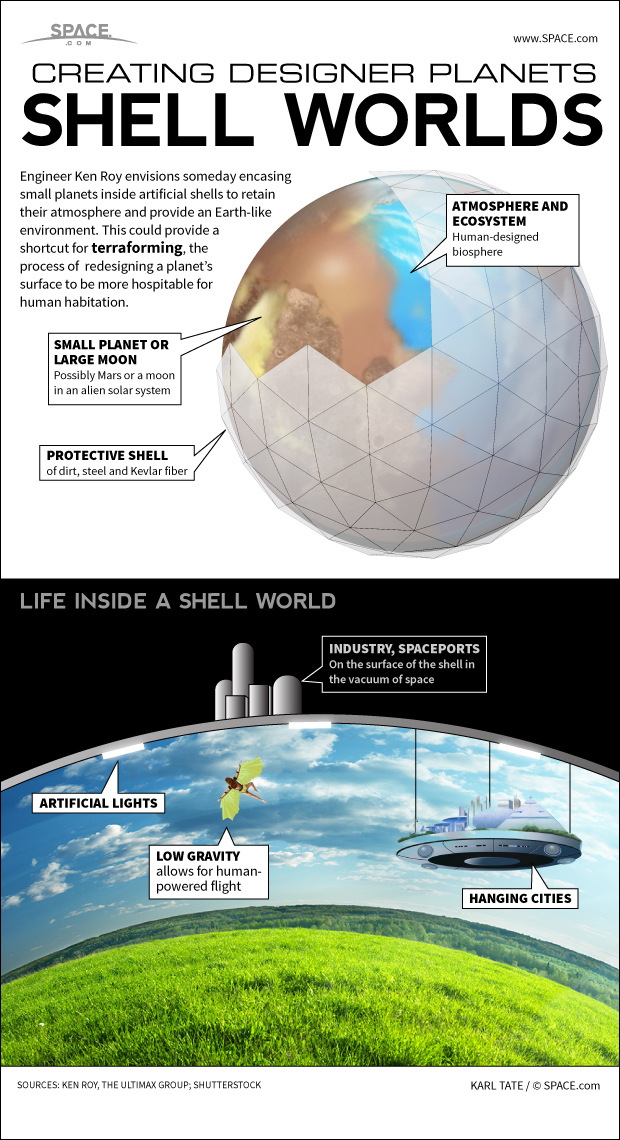
In fact what about layer of air between the water surface and the icy ceiling???
global, or pocket / domes one.
The metalo-silicate core could be mined for foam-ables ( silica, alumina, metals ... ) to cover as much as needed of the ocean surface with raft islands and continents ...
... although at such a low Gees of under 1% ... at such a world the 'vertical' won't matter so much.
Such planemos could occur to be REALLY numerous across the Galaxy and beyond - kinda stapple habitats 
AND, I remember that good old nuclear fission is quite doable out there.
'Cause the 'cometary material' contains as much uranium and thorium as if the total mass is as 'calorific' as ... wood ( Granite per instance is 30 times coal on average ).
So, enough fission energy for billions of years.
#47 Re: Terraformation » Titan Terraformation - Is it possible? » 2016-10-09 03:31:42
The density of liquid Tungstein is 17.6 g/cm3 or 17.6 tons/meter^3
Volume of the sphere is 628143703822703 meters cubed times 17.6 tons = 11,055,329,187,279,572.8 tons of Tungstein or 1.1e16 tons.
Now the question is what's the best way to heat this molten ball of Tungstein to the temperature of the surface of the Sun, the great thing about liquids is they hold their volume, rather than expand as a gas, in a condition of microgravity, surface tension will keep it to a ball of white hot liquid. So what's the best way to heat it? Perhaps a laser, a very powerful solar powered x-ray laser, target this ball with it, but avoid hitting Titan and this ball of molten metal and illuminate one hemisphere of Titan heating up its surface to Earth like temperatures. This leads to another problem. Much of the surface is ice, not only water ice, by dry ice, its nitrogen atmosphere will probably get a lot of carbon-dioxide as the dry ice on its surface sublimates, the water ice will eventually melt and form an ocean. The good news is there are a lot of carbon compounds in Titan's atmosphere and crust, through chemical rearrangement, they can be formed into artificial rock, to form a shell in the shape of the topography of this Moon.
http://images.nationalgeographic.com/wp … 00x450.jpg

Orrrr, like in Karl Schroeder's writings the tungsten ball to be the tip of an electromagnetic tether anchored centrifugally to Saturn itself.
Orrrr, instead of heating a radially emitting wasting hot ball why not a WHITE or pseudo-white lasers?
I agree on the necessity of a 'bark' on top to protect the nice cryo-environment from thawing and melting down ...
At the end of the day at this gravity multi-mile high and thosands of sq.mi. enclosed domed environments possible, so most probably Titan and these cryo-worlds are as good as they are ...
As emphasized too many times by me terraforming is NOT about turning a planet into baseline human habitat, but about INSTALLING such on the 1G iso-gravitational curved surface. EVEN Earth is far away from maximizing habitat surface versus total 1G surface.
#48 Re: Terraformation » Orbital Mirrors for the Transantarctic Mountains » 2016-10-08 03:34:55
The concept altered allows for the evaporation of ocean water near an ice cap, where it might condense into snow, therefore lowering the ocean level.
Yes, indeed.
Imagine litting up only the habitable zone and keeping most of West and East icy Antarctica in eternal darkness ( by adding a Hall Weather Machine aerostatic layer on top of the antarctic atmosphere to precisely manage the infalling light. ).
The most of the continental rim will be kept under present day conditions. So to say penguine-wise.
Thus the increased evaporation will get trapped into the Darkness making the ice sheat thicker and lowering the global ocean levels opening up more lands on the continental shelves shallows.
#49 Re: Terraformation » Orbital Mirrors for the Transantarctic Mountains » 2016-10-08 03:29:43
In total, at the distance of 15,000 km, it would have to be 338.24 kilometers in diameter, this will take into account the fact that the mirror will have to be angled at 45 degrees to reflect incident light rays from the Sun, so this reduces its apparent diameter to 0.7 of its actual diameter. At a distance of 15,000 kilometers the orbital period is 8 hours and change, if we want, we could increase the orbit to 24 hours, but then we'd have to increase the size of the mirrors too. the size of the mirror would have to be proportional to the mirror's distance from the Earth. If we increase to orbit to 35,870 km we would get a 24-hour orbit, if we did this however...
35,870/15,000 km = 2.39133.
2.39133 * 338.24 = 808.84 km
We'd have to increase the mirror diameter to 808.84 kilometers the Sun would then rise on a 24-hour schedule, it could be synchronized with the appearance of the real Sun to produce twice as much sunlight, the mirror doesn't have to be 100% reflective of course, and the real Sun when it appears is at a low angle, heavily filtered by the atmosphere, so it won't be quite twice as much as we see the Sun at high noon in the New York area for example. You probably do want to warm it up more to compensate for the cooling effect of the surrounding glaciers.
[image] http://www.users.globalnet.co.uk/~mfogg/Image8.gif [/image]

I'd suggest the lit up area to be the WHOLE TAM chain incl. the Antarctic peninsula. More than a million km2.
The mirrors could be either a swarm of the total needed for propulsion and positioning and illumination area or combination of balancing mirrors in sun-earth halo and solar orbits.
#50 Re: Terraformation » Shackleton Dome » 2016-10-08 03:12:38
The dome could be a mosaic of water bags.