New Mars Forums
You are not logged in.
- Topics: Active | Unanswered
Announcement
#30326 Re: Science, Technology, and Astronomy » ISS cutbacks » 2004-08-17 05:52:26
Ya lots of failed programs in the x series, tons of demonstrators or mock ups and the closest they came to something that was off the shelf and re-usuable was the DX.
Way to go Nasa, nothing like a workfare program.
#30327 Re: Human missions » China The Dominant Superpower In 20 Years..... - What does this mean for US? » 2004-08-17 05:31:39
But the one thing they have lots of is cheaper labor and american businesses love to farm out just about everything in order to make a buck.
#30328 Re: Science, Technology, and Astronomy » Masten, new contender in the RLV market - Looks at DC-X an RVT as inspiration. » 2004-08-16 20:53:29
Xprize contest team that has a simular looking rocket.
http://www.xprize.org/teams/american_acceleration.php
#30329 Re: Human missions » Cheap heavy launcher - can it be done at all » 2004-08-16 20:32:37
When I think of heavy lift I do not assume only cargo or of very large size modules. As I noted before I was referencing the need for more than a few astronauts with enough materials to maybe transfer into any such earlier launched Habitat modules.
The Progress is currently carrying to the Iss about 2.5 tons of food, water, propellant, and other supplies for its two-man crew.
How long do you think those supplies will last with a real size crew for exploration to mars or to the moon.
Just think about how many people would be on this journey and for how many months that the journey wil be fore not to mention the number of months they will be there in addition to the return trip.
If one does puny little capsulse for a max of 3. What then leave them parked in orbit for the four or 5 yearfor the round trip. I would hope not. I also do not see that many docking ports on a habitat module either. Not to mention bringing those capsules all the way to Mars or the moon, One would be bad enough.
Sorry If I am way off topic of cargo lift only.
#30330 Re: Human missions » Cheap heavy launcher - can it be done at all » 2004-08-16 14:24:48
We have talked about every thing but the manned portion of the rocket. As every one has noted it is fairly easy to design something to lift materials or other items to almost anywhere that we would want.
Man is the problem that still needs a real solution when it comes to space flight.
We could say use a capsule like; Big gemini or apollo, a small lifting body as in lockheeds concept art or from some of the x series vehicles and some would continue to say a plane format is the way to go.
We need this part of the solution today in order to retire the shuttle to only cargo mode and completion of the ISS.
I still believe that the wieght of this issue needs to be resolved by Nasa's current rocket vendors and not be issueing more contracts for what is already known to be of need.
#30331 Re: Human missions » MarsDirect or Mars Sustained ? » 2004-08-16 14:16:36
Cash flow is the only reason that we are not looking at this.
Building of the infrastucture to start the process is a must.
Finding some way to not only design a cheaper rocket but one that is less costly to operate is also a must.
#30332 Re: Human missions » Cheap heavy launcher - can it be done at all » 2004-08-16 13:53:55
Last I knew aerodynamics has to due with surface area and angles relative to direction. Hence the more surface area the more drag.
#30333 Re: Interplanetary transportation » Da Vinci in the Running - Let the Space Race Begin! » 2004-08-16 13:01:51
Try, try again: Space Transport Corp http://www.space-transport.com/ ., the Washington-based rocket team whose rocket blew up last weekend, is targeting Sept. 12 for the next test launch from the Olympic Peninsula, says Phillip Storm, the company's president.
"We’re going to fabricate two more identical Rubicon rockets. ... We're going to do another engine test in early September," Storm writes in an e-mail.
Storm says telemetry from the launch of Rubicon 1 indicates that the attitude control system "was fighting to keep it straight, even though the rocket was being torn apart."
"The rocket held in there pretty good even though one of the engines exploded," Storm writes. "I’m fairly confident a pilot could have thrown the parachute and been OK. The capsule was catastrophically damaged only on impact with the water. We’ll come up with some extra safety measures to ensure a command is sent for parachute deployment in the event of a failure."
#30334 Re: Space Policy » Space fairing Nations - The ever changing view » 2004-08-16 12:24:06
'Beagle 3' looks to American ride
http://news.bbc.co.uk/1/hi/sci/tech/3926253.stm
But even if they do not get to do another follow up mission to the failed attempt. The European Space Agency is planning its own lander mission, called ExoMars, to look for traces of life on the Red Planet. This might also launch in 2009.
#30335 Re: Human missions » Cheap heavy launcher - can it be done at all » 2004-08-16 12:03:00
Here is the other one that I had seen from the Next generation or SLI work that has been recently canned. It seems like most of the Nasa links are now gone to this info.

NASA Working with Contractors to Explore Shuttle Successor
http://dev.space.com/missionlaunches/fl_021030a.html
#30336 Re: Human missions » Cheap heavy launcher - can it be done at all » 2004-08-16 11:51:00
I could not help but notice the simularities to the Space Launch Initiative's vehicle and this one.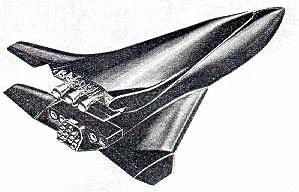
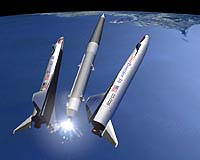
SLI Explores Flyback Booster Possibilities
http://www.spacedaily.com/news/rocketscience-02u.html
It is to bad that some programs have been cancelled that could have been the solution to the delma that we are in.
#30337 Re: Human missions » Rocket Business model for shuttle delta IV atlasV - and others good or bad » 2004-08-16 11:42:51
You are right if the price per unit is not effected by building by an assembly line process though automation versus by hand for a fix quantity of build. But that is just part of the problem is that high cost of build.
#30338 Re: Space Policy » Space fairing Nations - The ever changing view » 2004-08-16 10:21:42
India To Launch Recoverable Spacecraft In 2005
http://www.spacedaily.com/news/india-04l.html
#30339 Re: Human missions » Cheap heavy launcher - can it be done at all » 2004-08-16 10:07:09
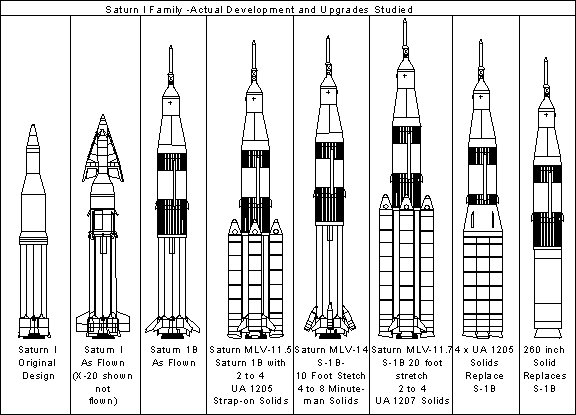
To take a page out of what the Russians continued to do with their soyuz space craft. They made continued changes and enhancemens as need to keep there rockets flying and are still doing so today.
While america kept changing the rocket platform in large jumps or into other design concepts each time.
#30340 Re: Human missions » Rocket Business model for shuttle delta IV atlasV - and others good or bad » 2004-08-16 08:55:03
The intent of my thread was to give a cost based analysis as to what should be the avenue of choice. What should be the cheaper heavy lift launcher developement and manufacturing cost to create infrastructure for the future. Based on the current rockets as models for what not to do.
Large protoype design cost and over runs
Cost over runs to solidly consistant manufacturing of expendable rocket designs
Cost over runs for refurbishment of re-usable craft designs
Operations launch cost
Workfare when staff is not really working but is idle
Questions for those that know more about the Lockheed and of Boeing rockets.
Does either launch there own rockets for profit?
What is there work staff base for carrying on these facets of infrastruture?
From earlier in another thread using the RD-170 versus the F1 of the Saturn is a good choice for a first stage engine.
This sort of sound like a Saturn 1 or V re-du derivative only modernized for a business model using what is a close match for the old specification.
#30341 Re: Human missions » Cheap heavy launcher - can it be done at all » 2004-08-16 08:35:37
From earlier in the thread using the RD-170 versus the F1 of the Saturn is a good choice for a first stage engine.
This sort of sound like a Saturn 1 or V re-du derivative only modernized for a business model using what is a close match for the old specification.
#30342 Re: Science, Technology, and Astronomy » ISS cutbacks » 2004-08-16 08:05:15
The problem is that America lost it's only manned vehicle it still has others for cargo thou they like even the Russians do have there limitations as well.
Thank full yes for the Russian manned ride but angry at not paying to continue these rides is a mistake. The amount of money barely pays for the building of such rockets how could this do any harm militarily.
These are our Partners for the ISS we should not treat them any differently than what we would want to be treated. Lets be fair to each other on this accord.
#30343 Re: Human missions » Moon vs Mars? - What did President Bush intend? » 2004-08-16 07:56:51
A basic stepping stone approach was layed out in the vision but each step needs to be reviewed for we do not want lots of little expense baby steps. When larger steps are needed in order to keep the timeline of manned flight in the future nearer to our present thoughts for justification for even beginning down the road of the vision.
#30344 Re: Human missions » Cheap heavy launcher - can it be done at all » 2004-08-16 07:51:53
The intent of my other thread, Rocket Business model for shuttle delta IV atlasV, and others good or bad was to give a cost based analysis as to what should be the avenue of choice. What should be the cheaper heavy lift launcher developement and manufacturing cost to create infrastructure for the future. Based on the current rockets as models for what not to do.
Large protoype design cost and over runs
Cost over runs to solidly consistant manufacturing of expendable rocket designs
Cost over runs for refurbishment of re-usable craft designs
Operations launch cost
Workfare when staff is not really working but is idle
Questions for those that know more about the Lockheed and of Boeing rockets.
Does either launch there own rockets for profit?
What is there work staff base for carrying on these facets of infrastruture?
#30345 Re: Human missions » Hubble mistake - Action needed » 2004-08-16 07:42:02
Another issue with Hubble is not just servicing it before it is to late but one of is it more cost effective if more instruments should also fail before what we had planned force other follow up missions to keep what was just invested worth while.
#30346 Re: Human missions » Human Base on Venus - An Engineering Challenge » 2004-08-16 06:47:20
Our biggest problem with teraforming is not for lack of ideas or for the places to actually make changes to. But is more of a down to earth funding issue. One enormous expense and one not easily justified to thoughs that do not believe that man should be in space.
We need that frontiering spirit again in the hearts and mind of all before we can get enough backing to correct the funding issues. Or we need to find ways to lower the cost of doing space. This may mean changing the way of doing business when it comes to Nasa and it's contractors. The big guy's need to start trying to lower cost for there products and that would allow for more to be purchased.
#30347 Re: Human missions » Opening space to Individual or private industry - Space CHASE Act » 2004-08-16 06:41:15
I am glad that this thread has become a good discusion of what it would take to be a united Earth Space Rights conceptual thought process. But lets keep it all in a positive manner. Maybe space like Babylon 5 or of any of the Star treks is a long way off but it is the right direction to take humanity.
#30348 Re: Human missions » Cheap heavy launcher - can it be done at all » 2004-08-16 06:27:12
The case for shuttle-derived heavy lift
http://www.thespacereview.com/article/208/1
#30349 Re: Unmanned probes » Spirit & Opportunity *7* - ...continuing... » 2004-08-16 06:15:34
On another note of exploration Zoe the robot to look for life on Earth as practice for Mars once it arrives in one of the driest places on Earth, Chile's Atacama Desert. Large stretches of the Atacama, where fog is the major source of precipitation, appear devoid of life; if machines can find life in the Atacama, the thinking goes, they might have a chance of finding life on Mars, if it exists there.
#30350 Re: Human missions » Rocket Business model for shuttle delta IV atlasV - and others good or bad » 2004-08-16 06:11:09
Some would laugh at the attempt by the Privately Funded Falcon-1 Rocket Nears First Flight but I for see this as a step to get Nasa and the big guy's to start thinking of ways to lower cost access to space.