New Mars Forums
You are not logged in.
- Topics: Active | Unanswered
Announcement
#28676 Re: Human missions » More ISS hardball - How does this affect US vision? » 2005-02-01 14:07:49
HTV spacecraft eyed as supply vehicle
This is sort of IMO hush hush so as to not anger the russian but if we can pay for these rockets though the nation of Japan. why not Russia? The safe guard of financing the russian military IMO is a moot point if they are truely our partners in space.
#28677 Re: Human missions » More ISS hardball - How does this affect US vision? » 2005-02-01 09:09:09
Well if you were on board here is something that you would hope not occur during a [url=http://msnbc.msn.com/id/6890895/] Spacewalk. Station thruster fires set off incident alarms within NASA.
Coordination breakdown could have led to toxic exposure.[/url]
During the spacewalk, the station's stabilizing gyroscopes repeatedly became overloaded with a mysterious torque, and they had to be relieved periodically by firing rocket thrusters located on the Russian half of the station. On at least one occasion, and contrary to agreed upon mission rules, these thrusters appear to have been activated when the two crew members were working dangerously close to them.
This put them at risk of both thermal damage from the thrusters themselves and, more likely, to chemical contamination from the fuel used by the thrusters. Even in small amounts, any fuel splashed on the space suits could render the air toxic in the station when the men returned from their spacewalk.
#28678 Re: Science, Technology, and Astronomy » Planned Earthly or Space Telescopes - from any nation » 2005-02-01 06:37:11
UW introduces world’s largest telescope Prime Focus Imaging Spectrograph (PFIS), capable of viewing distant galaxies and stars.
Beginning next month, the spectrograph will serve as the uppermost component to the biggest telescope in the southern hemisphere, named the Southern African Large Telescope (SALT).
“SALT will be used as a direct detector of history — as a time machine,” Nordsieck said. “With a very large telescope, you can look at great big objects at the very beginning of the history of the universe.”
According to the SALT website, the telescope will be capable of gathering light the size of a candle flame on the moon.
What light gathering power. 
SALT is part of a worldwide collaboration of a dozen academic and government establishments including New Zealand, Poland, Germany, Africa and the United States. These groups work for the advancement of astronomy by studying the southern heavens.
Looks like international cooperation is not dead but is going strong.
#28679 Re: Unmanned probes » New Horizons - mission to Pluto and the Kupier belt » 2005-02-01 06:18:06
The use of the Russian engines allows Lockheed Martin to save up to 20% of the funds used to build an Atlas rocket.
The article goes into other engines and there developement, as well as the issue of paying for things from Russia.
I like the fact that money can be saved per launch and that Nasa should be trying to do more of this. Not just its contractors.
#28680 Re: Science, Technology, and Astronomy » LRO » 2005-02-01 06:04:39
NASA and U.S. National Reconnaissance Office (NRO) to Team-Up on Lunar Spacecraft development.
The lunar spacecraft is intended as a first shot in a series of robotic probes paving the way for future human exploration missions of the moon.
The hope is that the technology developed from this effort can be applied to a military satellite expected to be launched around the same timeframe.
The cooperation will focus on developing a miniature synthetic aperture radar sensor that the lunar probe will use to develop detailed maps of the Moon’s surface. The Pentagon is planning to launch the fourth in a series of small spacecraft known as TacSat or Joint Warfighter spacecraft that year.
Leave it up to the military to get a hand into Nasa projects that could benifit them militarily.
In the meantime, NASA and the Air Force Research Laboratory continue to work together on the Integrated Powerhead demonstration, said Michael Braukus, a NASA spokesman. NASA and the Air Force have spent about $80 million on that effort, which is intended to develop an experimental reusable engine capable of 250,000 pounds of thrust, since 1994.
Only that amount of thrust? ???
Previously I had place some other posting with regards to this probe in the human, moon direct thread as well.
#28681 Re: Life support systems » Iss Plant growth experiments - planning the future in 0g » 2005-01-31 21:56:55
To do real experiments would not only be to actually eat what is produced but I would also hope that they would study pollination. Creation of a seed stock capable of early mars conditions before we get to terraforming the planet and for moon colonization.
#28682 Re: Interplanetary transportation » Japan launches Solar Sail - at last someone did it! » 2005-01-31 11:42:20
Does not the sun its self give off microwave rays as well as other wave lenghts.
Sounds like all that would be needed is a wave guide feed horn arrangement to collect and direct them onto the target sail.
#28683 Re: Science, Technology, and Astronomy » Heliopolis *2* - ...Sun, Solar Science Cont'd... » 2005-01-31 10:22:35
Sample Of Solar Wind Sent To Scientists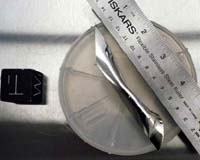
The sample, the first to be allocated for Genesis early science analysis, may hold important evidence about the overall composition of the sun. Several important Genesis science objectives will be investigated as part of the Early Science Return, including studies of noble gas isotopes in bulk solar wind and nitrogen isotopes.
"Gaining a better understanding of the noble gas elements in the sun is one of the 19 specific scientific measurement objectives originally proposed for the Genesis mission," said Stansbery. "We are delighted to provide this sample to our Washington University colleagues.
#28684 Re: Unmanned probes » Interstellar Boundary EXplorer (IBEX) » 2005-01-31 07:44:44
Another article: Nasa's mission to the edge of the solar system, and beyond
Buzz Lightyear wanted to go to infinity and beyond, now the US National Aeronautics and Space Administration (Nasa) wants to venture almost as far with a survey of the edge of the solar system.
Nasa has given the go-ahead for the Interstellar Boundary Explorer - or Ibex - to be built. It will be launched in 2008 from a Pegasus rocket, which will be dropped from the underbelly of a high-altitude aircraft.
Would it not be better to get the craft to the edge faster using a much larger rocket before the power levels drop to low and would not be capable of sending back the data.
#28685 Re: Human missions » More ISS hardball - How does this affect US vision? » 2005-01-31 06:28:28
Well the planning stages are set for when the shuttle retires though no one knows quite what that will mean as of yet.
At the heads of agency meeting last week in Montreal few indications were given about the long-term future of the International Space Station.
In fact NASA’s international partners are scratching their heads trying to figure out what the US is really planning to do with the ISS after the last shuttle mission has undocked from the ISS with the last load of large items to be returned safely to Earth?
The big question for the next NASA administrator will be whether he going to reverse the decision to delete the ISS service role from the Crew Exploration Vehicle’s mission.
the feeling in Washington seems to be, “let’s just commit ourselves to finish building the thing and we’ll figure out what to do with it later.”
While this may be typical of the way things happen inside the US Government it leaves the Europeans and the other partners thoroughly puzzled. Is there really no plan for the $100-billion “world-class” orbiting laboratory other than the few long-term exploration oriented developments that are currently in the works? It seems that NASA has not been able to develop a plan that can realistically fit post-2010 or 2014 ISS operations into its current budget plan.
The mission, the business, and the tandem
The concept of government-led exploration of the solar system requires a determined commitment by space agencies that could be “very much a hostage to fortune”.
With that said the US appears also to be held hostage to the present.
#28686 Re: Life support systems » Iss Plant growth experiments - planning the future in 0g » 2005-01-31 06:16:19
There have been in several of the human threads talk about what has been grown on the ISS. The list contains snow peas fourth harvest and now will contain two more candidates.
ISS crew members to grow radish, lettuce
Experiments involving radish plants were carried out aboard the ISS several years ago, producing very small radishes
What others have been tried?
#28687 Re: Human missions » Post central for information on CEV 2 - ...continue here. » 2005-01-31 06:07:18
NASA Sets Crew Exploration Vehicle Procurement Guidelines
Already there has been a few that have joined together to foster hopes in that they would be given the contracts to go forth with the CEV. This trend continues with the lockheed and EADS Space Transportation teaming up on the competition.
Lockheed Martin's Crew Exploration Vehicle Team Includes Top Industry Innovators
Key aerospace leaders - Lockheed Martin, EADS SPACE Transportation, United Space Alliance, Honeywell, Orbital Sciences and Hamilton Sundstrand - Combine strengths to design and build NASA's Crew Exploration Vehicle
Here is what each brings towards the design of the next CEV as part of the team.
Lockheed Martin will lead the team as the system prime contractor. United Space Alliance will draw upon its extensive experience in large, complex systems integration, operation and maintenance of multi-purpose space systems and reusable space launch systems, including the Shuttle and numerous systems associated with NASA's human space flight program. EADS SPACE Transportation provides its expertise in the design and development of space transportation vehicles and manned space systems, together with its long experience of international cooperation in manned space programs. Orbital brings its strengths in integration of solid rocket motor systems and significant experience with spacecraft and small launch vehicles. Honeywell provides Integrated Systems Health Management (ISHM) technology, which elevates crew autonomy and systems management to a new level, and will provide avionics, guidance, navigation and control (GN&C), and mission and ground systems support. Hamilton Sundstrand provides its expertise in the design, manufacture and servicing of Space Environmental Control and Life Support Systems (ECLSS) and brings over 40 years of technical experience from its key participation in every major NASA human space program with Space Suits, critical Vehicle Life Support, thermal control and power management systems.
#28688 Re: Unmanned probes » Mars Reconnaissance Orbiter (MRO) » 2005-01-31 06:02:31
Recon Orbiter Readied to Provide Cornerstone Science For Planetary Exploration Strategy
The spacecraft's mission is to obtain extremely detailed global imagery, composition and weather data around which to focus the next 15-20 years of Mars robotic lander planning and operations. MRO will have a resolution at least five times better than the best resolution from current Mars orbiters.
The goal of the $700-million mission is to create a comprehensive foundation of knowledge for the Mars side of NASA's new exploration vision and to accelerate the search for evidence of life on the red planet.
The expected 34 terabits of imagery and data is a factor of 10 or more increase over the data return from each of the current Mars missions.
The spectral capabilities of MRO's instruments are to characterize important water-related mineral.
The MRO data will be used to find sites for the 2007 Phoenix north polar stationary lander, the 2009 Mars Science Laboratory rover and the unmanned sample return rovers planned after 2010.
MRO is also expected to provide data that will begin to identify candidate landing sites for manned Mars missions envisioned after 2020.
#28689 Re: Interplanetary transportation » VASIMR for LEO Launches? - What prevents it? » 2005-01-31 05:21:04
You have forgotten to take into account the Earth's gravity well and air drag when going to orbit. The equation once in orbit is a lot closer.
#28690 Re: Human missions » Post central for information on CEV 2 - ...continue here. » 2005-01-31 05:17:13
Also in the same token that hold true for Nasa and why the current rockets are a bad business model to follow. Like the standing shuttle army and other areas that are sitting idle between launches. Not sure if moving all shuttle related functions for united space alliance to a new sight so as to trim the cost would even work.
The only thing close to a business model happens to by the Russian soyuz and progress for profitability. 20 million to make and 20 million for the third seat but even that is break even.
Until spacex actually launches they are an unknown even if they could get to much higher lift capability. They have some of there business model correct in that they are hauling in cost. SpaceX contains costs with simplified approach
The SpaceX Mission Control Center is an 18-wheeler.
Its Falcon rockets don't require huge mobile service towers or other complicated launch pad systems that are expensive to build and maintain.
Near launch-ready when they leave their California factory, Falcons roll up to a launch pad on an extended flatbed truck that also serves as a rocket erector with a built-in umbilical tower.
And the company's launch team is made up of 15 to 20 people, rather than hundreds or thousands of workers.
"My goodness, you can't sell rockets at low prices if you've got a standing army," said Gwynne Shotwell, the company's vice president of business development.
#28691 Re: Life support systems » Moss » 2005-01-30 21:00:48
Even if the moss does not need much water, nitrogen and such, It however does need warmth. That make plant section that would grow in mars climate problematic. One thought was to use the lander as if it were the center pole in a very large tent. One might get away with using 3mil plastic sheets to create a chamber to gradually warm. This would also act to capture any heat loss from the ships crew cabin or habitat module with each excursion outside to explore mars.
#28692 Re: Human missions » Return to flight slipping » 2005-01-28 14:06:34
Well regardless of how many are active there are still 8 remaining recommendations for Nasa from the CAIB to complete from the original 15.
#28693 Re: Human missions » Hubble Mistake **2** - Action still Needed » 2005-01-28 13:58:45
BY private sector do you mean Lockheed and Boeing or others.
They will not do and rescue attempt unless there is a garanteed contract for the work to be preformed. That is also where the problem starts but does not end there. There is no means to do a manned mission by US standards and to use Russian equipment might not be possible, even if it could be gotten.
Short of flying the shuttle as the only alternative there just seems to be none to be had.
#28694 Re: Life support systems » Moss » 2005-01-28 11:14:21
Not only would it be a first crop to plant for the added O2 that it might provide but it would also get the process for other more edible plants a chance to grow a little more easily.
#28695 Re: Human missions » Hubble Mistake **2** - Action still Needed » 2005-01-28 11:12:18
If Hubble is so important to all the astronomy groups then it just might be time that they try to concieve a means to rescue Hubble froms its doom.
Hubble Trouble: Saving Telescope May Require Non-Governmental Solutions
EDITOR'S NOTE: Welcome to SPACE.com's newest addition: Ad Astra Online, created in cooperation with the National Space Society (NSS). Ad Astra is Latin for "to the stars", and it is also the name of the NSS's official magazine. SPACE.com's parent company, Imaginova Corp., recently entered into an agreement with the NSS to edit and publish both Ad Astra Magazine and Ad Astra Online. What is Ad Astra Online? It's a forum for you, the space enthusiast. It is ideas and opinions with one ultimate goal: The creation of a spacefaring civilization. What does this forum need? It needs you, of course. Join the National Space Society, get involved, get online and get your voice heard.
#28696 Re: Human missions » Post central for information on CEV 2 - ...continue here. » 2005-01-28 11:08:56
While many approaches have been voiced as to how to design a rocket and crew section. Most start with what we have now and try to build what can be lofted by them rather than design what is needed for the crew to survive depending on mission stay and then trying to figure out what can loft it into space for its intended purpose of exploration.
Rocket design up in air, says Marshall chief
"We are looking at all concepts from a heavy-lift, Saturn V-like vehicle, to a shuttle-type vehicle, to using expendable rockets," Marshall Director Dave King said. "The truth is that we've got to pick what type of crew vehicle that's best for the exploration (plan), and then design a vehicle to lift it."
There are advantages and disadvantages to many designs. A Saturn V-like vehicle would place a lot of cargo into Earth orbit with just a few launches, but it would be expensive, space experts predict.
Another option would be to modify the shuttle's external tank and solid rocket boosters to lift an unmanned cargo package, and yet another one to launch multiple expendable rockets like the Boeing Delta IV or Lockheed Atlas 5 into orbit.
"We just don't know yet," King said. "I expect that within the next year the design (plan) will take shape and we will work toward that goal."
A new, large rocket could keep NASA plans to return to the moon on the ground. Dennis Wingo, Huntsville businessman and space expert, predicts a Saturn V-type design would bankrupt any space exploration plan.
"If they hold out for a Saturn V, then this will fall apart," Wingo said. "There's no money for a long development program to design and test a heavy-lift, Saturn V type vehicle."
Wingo said a promising option would be to develop automated docking systems and use Boeing's Delta IV expendable vehicles to assemble a crew vehicle in space. "This is all proven hardware and wouldn't take that long to develop,"
And it would seem that the cheapest is to do a SDV but we all have wondered how cheap.
#28697 Re: Science, Technology, and Astronomy » Genesis, Stardust, Etc.: Snag & Bag » 2005-01-28 08:21:23
Yup, just started to read the Nasa news release: NASA Sends First Genesis Early-Science Sample to Researchers
As you mentioned the:
Scientists at NASA's Johnson Space Center (JSC) in Houston recently shipped a piece of the Genesis polished aluminum collector to researchers at Washington University in St. Louis. The shipment marked the first distribution of a Genesis scientific sample from JSC since the science canister arrived on Oct. 4, 2004. Preliminary examination of the sample by researchers has confirmed it contains solar ions, traces of the solar wind.
Washington University researchers Charles Hohenberg and Alex Meshik will study the sample to try to determine detailed information about the gases that make up the sun.
Granted they will have a good look at some of the elements that the sun spues out but the Isotopes and radioactive elements with short half life will be gone.
#28698 Re: Science, Technology, and Astronomy » Pluto: "Twin" Impact - ...created Charon? » 2005-01-27 14:38:29
Provided the new horizon mission is not cancelled, we will be able to get some of our questions answered.
#28699 Re: Unmanned probes » Cassini-Huygens III - Continued from previous » 2005-01-27 10:44:01
Saturns rings sometimes reminds me of looking at the bands on an old LP record. 
#28700 Re: Life support systems » Moss » 2005-01-27 10:40:00
Had posted like item to the gravity thread in this grouping:
MOSS IN SPACE PROJECT, SHOWS HOW SOME PLANTS GROW WITHOUT GRAVITY
At least some work is being done.
Experiments on moss grown aboard two space shuttle Columbia missions showed that the plants didn't behave as scientists expected them to in the near-absence of gravity.
The common roof moss (Ceratodon purpureus) grew in striking, clockwise spirals, according to Fred Sack, the study's lead investigator and a professor of plant cellular and molecular biology at Ohio State University.